[SeoulTech x IT Donga Joint Project] The Preliminary Startup Package Support Program (hereinafter “Preliminary Startup Package”) is a major startup support initiative of the Ministry of SMEs and Startups and the Korea Institute of Startup & Entrepreneurship Development designed to help launch promising ideas. As an implementing institution for the 2025 Preliminary Startup Package, the Seoul National University of Science and Technology (SeoulTech) Startup Support Group supports the growth and development of early-stage companies. IT Donga, together with the SeoulTech Startup Support Group, profiles promising startups currently in growth.
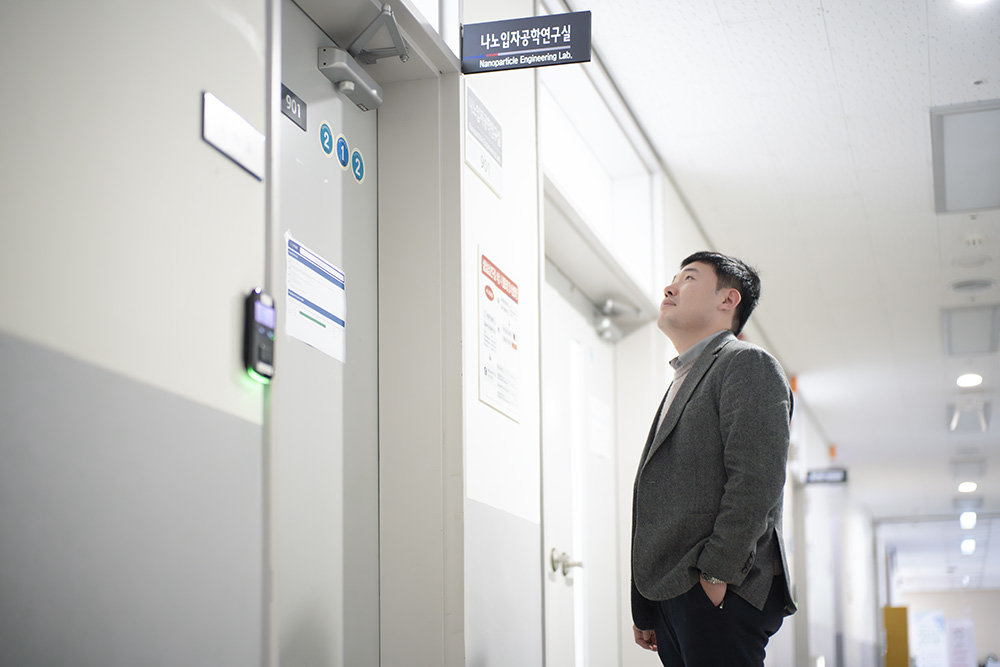
Keinano is a startup founded in September 2025 based on aerosol measurement technology and is led by CEO Kwak Dong-bin, an assistant professor in the Manufacturing Systems and Design Engineering (MSDE) Department at Seoul National University of Science and Technology. After earning a Ph.D. in Mechanical Engineering from the University of Minnesota in 2023, Kwak worked at Applied Materials and Onto Innovation, and has been teaching at SeoulTech since 2024. He currently conducts research in the “Nanoparticle Engineering Laboratory,” which focuses on developing filter efficiency methods and measurement techniques, and is also developing real-time monitoring measurement devices that can be used in advanced industrial processes such as semiconductors.
“Real-time monitoring” proposed for ultrapure water measurement for semiconductors that currently takes days
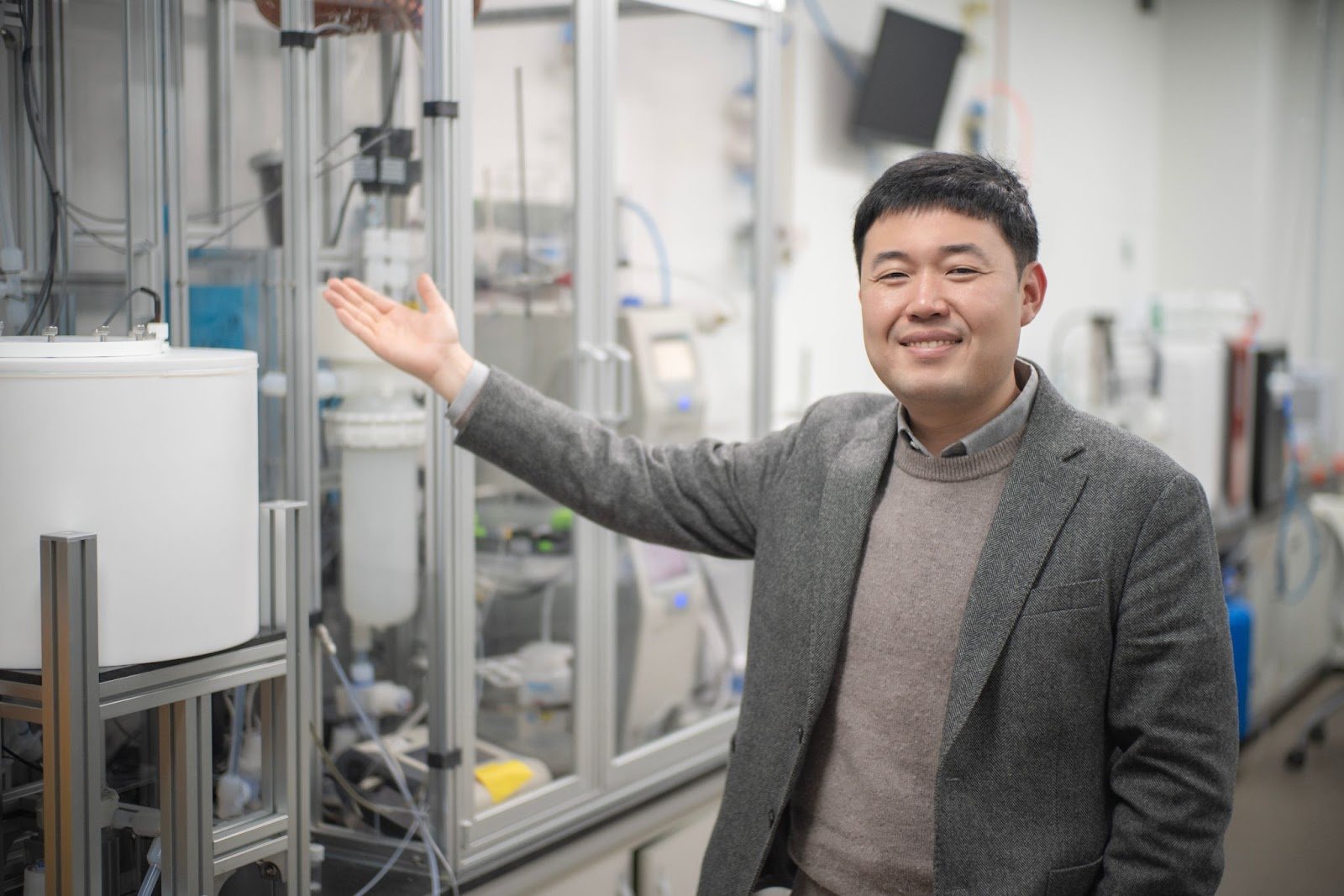
CEO Kwak Dong-bin introduces the real-time liquid monitoring system developed by Keinano / Source=IT Donga
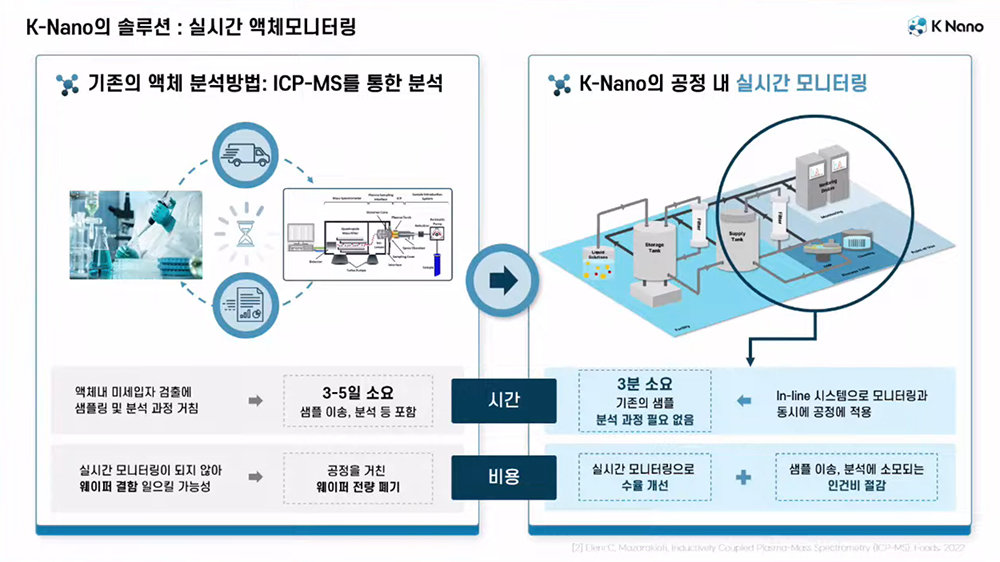
Keinano’s flagship product is a real-time analysis device that can complement ICP-MS (Inductively Coupled Plasma Mass Spectrometry), an industrial liquid monitoring system. ICP-MS ionizes atoms by applying high-temperature plasma to liquid samples, and then measures trace-level remaining elements with a mass spectrometer. It is widely used in research and industrial fields such as medicine, pharmaceuticals, and chemistry, but a major problem is that it takes from three to up to five days to obtain results after measurement.
Kwak explained, “ICP-MS is a device that is widely used in all R&D facilities. In semiconductor processes, it is used to test the purity of ultrapure water used in the CMP (Chemical Mechanical Polishing) process for polishing wafer surfaces. The CMP process uses a liquid polishing agent called slurry, which contains both chemical components and polishing particles. If the polishing particles are too large or the chemical composition ratio is incorrect, issues can occur in the process, so slurry is tested using ICP-MS.”
Explanation of differences between analysis via ICP-MS and Keinano’s real-time monitoring / Source=Keinano
He continued, “Since it takes three to five days for ICP-MS results to be released, if the analysis results are deemed problematic, all wafers processed over those days must be scrapped. To prevent this, there are optical hydrosol counters, but if bubbles are present in the water, they create noise in the measurements, and particles smaller than 20 nanometers or dissolved ions in the water cannot be measured.”
Keinano’s real-time monitoring equipment is a solution that overcomes these limitations of existing measurement methods. Kwak explained, “By converting the medium into an aerosol, it fundamentally eliminates noise caused by bubbles, and by removing the liquid component before testing, it can detect particles from at least 1 nanometer to 1 micrometer in size. Using an electric field, nanoparticles are classified by size according to their mobility, and condensation is induced around the nanoparticles to enlarge the particle size for measurement.”
Preliminary Startup Package and Laboratory-Specialized Startup Leading University Program turn ideas into reality
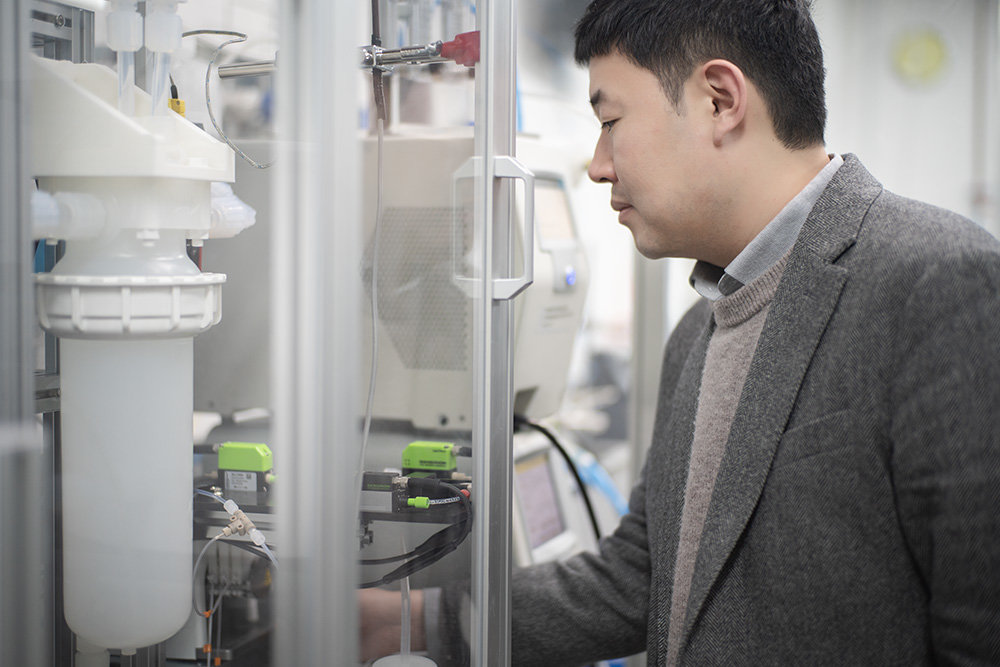
CEO Kwak operates the aerosol measurement equipment in practice / Source=IT Donga
The support of Seoul National University of Science and Technology played a key role in moving Kwak’s idea beyond a prototype and up to the brink of mass production. Kwak stated, “As this is a faculty startup, I received a lot of assistance from the university. I applied to the Preliminary Startup Package with the goal of commercializing the technology of the Nanoparticle Engineering Laboratory, and through it, completed prototype development and laid the groundwork for commercialization. The Startup Support Group helped me with guidance on startup procedures and processes, the process of establishing a corporation, and also arranged networking meetings with other founders. Talking with the other CEOs, I was able to gain valuable information that cannot be found on the internet,” he said. He added that he also received mentoring and assistance in preparing his business plan through the Laboratory-Specialized Startup Leading University Program.
He went on, “On December 12, I plan to participate in the 2025 Creative Capacity Enhancement Networking Event as well. At previous networking events, I was able to track when support programs open, as well as trends in research projects and government commercialization funds, through discussions with other CEOs, and also gained information on the investment market. I received feedback on what to present during investment reviews and what improvements were needed. In addition, I was able to identify companies that could become long-term customer firms,” he said.
CEO Kwak is also a researcher affiliated with CFR, which builds systems and theory related to filters / Source=IT Donga
Kwak is keeping network channels open not only with preliminary startup companies but also with academia. He is a researcher at CFR (Center for Filtration Research), which develops theoretical frameworks on filter media and system performance and builds filtration systems. Member institutions of CFR include Virginia Commonwealth University, the University of Minnesota, and ETH Zurich, and Seoul National University of Science and Technology is also registered as a partner university under Kwak’s name.
Companies related to filters and filtration systems such as 3M, Boeing, Applied Materials, Samsung Electronics, and LG Electronics also collaborate with CFR. As a CFR member, Kwak plans to monitor technology trends in the semiconductor industry, conduct joint research, and promote Keinano’s technological capabilities to the industry.
With MSDE alumni from SeoulTech, aiming for “standardization of liquid monitoring”
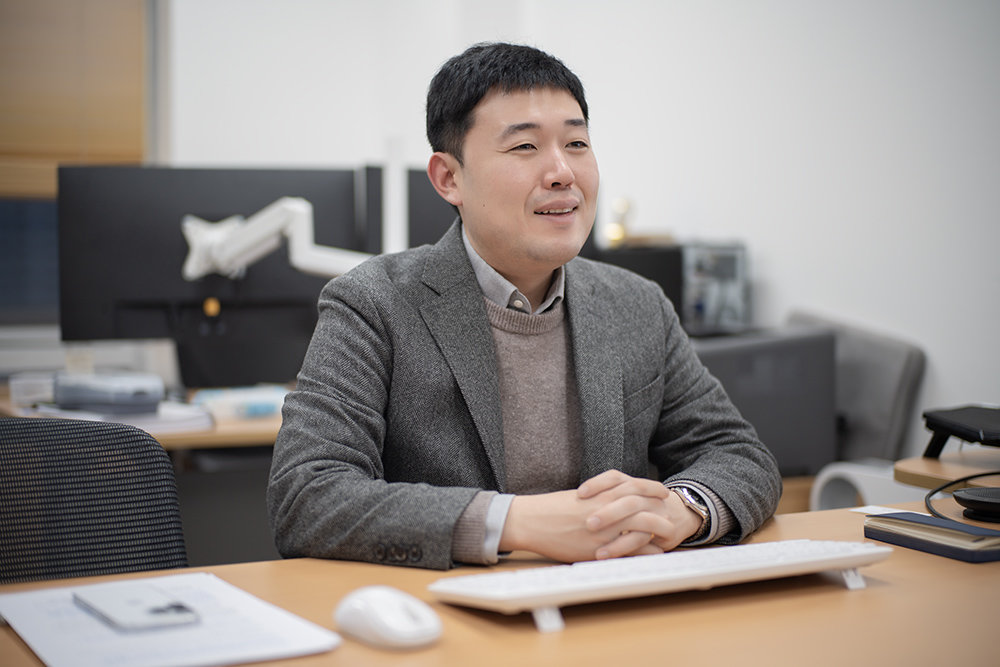
CEO Kwak declared his goal of making Keinano’s technology a global standard / Source=IT Donga
In addition to CEO Kwak, Keinano is joined by Project Manager Ji Hyeong-woo, Software Engineer Lee Yoo-seon, Hardware Engineer Lee Seung-woo, and Application Engineer Cho Sung-min. Except for PM Ji, the three team members are pursuing their master’s or doctoral degrees in the MSDE Department at SeoulTech, working closely with Kwak.
Kwak said, “Our department, based on its global competence, conducts all classes in English and offers a capstone design course from the second semester of the third year. Students are trained to independently carry out projects as undergraduates, and after graduation they proactively perform their duties in the field. Talents like these are working together at Keinano.”
In closing, Kwak stated, “Keinano’s solution can be used not only in semiconductors but also across a wide range of industries such as secondary batteries, displays, and petrochemicals. We intend to make our technology the standard for liquid monitoring and drive innovation on the industrial front lines.”
Reporter Nam Si-hyun, IT Donga (sh@itdonga.com)
ⓒ dongA.com. All rights reserved. Reproduction, redistribution, or use for AI training prohibited.
Popular News