Study published in Nature’s sister journal Scientific Reports
Demonstrates significantly higher predictive power than human interviewers across all areas
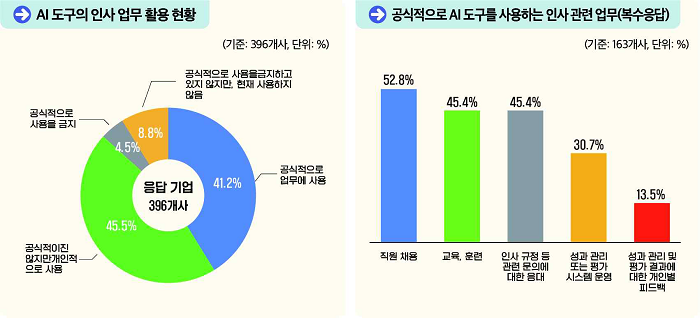
The wave of the AX (AI Transformation) era is also flowing into the recruitment market. According to the “2025 Corporate Recruitment Trend Survey” released by the Ministry of Employment and Labor and the Korea Employment Information Service on the 28th of last month, 86.7% of the 396 companies surveyed were found to be using AI tools in HR operations. The survey was conducted among HR managers at the top 500 companies by sales and 3,093 young employees nationwide.
Source = Ministry of Employment and Labor
Among the 163 companies that have officially introduced AI tools in HR operations, “employee recruitment” accounted for the highest share at 52.8%. Within this category, the task with the highest level of utilization was “AI-based aptitude or competency tests,” at 69.8% of the total, exceeding the use of AI for “review of application documents” or “AI interviews.”
Companies planning to introduce or expand AI tools in recruitment operations in the future also indicated that they are considering this as a top-priority area for adoption.
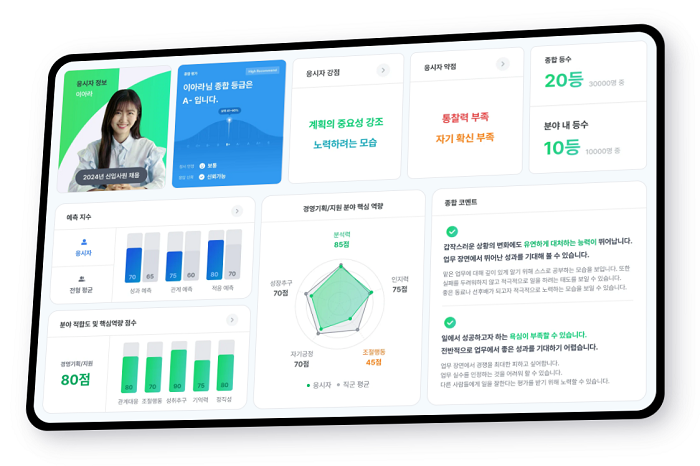
“AI Competency Test” (Yeokgeom) result sheet. Image provided by Midas Group
AI competency tests were used in open recruitment drives conducted in the second half of this year by large corporations such as Kia, CJ Group, GS Retail, and LIG Nex1. According to Midas Group (Midas IT, Midas In, Jain Research Institute, etc.), which developed the “AI Competency Test (Yeokgeom)” for the first time in Korea, more than 1,200 companies and institutions have adopted its AI competency test. This represents an approximately 40-fold increase from 30 companies at the time of development in 2018 and shows that AI-based recruitment is becoming a new standard.
The response from young job seekers entering the recruitment market has also been positive. Among the young respondents in this survey, 63.8% supported companies’ use of AI in recruitment processes, and 23.7% reported having actually experienced AI-based recruitment.
Despite the rapid spread of AI recruitment, distrust remains regarding objectivity and fairness. Among companies that do not introduce or expand AI tools, the primary reason cited was “a lack of confidence in the fairness and objectivity of AI tools” (36.6%). Young respondents likewise expressed concerns about the fairness of AI decision-making criteria. They responded that verification of the accuracy of AI evaluations is necessary to protect job seekers.
Against this backdrop, Midas Group stated that the reliability of its “AI Competency Test (Yeokgeom)” was verified through a study conducted by a KAIST research team in July. The research results were published in Scientific Reports, a sister journal of the international academic journal Nature, and, according to the company, demonstrated superior performance prediction capability compared to human interviewers.
The research team conducted recruitment for nursing positions at a major domestic hospital using both Midas Group’s AI competency test and conventional interviews (manager and executive interviews), and then compared the ability to predict actual job performance one year later. The company explained that the AI test showed significant predictive power in all areas, including job expertise, job performance, interpersonal skills, and overall evaluation, whereas biases and limitations inherent in human interviewers were identified.
A Midas Group representative said, “Client satisfaction is high with respect to the accuracy and efficiency of the recruitment process,” adding, “Now that reliability has been demonstrated, the company hopes many employers and job seekers will use the AI competency test to help build a fair recruitment ecosystem.”
ⓒ dongA.com. All rights reserved. Reproduction, redistribution, or use for AI training prohibited.
Popular News