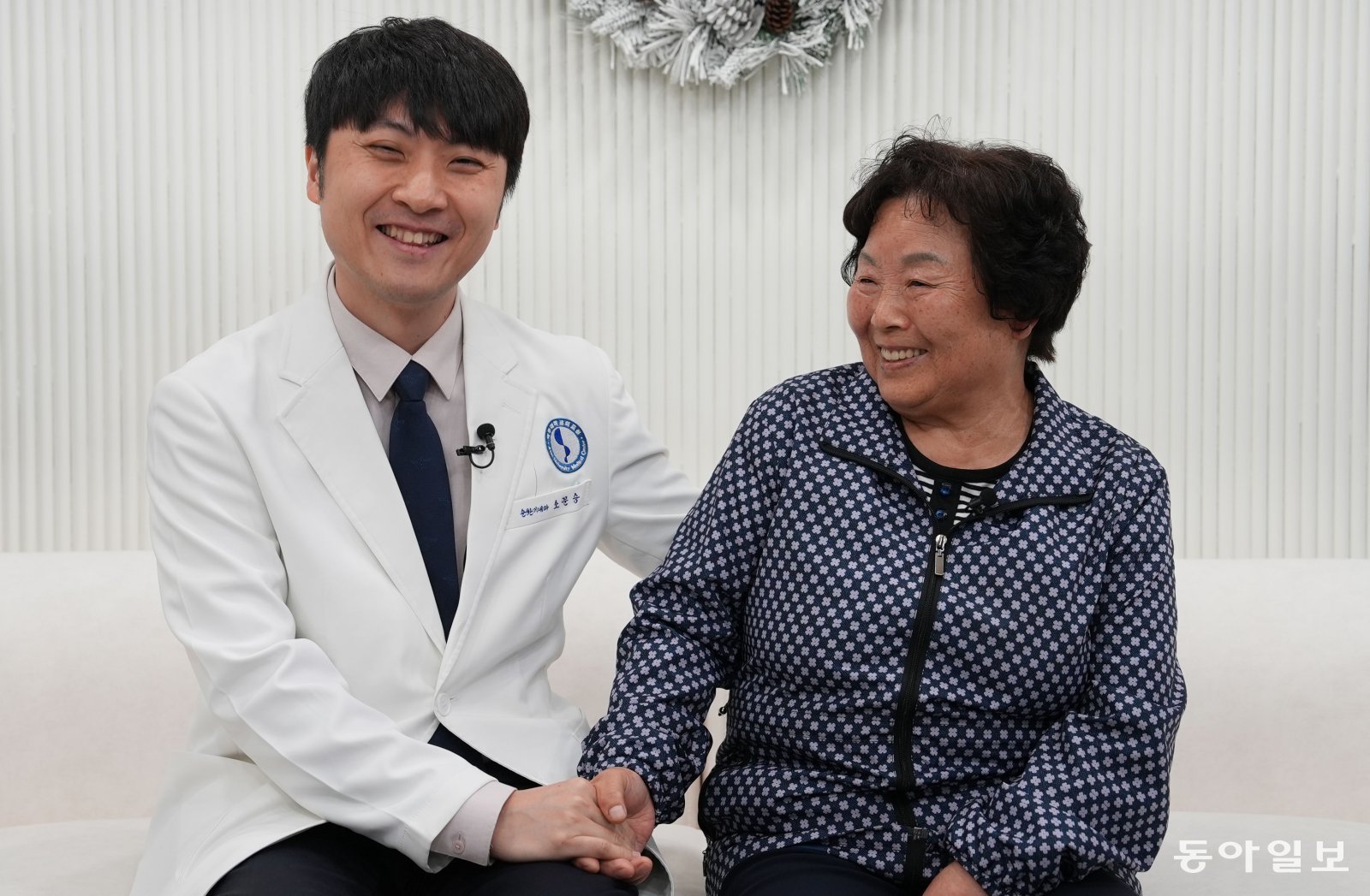
Patient Kim Dong-ho (right), whose condition improved after receiving treatment for obstructive hypertrophic cardiomyopathy, talks while holding hands with his attending physician, Prof. So Moon-seung of the Division of Cardiology at Ajou University Hospital. Lee Jin-han, Medical Reporter·Physician likeday1@gmail.com
There is a relatively little-known disease among conditions that make it hard to climb stairs due to shortness of breath and cause body swelling. It is “obstructive hypertrophic cardiomyopathy (OHCM).”
Obstructive hypertrophic cardiomyopathy is a type of hypertrophic cardiomyopathy in which the heart muscle becomes abnormally thickened. The wall of the left ventricle thickens, narrowing or blocking the outflow tract through which blood leaves the heart. It can cause dyspnea, chest pain, dizziness, and syncope. In severe cases, it carries a risk of sudden cardiac death and is a serious condition. There are currently 3,159 patients in Korea. The reporter met patient Kim Dong-ho, who is receiving treatment for obstructive hypertrophic cardiomyopathy, and his attending physician, Prof. So Moon-seung of the Division of Cardiology at Ajou University Hospital.
― What kind of disease is obstructive hypertrophic cardiomyopathy?
Prof. So Moon-seung = “It is a disease in which the heart muscle becomes abnormally thickened. Family history and genetic mutations are known to be important factors. The heart supplies blood throughout the body through contraction and relaxation, but when the heart muscle thickens, its relaxation function declines, leading to problems with blood supply. In particular, when the left ventricular muscle thickens and obstructs blood flow to the aorta, this is called ‘obstructive hypertrophic cardiomyopathy.’”
― How was the patient diagnosed?
Patient Kim Dong-ho = “In 2022, I collapsed while visiting a friend’s house. At the hospital I went to at that time, I was told that my heart muscle was thick. I had shortness of breath and dizziness, and later I also experienced gripping chest pain. In May this year, my symptoms worsened, so I underwent MRI, 24-hour electrocardiogram, and echocardiography at Ajou University Hospital to find the cause, and I have since continued treatment for hypertrophic cardiomyopathy.”
― How is obstructive hypertrophic cardiomyopathy diagnosed?
Prof. So = “Hypertrophic cardiomyopathy is divided into obstructive and non-obstructive forms. It is important to distinguish between the two in diagnosis. Hypertrophic cardiomyopathy can be detected early through echocardiography and electrocardiography. However, because these are not as routinely performed as blood tests or X-rays, some people do not undergo testing because they do not recognize their symptoms. If a family member died at a young age from heart disease, or if anyone has ever been told that their heart muscle is thick, it is strongly advisable to have echocardiography and electrocardiography.”
― What symptoms should raise suspicion?
Prof. So = “If you become more short of breath than others during exercise or daily activities, or if physical activity has become more difficult compared with the past, obstructive hypertrophic cardiomyopathy should be considered. If suddenly it becomes difficult to climb stairs that used to be manageable, or if there is a feeling of swelling in the body, these may be signs of obstructive hypertrophic cardiomyopathy, and I recommend undergoing echocardiography at a nearby hospital. Echocardiography does not use contrast agents, so no fasting is required beforehand and the burden of testing is low.”
― What has been the most difficult aspect in daily life?
Patient Kim = “Even walking was difficult. It felt as if a tree was standing inside my chest, making it tight. I used to work as a cleaner, and once I suddenly collapsed while cleaning an elevator, and it was also hard to maintain my job.”
― What are the treatments for obstructive hypertrophic cardiomyopathy?
Prof. So = “The normal thickness of the heart muscle is about 12 mm, but in patients with hypertrophic cardiomyopathy it thickens to 1.5–2 cm. In the past, surgery to resect the thickened muscle or a procedure injecting alcohol to induce necrosis of the thickened heart muscle were performed. These methods are invasive, and surgery involves opening the chest, which poses significant risk for elderly patients. Fortunately, a new drug, ‘mavacamten,’ which works by reducing excessive contraction of the heart muscle, has recently become available, making it possible to expect improvement in symptoms of obstructive hypertrophic cardiomyopathy without surgery. Patient Kim also began treatment with this new drug in May, and his symptoms have greatly improved.”
― How is your health after treatment?
Patient Kim = “It has become very good. I still occasionally feel palpitations when I move, but the gripping pain has greatly decreased. I can now walk for about an hour.”
Prof. So = “Before treatment, just walking was difficult due to shortness of breath, but within six months of starting treatment, his symptoms improved remarkably. Considering his advanced age, the drug effect is quite good, and if treatment continues for about another year, the remaining symptoms are also expected to improve.”
― Is the new drug covered by the national health insurance system?
Prof. So = “It has been covered by the National Health Insurance since December last year. It is also eligible for the reduced copayment program for serious diseases. Patients’ out-of-pocket costs have significantly decreased compared with the past, and the treatment environment has improved to the point that physicians can prescribe it routinely. Now patients themselves look it up and ask about it. The greatest impact is that if patients meet the indication criteria, new treatment can be actively attempted.”
― What changes are needed to improve patients’ access to treatment going forward?
Prof. So = “Compared with Europe or the United States, the reported prevalence in Korea is low. Given the nature of this being a genetic disease, many patients are presumed to remain undiagnosed. Because hypertrophic cardiomyopathy is not well known, many patients only understand it as ‘the heart is thick’ or ‘the heart is bad.’ Raising awareness of the disease is essential. Those with a family history also need to undergo echocardiography and electrocardiography at an early stage.”
― Any concluding remarks?
Patient Kim = “I came back from the brink of death. I want to say that if treated early, the condition can become much better.”
Prof. So = “In the past there were patients whose symptoms did not improve, but now that the new drug is also covered by health insurance, more people are regaining their health, which makes the treatment rewarding for medical staff as well. If there is a family history, or if symptoms such as shortness of breath and palpitations are present, I strongly recommend undergoing echocardiography or electrocardiography regardless of age or gender.”
ⓒ dongA.com. All rights reserved. Reproduction, redistribution, or use for AI training prohibited.
Popular News