Partial Knee Replacement Surgery: Increasing Cases of Partially Damaged Arthritis… Preserves Healthy Ligaments
Natural Movement and Faster Recovery… Plans Made with 3D Simulation
Controlled to Stay Within Cutting Range… Patients Request "Robotic Surgery" First
As the number of patients with joint diseases rapidly increases due to aging and increased activity levels, the standards for treatment are also changing quickly. In particular, in the field of artificial joint replacement surgery, the introduction of robotic technology is elevating the precision, safety, and recovery speed of surgeries to a new level. This publication provides an in-depth analysis over three parts on how robotic surgery is bringing changes to knee and hip treatments. The second part focuses on the role of robotic technology in partial knee replacement surgery.
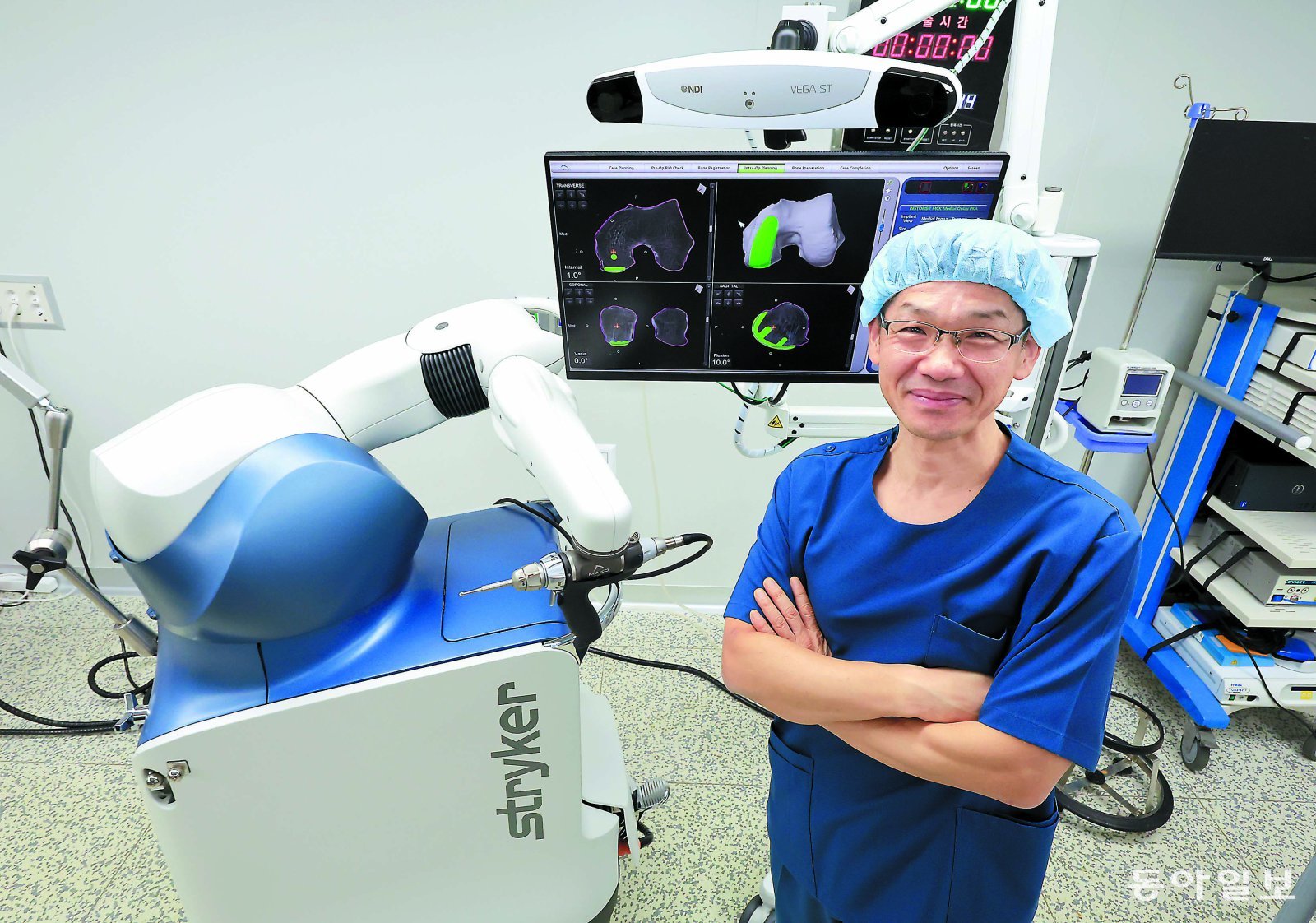
Dr. Cheolhong Park, a medical doctor, explained that the knee is not a simple hinge but a biological joint that moves organically with bones, ligaments, and muscles, and how much normal tissue is preserved makes a significant difference in recovery and function. Reporter Youngcheol Park skyblue@donga.com
Knee joint diseases are steadily increasing not only in the elderly but also among those in their 50s and 60s with high activity levels. Repetitive impact sports, prolonged standing or squatting habits, and muscle weakness are complex factors contributing to the earlier onset of arthritis than in the past. As the number of patients with arthritis affecting only specific areas rather than the entire joint increases, the need for partial replacement surgery, which selectively replaces only the damaged area, is growing.
Unlike total replacement surgery, which removes ligaments, partial replacement surgery preserves healthy cartilage and ligaments, allowing for natural movement. It is a treatment with particularly high satisfaction among the middle-aged and elderly with high activity levels. With the addition of robotic technology, the accuracy and safety of partial replacement surgery have greatly improved. Recently, Dr. Cheolhong Park at Mokpo Orthopedic Clinic, who has introduced the MAKO robot for partial knee replacement surgery, was asked in detail about robotic surgery for partial knee replacement.
―There is an increase in patients with degenerative arthritis recently. What changes are there in age or symptoms?
“The significant change in the actual clinical setting is the broader age range. Unlike in the past, when only those in their 70s and older came, there is a noticeable increase in the proportion of active middle-aged people in their 50s and 60s. Activities such as hiking, golf, jogging, and fitness, which accumulate repetitive impact on the knees, have increased. Those who stand for long periods or squat frequently due to their jobs progress in arthritis quickly. Lifestyle habits such as obesity, lack of muscle strength, and prolonged sedentary living also have an impact. It is not uncommon for early arthritis symptoms to appear in the 20s and 30s due to sports injuries or body shape issues. Treatment should be approached step by step. Initially, symptoms are managed through lifestyle correction, weight management, medication, injections, and physical therapy, and surgical treatment is considered when the joint space narrows and walking becomes difficult. For patients with wear limited to specific areas, partial replacement surgery, which does not replace the entire knee, is often more suitable.”
―What is partial knee replacement surgery?
“Partial knee replacement surgery is a method that precisely replaces only the damaged area, unlike total replacement surgery, which replaces the entire joint. The key is to preserve as much healthy cartilage and ligaments as possible. The knee is not merely a structure that bends and straightens but a biological tissue that moves complexly with bones, ligaments, and muscles. The small cutting range minimizes damage to surrounding tissues and maintains the knee's inherent sense. The movement is natural, and the recovery speed is fast. This is why it is highly satisfactory among the middle-aged and elderly with high activity levels.”
―Which patients are suitable for it?
“The condition of the ligaments is most important. It is suitable for patients with well-maintained ligaments and arthritis confined to specific areas. Among all patients undergoing artificial joint surgery, the actual proportion suitable for partial replacement surgery is less than 10%. The decision for surgery is made based on a detailed analysis of the damage range, alignment, and ligament function through X-Ray and 3D CT imaging with the robotic system. If the damage is extensive or the ligament function is deteriorated, total replacement surgery is needed instead of partial replacement.”
―Why is robotic technology particularly important in partial knee replacement surgery?
“Partial replacement surgery has a narrow surgical range and high surgical difficulty. Small errors in alignment and cutting angles significantly affect the results. In traditional surgery, these judgments relied on the surgeon's sense, but robotic technology plans the surgery with preoperative CT-based 3D simulation and controls the cutting to stay within the planned range during surgery. It is advantageous for reducing unnecessary cutting and preserving ligaments by allowing real-time checking of ligament tension and joint balance. When the implant is placed in the correct position, joint movement is natural, wear is reduced in the long term, and stability is increased.”
―How is patient satisfaction after the introduction of robotic surgery?
“In the past, there was a great fear of artificial joint surgery, but nowadays, patients often ask if surgery can be done with a robot. Partial replacement surgery can replace only the damaged area, so there is less psychological burden and faster recovery, which increases interest. After surgery, patients say, ‘The knee feels like it fits my body’ and ‘The movement is natural.’ Because the alignment is precisely matched and tissue damage is minimal, there is less pain and swelling, and recovery is faster.”
―There are also medical activities the hospital has been doing in the community.
“Our hospital has been with the community for nearly 30 years. We have conducted annual regular check-ups for students at Hampyeong Film School and have been providing visiting medical services and health consultations at Mokpo Senior Welfare Center for over 10 years. I want to provide the best medical service with the best equipment in the area where I grew up, so local residents no longer have to travel far to Seoul for surgery.”
ⓒ dongA.com. All rights reserved. Reproduction, redistribution, or use for AI training prohibited.
Popular News