[SeoulTech x IT Donga Joint Planning] The Preliminary Startup Package Support Project (hereinafter referred to as "Preliminary Startup Package") is a major startup support project by the Ministry of SMEs and Startups and the Korea Institute of Startup & Entrepreneurship Development, aimed at assisting the establishment of promising ideas. The Startup Support Group at Seoul National University of Science and Technology acts as the host institution for the 2025 Preliminary Startup Package, aiding the growth and development of new companies. IT Donga, in collaboration with the SeoulTech Startup Support Group, examines the promising startups currently in growth.
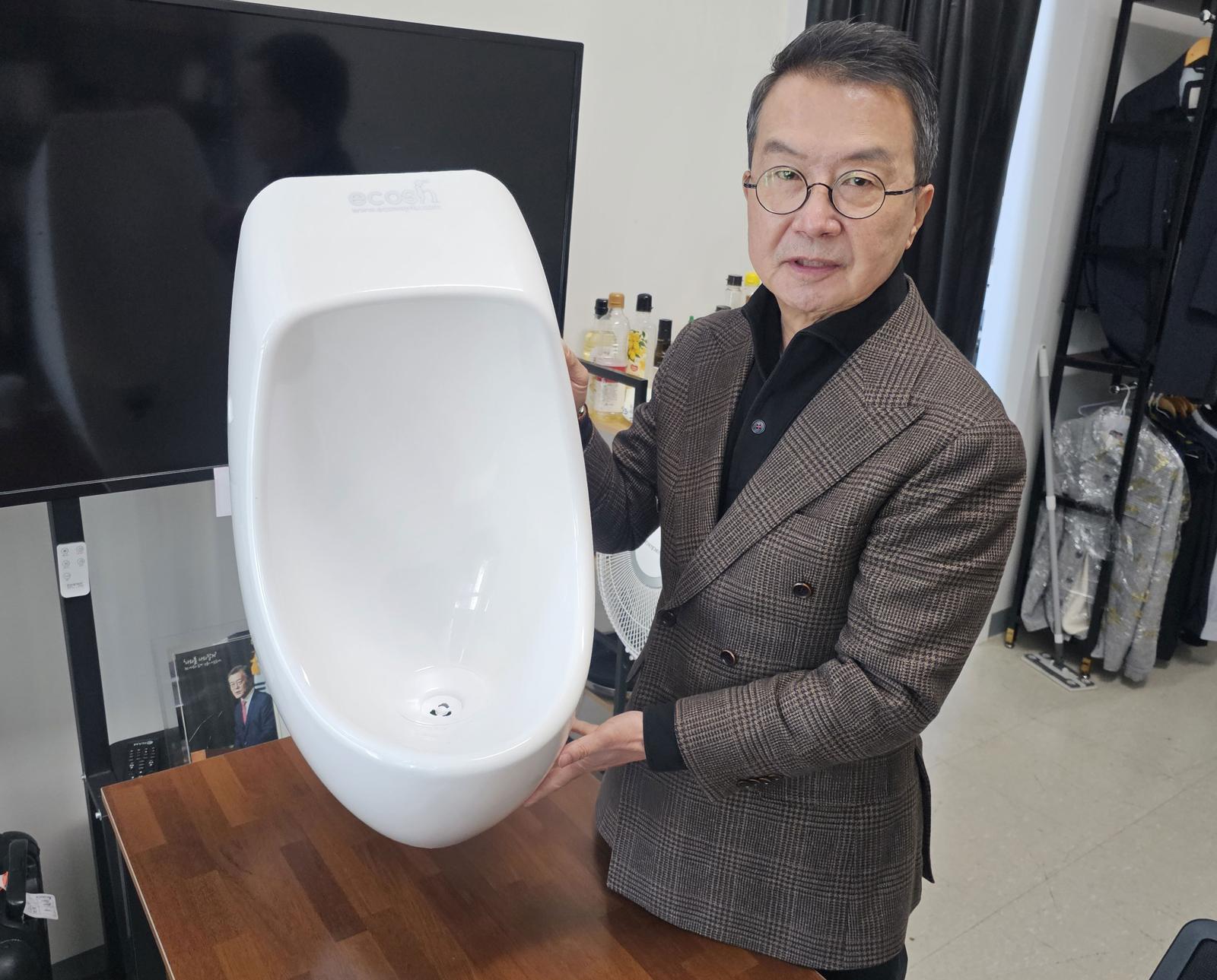
Introducing the waterless urinal 'Ecoshi' by Jo Soo-hyun, CEO of Ecosa / Source=IT Donga
The global water shortage issue is becoming increasingly severe. Since being classified as a water-scarce country by the United Nations in 2018, South Korea has highlighted the importance of water conservation. A significant portion of domestic water usage occurs in restrooms, with a substantial amount being wasted in urinals.
Ecosa (CEO Jo Soo-hyun) is a startup that developed the waterless urinal 'Ecoshi' to address this issue. CEO Jo Soo-hyun is an expert in this field, having researched related technologies for over a decade. The press met with CEO Jo to learn about the features of waterless urinal technology and the potential impact of this product.
- What prompted the development of the waterless urinal? What was the background?: Originally, I ran a construction management (CM) company. After South Korea was declared a water-scarce country in 2008, I realized the importance of water. I happened to watch a documentary about African children dying due to a lack of drinking water, which made me realize the significance of water.
While investigating where the most water wastage occurs in daily life, I noted the enormous amount wasted in restrooms. I thought that improving urinals could significantly conserve water. This led to the establishment of 'Ecoway Co., Ltd.' in 2012 and the development of the 'Ecoshi' product.
- It's been over 10 years since you started in 2012. A lot must have happened during that time.: Indeed. I ran the business through Ecoway for over 10 years, facing various challenges, and eventually closed in December 2024. It was a tough period. However, in February 2025, I came across a recruitment notice for the Preliminary Startup Package for re-entrepreneurs by the Korea Institute of Startup & Entrepreneurship Development. Considering the effort and potential of the technology, I felt it was too valuable to give up and wanted to try again. Thus, I founded Ecosa on May 30.
- Please introduce the features of Ecosa's product, 'Ecoshi'. How does it differ from existing urinals?: Firstly, the material is different. All restroom urinals are ceramic, but our product is made of ABS material. ABS is the same material used in motorcycle helmets, known for being lightweight and shatter-resistant.
Ceramic products have a limited lifespan and become waste when broken, making them difficult to recycle environmentally. In contrast, ABS material can be extracted and used as recycled plastic, and it is strong enough not to break even when hit with a hammer. With proper maintenance, it can be used semi-permanently.
- It's not just the material that's different. What are the design or functional features?: Design-wise, traditional ceramic urinals have a flat surface where urine hits, causing splashing. We took inspiration from the traditional 'chamber pot' used in rural areas to design it to minimize splashing from any angle. The phrase 'one step forward' is often seen in restrooms because people tend to stand far back to prevent urine from splashing on their clothes. We incorporated the beauty of the 'chamber pot' into the product design.
Additionally, because urine color varies from person to person, any residue on the urinal surface is immediately noticeable, raising concerns about odor. We applied a nano hydrophilic coating to the surface, ensuring that no residue sticks and flows down completely.
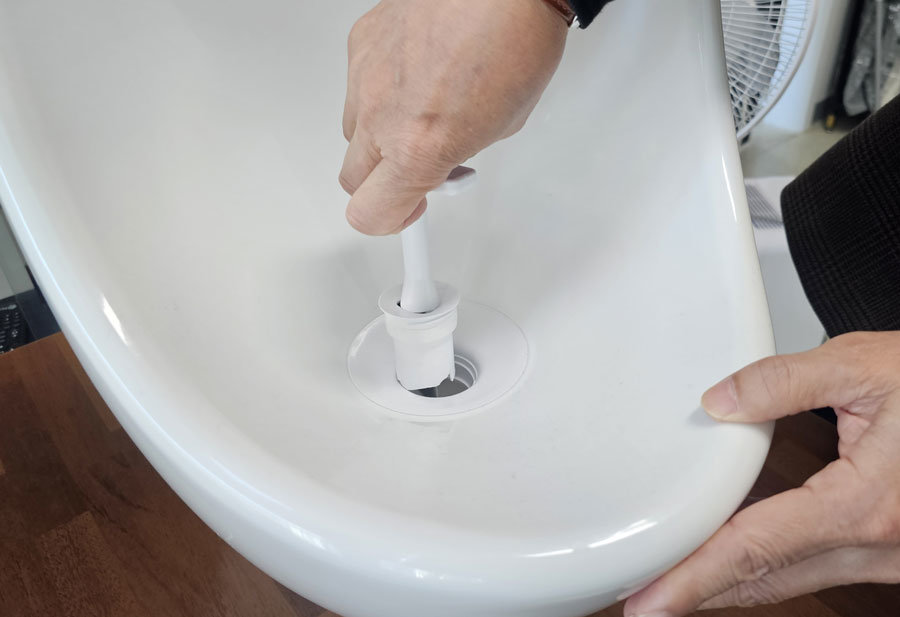
The core of Ecoshi, the Magic Valve / Source=IT Donga
- The most important function of a waterless urinal seems to be odor prevention. How do you prevent odors without using water?: The main feature is water conservation along with odor control. Many misunderstand that most restroom odors come from urine itself, but they actually originate from uric scale formed in the pipes.
Urine is 98% water, with the remaining 2% consisting of proteins, fats, and phosphorus from consumed food, which form uric scale when they meet water in the pipes. Ultimately, restroom odors come from the drains. In fact, there was an incident around 2020 where a high school girl died in an outdoor restroom in Suyeong-gu, Busan, due to hydrogen sulfide from the drains.
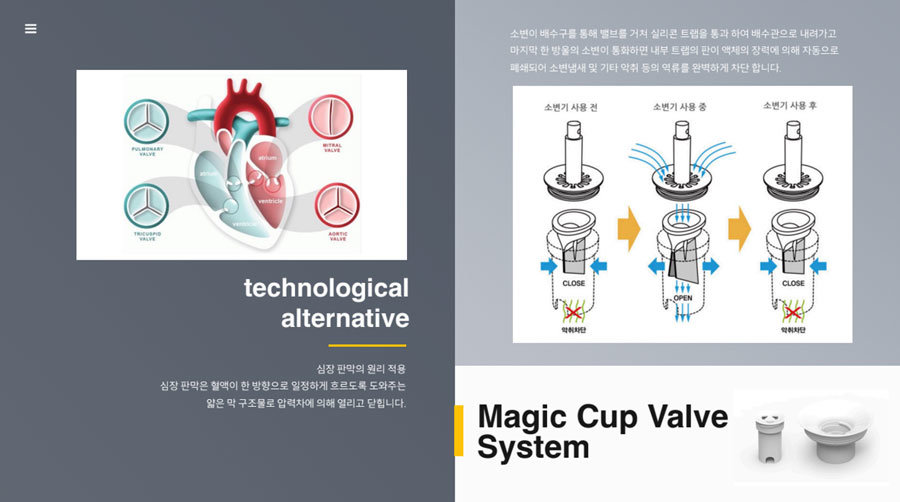
Traditional restrooms use water inefficiently without preventing odors. We solved this problem with the 'Magic Valve', inspired by the heart valve principle.
- What is the principle of the core technology, the Magic Valve? How does the current product differ from the initial model?: The Magic Valve is a silicone valve installed in the urinal drain, equipped with a backflow prevention system inspired by the heart valve principle. When urinating, the valve opens to allow complete discharge, and it closes tightly after the last drop, blocking 100% of odors from the drain.
The Magic Valve continues to evolve. There are design and performance differences between the old version from the Ecoway era and the recently developed new version. The new version has improved sealing and faster drainage, with a design change from a straight to a Y-shape.
Structure of the Magic Valve using the heart valve principle / Source=Ecoshi
- How much water can be saved with this?: Our developed urinal uses no water, so no water supply line is needed. Only the drain line for urine discharge needs to be connected. For example, if the male urinals in about 50,000 public restrooms nationwide were replaced with Ecoshi, 15 million tons of water could be saved annually. This equates to approximately KRW 60 billion in water fees.
As water fees increase annually, the savings effect becomes greater in the long term. This is based only on public restrooms, and the market size could be much larger if private restrooms are included. About 70% of water wasted in restrooms is due to toilets, which applies to both public and private restrooms.
- You mentioned developing and selling products for over 10 years. Where have they been installed?: In 2015, during the Ecoway era, it was selected as an excellent product by the Public Procurement Service. Notable installations include the PyeongChang Winter Olympics stadiums and the Blue House, as well as various parks, schools, and stations nationwide.
It has also been exported to eight countries, with a surprisingly good response from water-scarce countries in Southeast Asia, particularly the Philippines.
- Despite such achievements, what challenges did you face in business?: While the product received positive feedback, business expansion was limited. In South Korea, marketing was focused on public institutions, but budget issues were the biggest hurdle. Although the product was well-received, securing budgets for one-time large purchases was difficult.
- I heard you introduced a new sales method to overcome previous challenges. Could you explain?: Yes, to overcome difficulties, we expanded sales methods to include the rental market, in addition to sales. In the traditional purchase method, institutions had to bear both the product price and construction costs. However, with the rental method, construction costs can be financed through capital, and users only pay a monthly fee.
The key is that water savings can offset the monthly rental fee. For example, if KRW 60 billion is saved annually, the rental method allows recovery of the savings, reducing the burden on institutions. Like renting a water purifier, users pay a monthly rental fee.
- Has the newly introduced rental method been adopted anywhere?: Jinju Goryeo Hospital received and has been operating the products since early this year. Along with the Ecoshi urinals, they are also operating companion water-saving toilets under a five-year contract. The first rental supply at Jinju Goryeo Hospital has high satisfaction, and further business expansion is expected. We are currently conducting sales to various hospitals.
- I heard you are receiving support from the Preliminary Startup Package hosted by SeoulTech. How do you find the program?: The mentoring program was particularly impressive. I thought there wouldn't be much to learn since I've been in the industry for over 10 years. However, manufacturing has changed significantly over the past decade. Especially in this era, understanding advanced technologies like AI is essential for business operation.
I wasn't familiar with these new trends, but the support program at SeoulTech, particularly the expert mentoring program, provided new perspectives. Various programs related to investment, patent applications, finance, and labor were very helpful.
The Preliminary Startup Package is often thought to be youth-oriented, but the program operated by the Korea Institute of Startup & Entrepreneurship Development through SeoulTech was also very beneficial for middle-aged individuals like me. It's highly recommended for both young entrepreneurs and re-challenging businesspeople like myself.
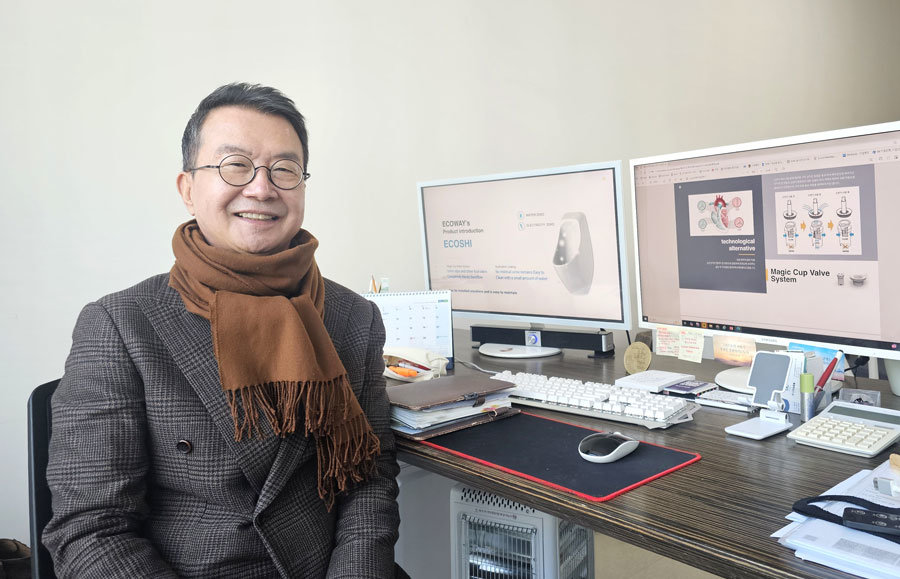
Jo Soo-hyun, CEO of Ecosa / Source=IT Donga
- Re-establishing a business is not an easy decision. What are your future plans?: It wasn't easy, of course. But I believed in the potential and social value of this technology. The water shortage issue is becoming more severe, and our product can make a practical contribution to solving this problem. I thought it was too valuable a technology to give up after one failure.
Ecosa's direction is not limited to water conservation. We will diversify our products into energy conservation, air quality improvement, and fire-related products. We are actively preparing to target not only the domestic market but also overseas markets.
During the Ecoway era, we participated in overseas exhibitions and export consultations five to six times a year. Ecosa will also actively target overseas markets, leveraging past experiences. From next year, we plan to expand participation in overseas exhibitions. I believe that various support programs provided by related institutions, including SeoulTech, will be a great help.
- Please share your thoughts on the future of South Korea's manufacturing industry.: While we must keep up with the times, South Korea is a country based on manufacturing. Although there is a tendency to focus on AI and software fields these days, I hope there will be more interest and support for entrepreneurs in the manufacturing sector.
Our Ecosa will strive to meet expectations with more advanced ideas, technologies, and products. We aim to become a company that contributes to solving the global water shortage problem, protecting the environment, and creating economic benefits.
IT Donga Reporter Kim Young-woo (pengo@itdonga.com)
ⓒ dongA.com. All rights reserved. Reproduction, redistribution, or use for AI training prohibited.
Popular News