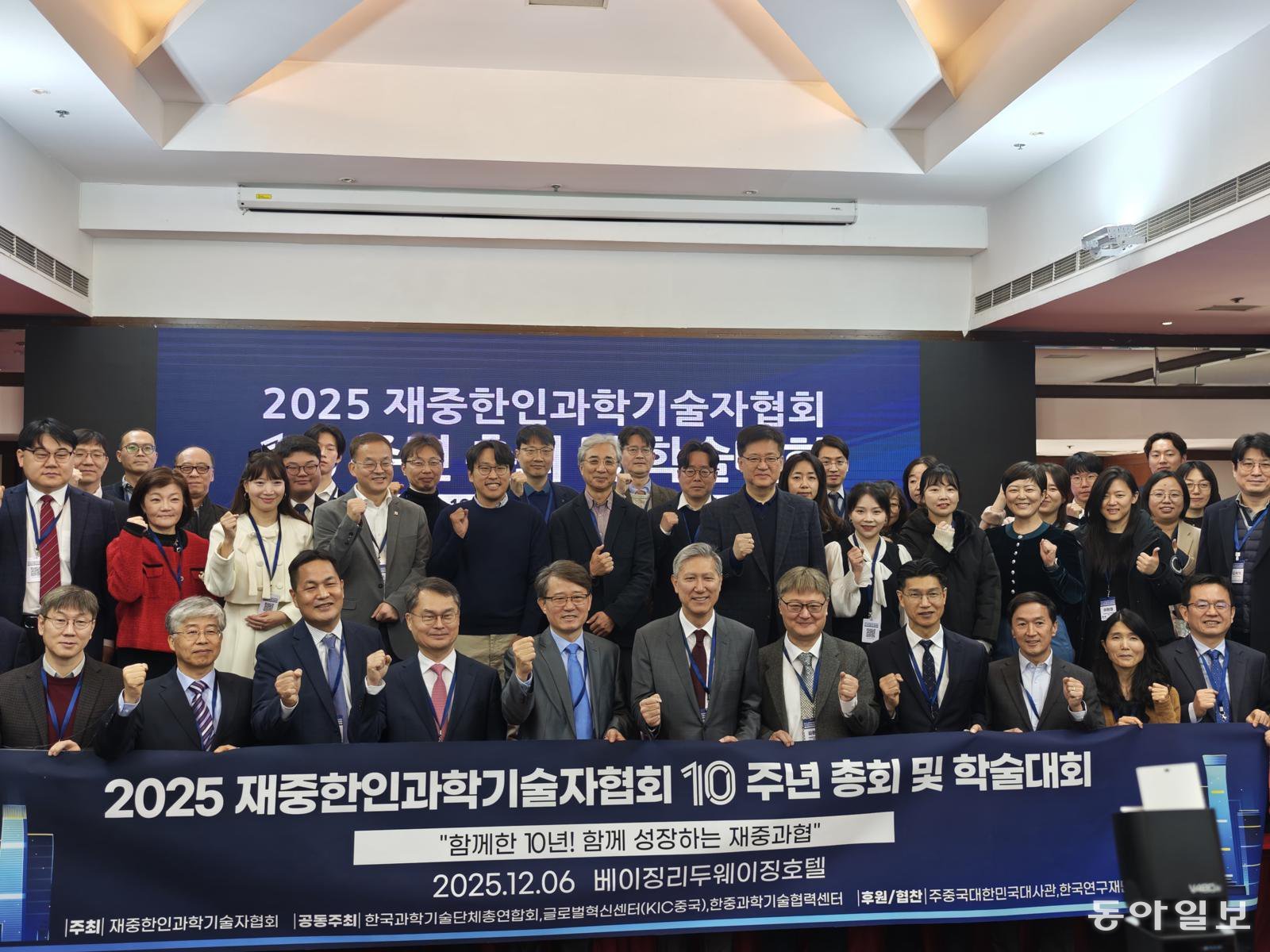
On the 6th, at the '10th Anniversary Academic Conference of the Korean Scientists and Technologists Association in China' held in Beijing, President Jeong Yong-sam (fifth from left in the front row) and Ambassador to China Noh Jae-heon (sixth from left) pose for a photo. Beijing = Kim Cheol-joong, Correspondent tnf@donga.com
Amid the intensifying competition between South Korea and China due to changes in their economic structures, there is a call for continuous strengthening of scientific and technological cooperation. Rather than the past model of leveraging South Korea's technological superiority and China's large-scale market, cooperation utilizing China's excellent research infrastructure and academia-industry collaboration system, focusing on energy and climate issues, is necessary. With science and technology influencing international order, security, and sovereignty, the role of Korean scientists active in China has become more significant.
●
“Need to Find Areas for 'Risk Sharing' with China”Kim Jun-yeon, Director of the Korea-China Science and Technology Cooperation Center, stated in the keynote speech at the '10th Anniversary General Meeting and Academic Conference of the Korean Scientists and Technologists Association in China (KSTAC)' held in Beijing on the 6th, that “the industrial structures of South Korea and China have a similarity of up to 96%, and the capabilities of Chinese companies like CATL and Xiaomi have significantly improved.” Since the deployment of the THAAD (Terminal High Altitude Area Defense) system in South Korea in 2016, the proportion of China in South Korea's total overseas investment has dropped to about 3%.
However, Kim expressed that completely severing cooperation with China carries significant risks. China is already fiercely competing with the United States for leadership in advanced technology fields such as artificial intelligence (AI) and batteries. If China dominates the technology standards in certain fields, market access itself may become difficult, making it challenging to choose one side. Kim emphasized, “The era when South Korea could leverage its technological superiority to cooperate with China in industrial or technological research fields is over, and a new 2.0 cooperation model is needed.”
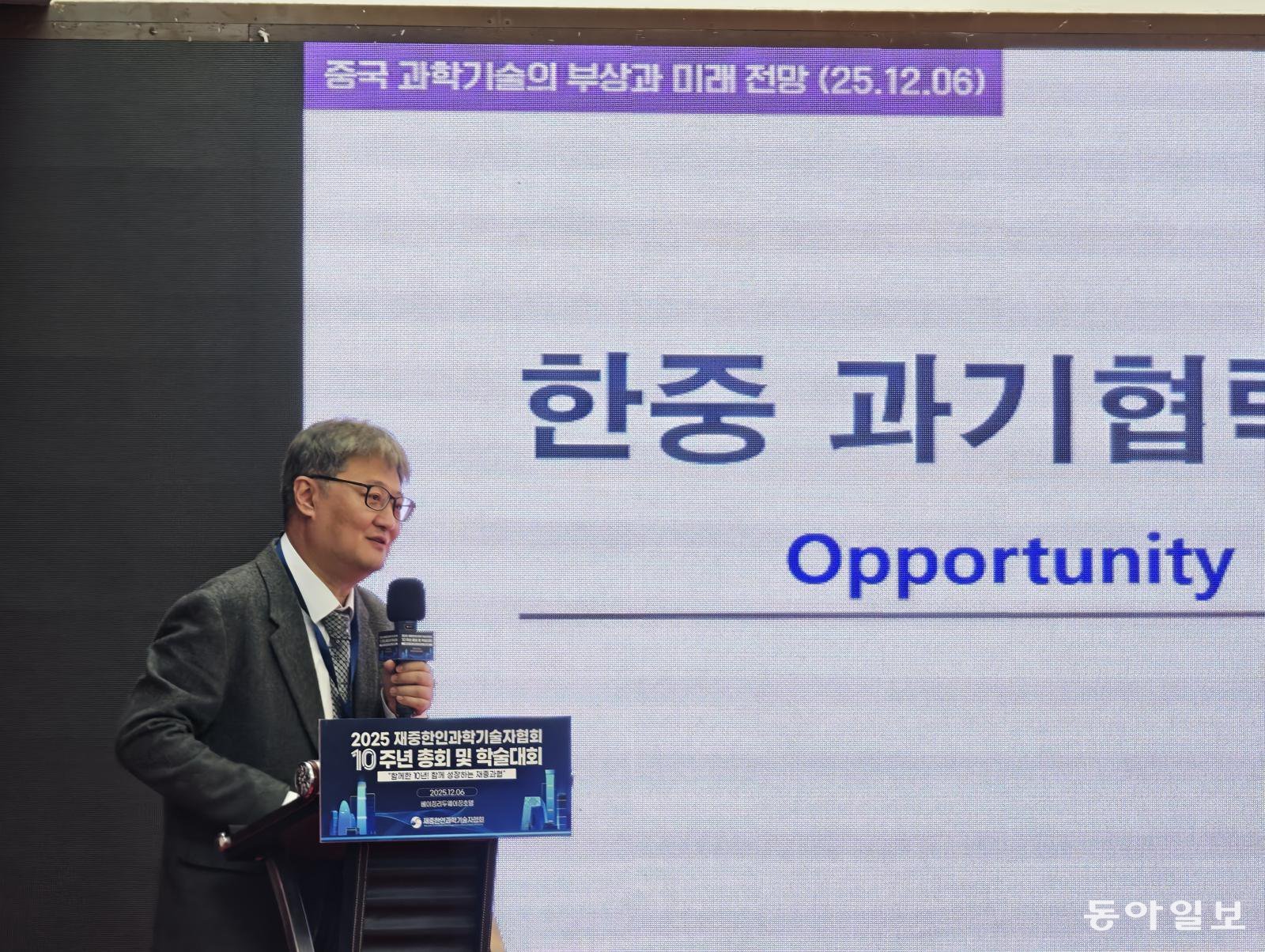
Kim Jun-yeon, Director of the Korea-China Science and Technology Cooperation Center, delivering the keynote speech at the '10th Anniversary Academic Conference of the Korean Scientists and Technologists Association in China' held in Beijing on the 6th. Beijing = Kim Cheol-joong, Correspondent tnf@donga.com
To this end, Kim proposed approaching China as a 'huge laboratory' with well-established research infrastructure and academia-industry collaboration systems. He noted, “China allocates 30% of its R&D support budget to young and challenging researchers, creating a foundation for innovative research outcomes, unlike South Korea and Japan.” He explained that in research fields that can lead the future but carry high risks relative to investment, such as energy, climate, aging, and space, cooperation with China can allow for risk sharing.
The forum was attended not only by Korean scientists in China but also by renowned scholars in international politics. Kim Sang-bae, a professor at the Department of Political Science and International Relations at Seoul National University, emphasized, “Terms like alliance, security, and sovereignty, which are often attached to the word technology these days, are primarily used in international politics. AI, for example, can disrupt international order beyond the economy and into the military field.”
However, Professor Kim cautioned against viewing advanced technology cooperation solely from a geopolitical perspective. He pointed out, “South Korea has enjoyed prosperity through mutual cooperation and collaboration in advanced technology fields. We should avoid determining our future direction by being caught up in the geopolitical competition of major powers.”
●
10 Years of KSTAC… “Expect More Achievements in the Future”The KSTAC, which held its 10th-anniversary academic conference on this day, started as a small gathering of Korean scientists in China in 2015. Since then, it has played a pivotal role in not only fostering cooperation among its members but also serving as a focal point for a practical Korea-China academic network. In his opening speech, KSTAC President Jeong Yong-sam stated, “We have faithfully served as a bridge for the exchange and cooperation of scientific and technological talents between Korea and China,” adding, “We will not be satisfied with the achievements of the past 10 years and will prepare for a more challenging next decade.”
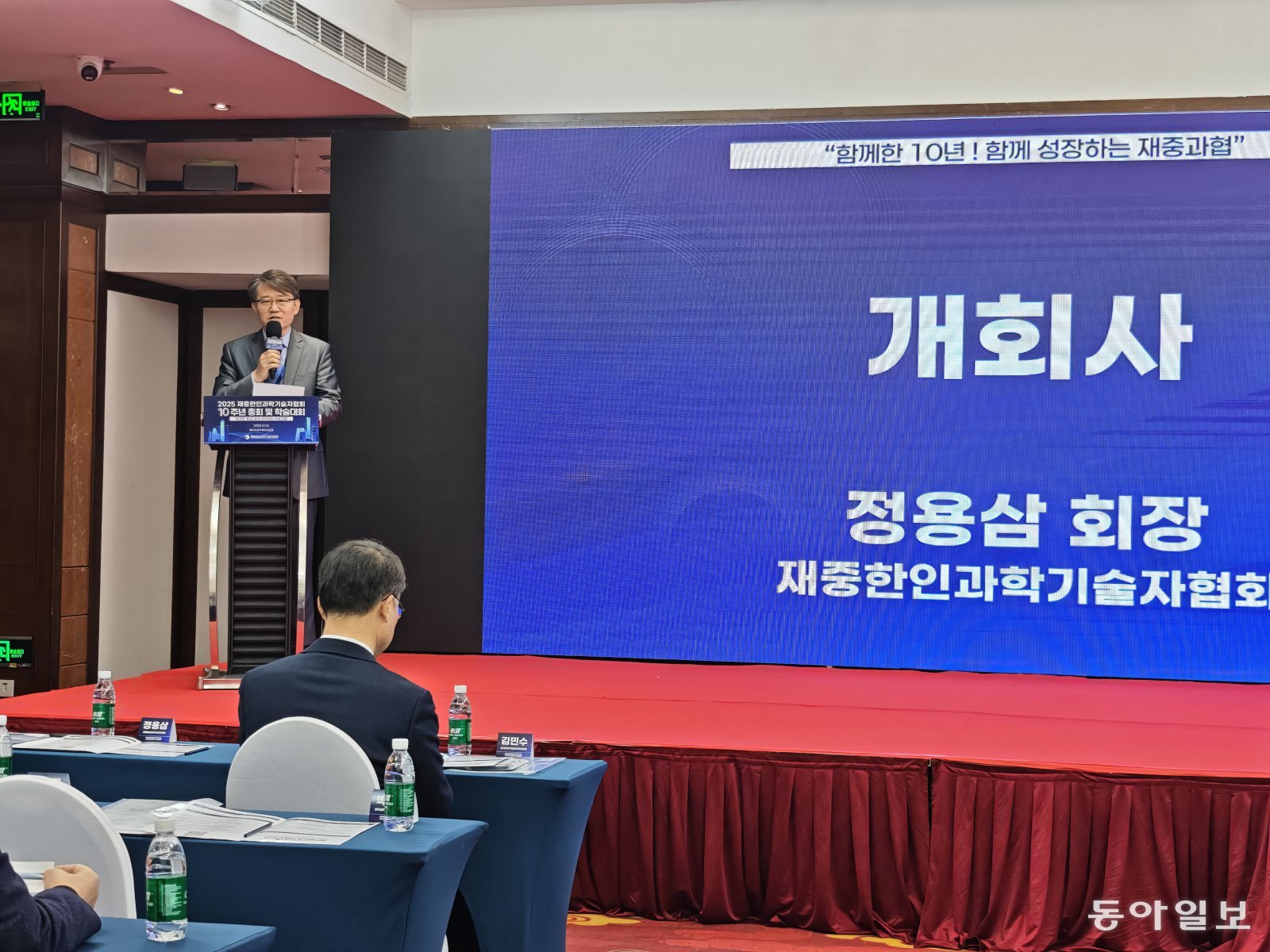
KSTAC President Jeong Yong-sam delivering the opening speech on stage at the '10th Anniversary Academic Conference of the Korean Scientists and Technologists Association in China' held in Beijing on the 6th. Beijing = Kim Cheol-joong, Correspondent tnf@donga.com
In his congratulatory address, Ambassador to China Noh Jae-heon urged, “I hope that Korea and China will create a development direction that can contribute to the region and humanity through cooperation.” Acting President of the Korean Federation of Science and Technology Societies, Kim Min-soo, also remarked, “Korea and China, sharing a long history and culture, are partners leading technological advancement for Asia to emerge as the world's center,” adding, “The role of Korean scientists in China has become more important in a situation where the pace of technological change, including deep tech, is rapidly accelerating.”
To mark its 10th anniversary, KSTAC also published a book titled 'The Rise of Chinese Science and Technology in 2026 and Future Prospects.' The book contains various analyses on the rapidly advancing level of Chinese technology, the innovation strategies in each field that made this possible, and new models of Korea-China technology cooperation.
ⓒ dongA.com. All rights reserved. Reproduction, redistribution, or use for AI training prohibited.
Popular News