Professor Jung Geun-hwa, Seoul National University Hospital Neurology Department
Quick identification of early symptoms is crucial… Paralysis on one side of the body and speech disorders are most common
Severe headache with vomiting may indicate brain hemorrhage… Symptoms often appear suddenly
If blood pressure suddenly spikes, be suspicious… Even if symptoms disappear, the condition progresses, examination is essential
Professor Jeong Geun-hwa from the Department of Neurology at Seoul National University Hospital emphasized that recognizing the warning signs of a stroke and quickly transporting the patient to a hospital is the best way to increase survival rates and eliminate aftereffects. It is important to carefully consider the patterns and types of warning signs. Provided by Seoul National University Hospital.
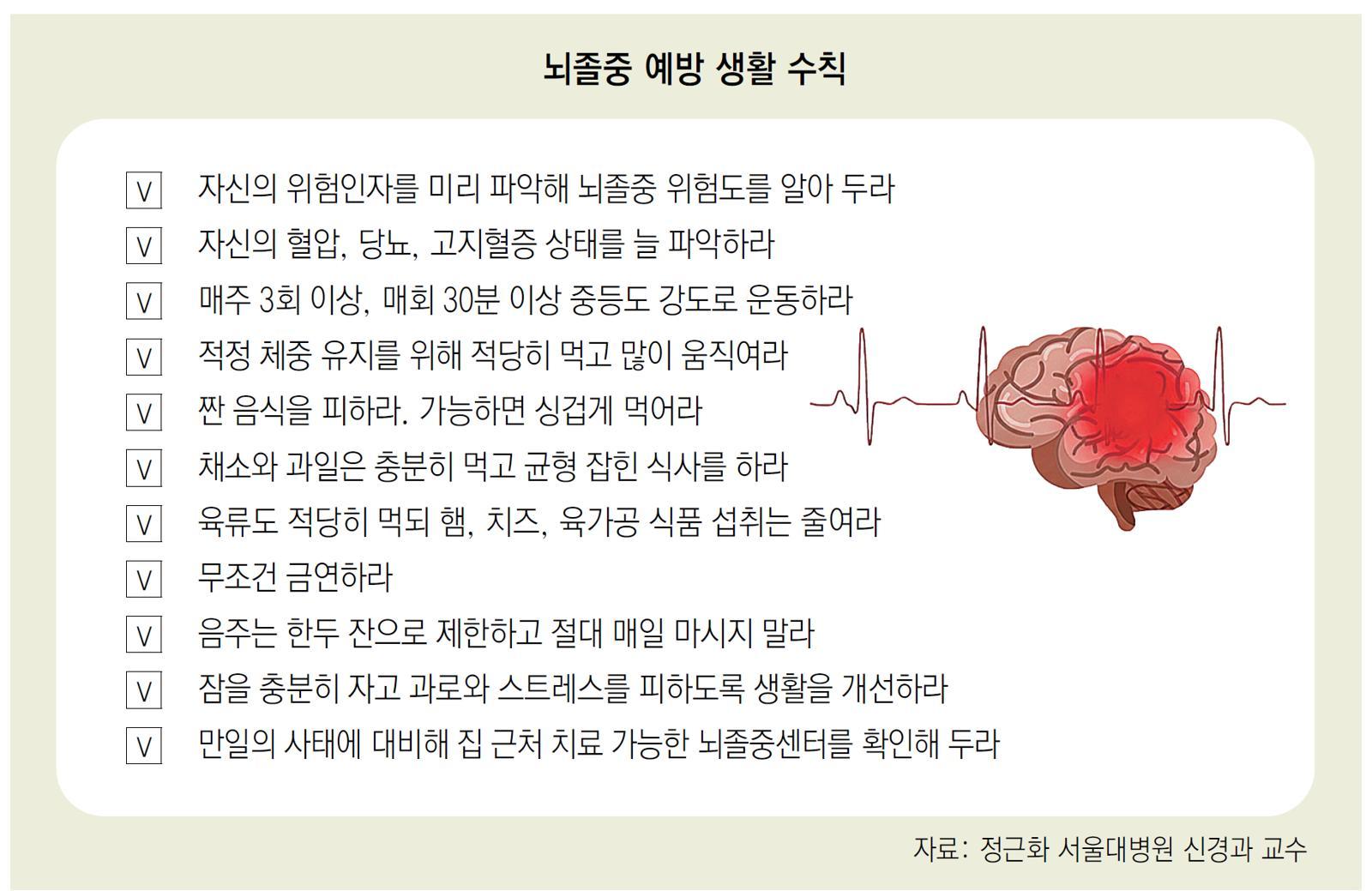
Stroke is divided into cerebral infarction, where a blood vessel in the brain is blocked, and cerebral hemorrhage, where a blood vessel bursts. Prevention is the best approach due to the serious consequences it can cause.
90% of strokes are hypertensive strokes. This means that managing hypertension is crucial to avoiding strokes. Additionally, high-risk groups should undergo brain magnetic resonance imaging (MRI) every 1-2 years to assess brain health. Professor Jeong Geun-hwa from Seoul National University Hospital identified four types of high-risk groups: patients with a history of stroke, those with a family history, individuals with risk factors such as hypertension, diabetes, and hyperlipidemia, and those who frequently smoke and drink. The frequency of tests should be decided in consultation with a doctor.
After onset, prompt action is crucial. The 'golden time' for cerebral infarction is 4.5 hours. The blocked blood vessel must be cleared within this time for complete treatment. Recently, the golden time has been extending. Professor Jeong stated, "Many patients see full effects if treated within 6 hours of onset. Some patients even see treatment effects up to 24 hours."
There is no specific golden time for cerebral hemorrhage because the future outcome is unpredictable depending on the size and location of the hemorrhage. Generally, when a blood vessel bursts, blood accumulates in the brain, forming a hematoma. If left untreated, the hematoma enlarges, and the pressure inside the brain increases. It becomes dangerous after 3 hours, and surgery becomes impossible, with a higher risk of death after 6 hours.
It is important to recognize the early warning signs of a stroke. The warning signs are varied, including headaches, dizziness, paralysis, loss of balance, difficulty breathing, vomiting, and diplopia (double vision). Professor Jeong noted, "The brain has different functions depending on the area. Symptoms vary depending on the location of the stroke."
● Understanding the Patterns of Warning Signs
Among the warning signs, three are most common: drooping and paralysis of one side of the face, paralysis of one arm or leg, and slurred speech and language disorders. These functions are managed by the front part of the brain. Professor Jeong explained, "The frontal area of the brain is the largest, so the probability of stroke occurrence is high, leading to functional abnormalities."
It is important to closely observe the pattern of paralysis. The brain is divided into left and right hemispheres. If there is a problem in the left brain, paralysis occurs on the right side of the body. If symptoms appear on both the left and right sides, it is likely not a stroke.
If a stroke occurs in the back part of the brain, balance and equilibrium functions decrease, making it difficult to walk properly. Dizziness may become severe. As the area responsible for vision, some objects may appear less visible, split, or overlap.
Headaches are also a typical warning sign. However, not all headaches are related. Professor Jeong stated, "Headaches related to strokes often accompany other symptoms such as paralysis or dizziness. If a headache appears alone, it is unlikely related to a stroke."
Headaches are particularly common in cerebral hemorrhage. In such cases, there are specific characteristics. Professor Jeong noted, "Headaches of an intensity never experienced before, like being hit with a hammer, often appear. Vomiting symptoms are common." In cerebral hemorrhage, losing consciousness is also quite common. It is important for family or caregivers to quickly identify the location of an unconscious patient.
When symptoms appear, one must first consider 'sudden onset.' Professor Jeong stated, "Any symptom that suddenly starts rather than appearing chronically over a long period should be particularly suspicious."
Another point to consider is that blood pressure generally rises as the disease progresses. Especially in cerebral hemorrhage, blood pressure can rise sharply. Checking blood pressure with a home blood pressure monitor can be helpful. If warning signs appear despite taking hypertension medication and blood pressure rises simultaneously, the likelihood of a stroke is high.
● Go to the Hospital Immediately if Symptoms Appear Warning signs are a signal of an impending stroke. The patterns of symptoms that appear afterward vary slightly. Professor Jeong classified them into three types. The first type is 'progressively worsening.' Professor Jeong stated, "This is the most common type. Symptoms suddenly appear, followed by other symptoms, and the symptoms worsen."
For example, paralysis symptoms initially appear in one arm or leg. Over time, the paralysis worsens. Then, the inability to move is added. Speech becomes severely slurred. Many experience narrowing vision or seeing multiple objects, followed by dizziness leading to collapse.
This type of symptom manifests clearly in a short period, leading to a high rate of early stroke detection. Professor Jeong stated, "In this type, many patients arrive at the hospital within the golden time. As a result, the treatment effect is good, and the possibility of maintaining normal life is high. The problem with the other two types is that it is difficult to recognize the warning signs."
● Is It Okay if Symptoms Disappear?
The second type is where symptoms appear briefly and then disappear. This was the case for a 60-year-old former teacher, Mr. Park Jin-soo (pseudonym).
Mr. Park starts his day by reading the newspaper every morning. One day, the letters became blurry, followed by dizziness. He thought it was because he was not feeling well, and after exercising, the symptoms disappeared. The same thing repeated for two days. On the third day, during breakfast, his daughter noticed that he was speaking slurred and seemed dazed. Only then did he head to the emergency room.
The examination revealed that cerebral infarction had already progressed. It was presumed that the artery connecting the spine to the brain was the first to be blocked. This caused the letters to appear blurry and dizziness. However, since the symptoms soon disappeared, he did not suspect a cerebral infarction. In the meantime, the blood vessels in the cerebellum and occipital lobe became blocked, eventually leading to severe damage to the left occipital lobe and complete loss of vision in the right eye.
This type of stroke is commonly referred to as a 'mini-stroke.' Professor Jeong stated, "The term 'small stroke' is complacent. It is merely taking a break, but the disease is progressing. More than 15% of these patients worsen to cerebral infarction within a week. It's like a dormant volcano about to erupt."
Why does this phenomenon occur? It is because the body's defense mechanism activates to replenish blood flow when the blood supply to the brain is interrupted. Temporarily, blood flow is supplied, making the symptoms seem to improve. However, that time is not long. The disease progresses again. Medically, this is called a 'transient ischemic attack.' Professor Jeong stated, "If symptoms such as paralysis of one arm or leg or sudden darkness in front of the eyes appear suddenly, even if they last less than 10 minutes, it is advisable to visit a hospital for an examination."
● Be More Cautious When Symptoms Are Ambiguous The third type is more ambiguous. The same warning signs repeat only in specific situations. At first glance, it seems unrelated to stroke, making early detection difficult.
Mr. Lee Seok-cheon (pseudonym), a man in his mid-70s, enjoyed exercising. He ran along the Han River and frequently visited the gym. From some point, after exercising, he felt his grip weaken. However, after some time, it returned to normal. Mr. Lee only thought it was an aftereffect of strength training. Similar situations repeated afterward. Only after exercising did his right hand lose strength. It wasn't very severe, so he didn't take it seriously.
On a day he came home after drinking, the symptoms worsened. The lethargy and paralysis symptoms that appeared only in his right hand extended to his leg. Mr. Lee had hypertension and hyperlipidemia. Only then did he worry and rush to the hospital. His left carotid artery was nearly 80% blocked. The blood flow to the brain was insufficient, and brain damage was progressing. Although urgent treatment was administered, the damaged area could not be salvaged.
Professor Jeong explained, "Especially after dehydration, exercise, drinking, or overeating, blood flow is temporarily diverted to the stomach, reducing blood flow to the brain and causing stroke symptoms." Professor Jeong emphasized, "If similar warning signs of a stroke repeatedly appear, even if it doesn't seem like a stroke, it is wise to get tested at a hospital."
ⓒ dongA.com. All rights reserved. Reproduction, redistribution, or use for AI training prohibited.
Popular News