3D protein structure prediction for 25 years… Top 3 globally in international competitions for 10 consecutive years
From finding 1 in hundreds of thousands of drug candidates to designing 50 and hitting 15
“The era of drug design, not discovery… Development time and costs will be significantly reduced”
Vice President Park Tae-yong of Galux holds a model of a de novo antibody that precisely attaches to the target protein (FZD7) involved in colorectal cancer, liver cancer, stomach cancer, and brain tumors, explaining the design process. The company anticipates a new de novo antibody drug that eliminates the bone fracture side effects of Vantictumab, which was being developed by another company. Reporter Heo Jin-seok jameshur@donga.com
Among protein therapeutics, antibody therapeutics are representative. Antibodies must attach precisely to specific molecular sites on the surface of viruses or cancer cells to function properly. Traditionally, to obtain such antibodies, antigens were injected into animals to induce the body to produce antibodies, or tens of thousands of pre-made antibody candidates (libraries) were tested one by one to select the best-binding antibody.
However, a technology that overturns this paradigm has emerged. It is a technology where artificial intelligence (AI) creates completely new antibodies (proteins) from scratch. These newly designed antibodies are called 'de novo antibodies' (de novo meaning 'from the beginning' in Latin). The first appearance of de novo antibodies globally was in 2024, and only five places worldwide possess this technology. In Korea, Galux (CEO Seok Cha-ok) is the sole company. Vice President Park Tae-yong (32), met at the Seoul Gwanak-gu headquarters on the 2nd, stated, "The five companies are aiming to overcome diseases with different approaches," adding, "Galux is dramatically enhancing the efficiency of exploring new drug candidate substances by designing antibodies that act on eight target proteins causing lung cancer, breast cancer, pancreatic cancer, autoimmune diseases, obesity, and brain diseases."
● Precise Prediction of 3D Protein Structures
Proteins in the human body are connected in a one-dimensional sequence of 20 types of amino acids and then fold into specific three-dimensional structures like origami. This structure determines the protein's function. The problem is that even with just 100 amino acids, the theoretically possible 3D structures are far more numerous than the number of possible moves in a Go game.
Galux's AI platform, GaluxDesign, predicts the 3D structure of a protein by inputting the amino acid sequence that makes up the protein. Furthermore, it reversely finds the amino acid sequence of a protein to bind well to a specific target or perform a desired function.
To explain with an immuno-oncology drug: cancer cells produce a protein called PD-L1 to evade attacks by immune cells. Vice President Park explained, "Cancer cells deceive immune cells by presenting PD-L1 as if saying, 'I am an ally.' However, if an antibody first binds to PD-L1, cancer cells cannot disguise themselves and are attacked and killed by immune cells. Our technology allows us to precisely design antibodies that bind well to PD-L1."
In March this year, Galux designed a new antibody with binding strength and stability equal to or superior to 'Tecentriq,' an immuno-oncology drug from the global pharmaceutical company Roche, which sells nearly KRW 7 trillion annually. Vice President Park stated, "The difference between the AI-designed structure and the laboratory-made protein (antibody) structure was only about the diameter of an atom, meaning it was almost identical," adding, "It signifies that we have realistically designed proteins that can actually exist."
The efficiency is particularly noteworthy. According to data released by Galux in November this year, even though AI designed only 50 antibodies per target protein causing disease, 15 (30%) of them were actually made into antibodies that bind well to the target. This exploration efficiency is incomparable to the traditional method of testing tens of thousands of candidates one by one. Vice President Park stated, "We have succeeded in de novo design for all eight different targets so far, and among them, we have secured drug candidate-level antibodies that bind very strongly to seven targets."
● "Let's Make Research Results Useful in the World" Galux was founded by researchers who had been devoted to protein structure research for 25 years and their students coming together. CEO Seok Cha-ok (55) entered the Department of Chemistry at Seoul National University as the top female student in the 1989 college entrance exam, earned a Ph.D. from the University of Chicago, and worked as a postdoctoral researcher at MIT and UCSF, focusing on protein structure research. In 2000, she joined Professor Ken Dill's lab, a master of protein folding theory, at UCSF, where more in-depth research began. After becoming a professor in the Department of Chemistry at Seoul National University in 2004, she developed the protein structure modeling platform GALAXY with her graduate students. CEO Seok believed that, just as the universe's galaxies move according to physical laws despite their complexity, the molecular world can be understood and predicted if the basic principles are known.
This belief was proven by results. Galux consistently ranked in the global top 3 in the International Protein Structure Prediction Competition (CASP) for over 10 years from 2010 and even won 1st place in the Protein Interaction Prediction Competition (CAPRI). In 2018, when Google's DeepMind's AlphaFold showed overwhelming performance over existing methods at CASP, surprising the world, CEO Seok was part of the judging panel, witnessing the 'AlphaFold shock' up close.
As a basic science researcher, Professor Seok, who was purely curious about the molecular principles of nature, encountered a turning point in 2020. It was the startup proposal from her student Park Tae-yong, who was about to graduate with a Ph.D. Vice President Park stated, "I thought the path of tech entrepreneurship was the shortcut to achieving my dream of doing work that protects human life," adding, "I joined forces with researchers Won Jong-hoon and Yang Jin-sol from the lab, and the professor willingly joined us."
Galux's core technology is teaching AI the physical principles of protein structures. Vice President Park stated, "While large language models (LLMs) only learn patterns, we ask, 'Why do you think this is the answer?' and teach the physicochemical principles," adding, "AI that learns principles can provide answers based on principles even with a small amount of data and for new problems it has never seen before."
● The Dawn of the AI Drug Market
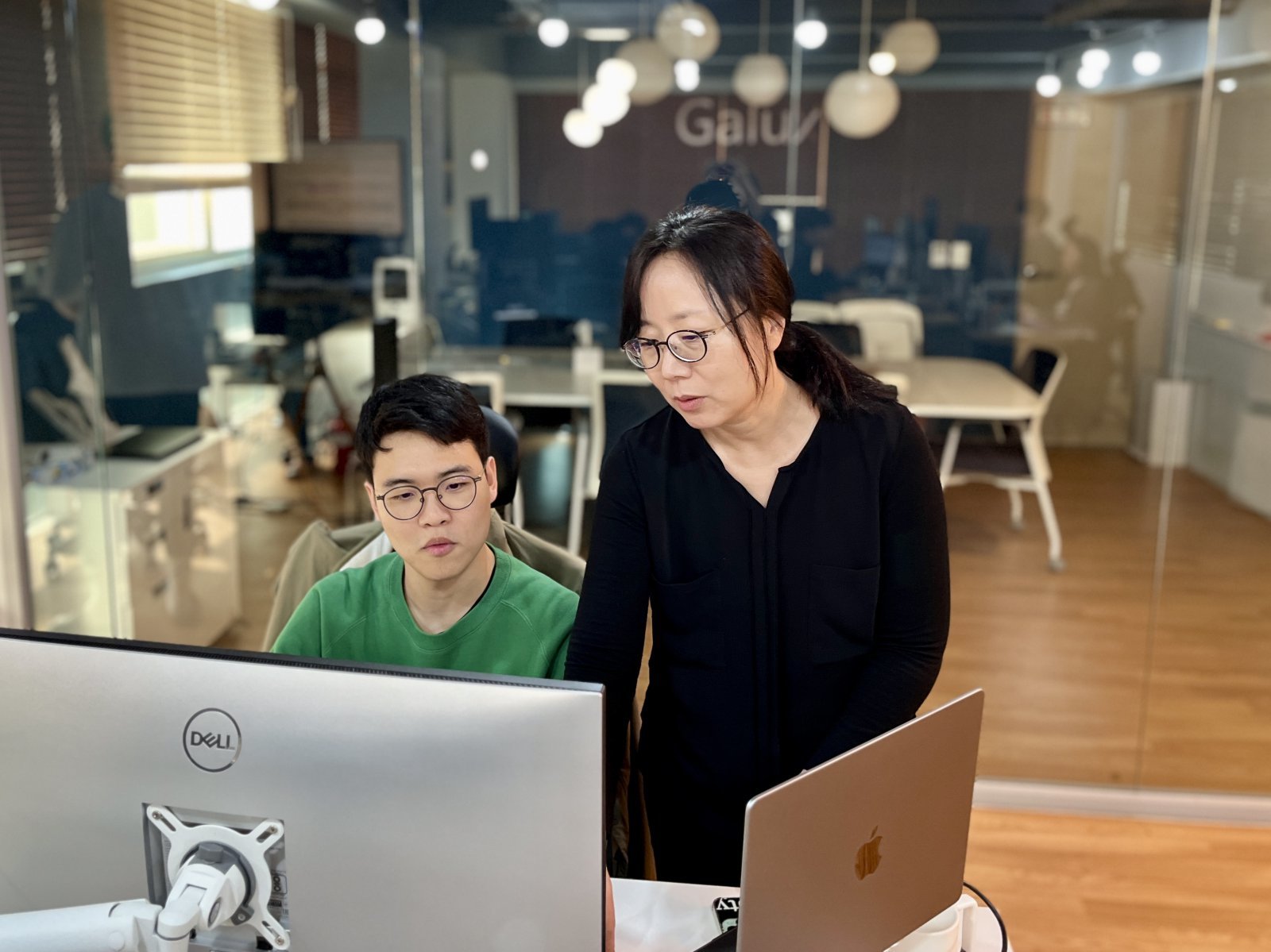
CEO Seok Cha-ok of Galux (right) discusses ways to enhance the performance of protein design AI with a researcher. Provided by Galux
The AI drug development market is at its dawn. According to the Korea Health Industry Development Institute, the global AI drug development market is expected to grow more than threefold from approximately KRW 1.3 trillion in 2023 to about KRW 4.2 trillion in 2028. Utilizing AI is expected to reduce the traditional drug development period from 10-15 years to 3-4 years and costs from trillions of KRW to hundreds of billions of KRW. Therefore, AI drug development is evaluated as a technology with the potential to fundamentally reshape the entire drug market, worth hundreds of trillions of KRW.
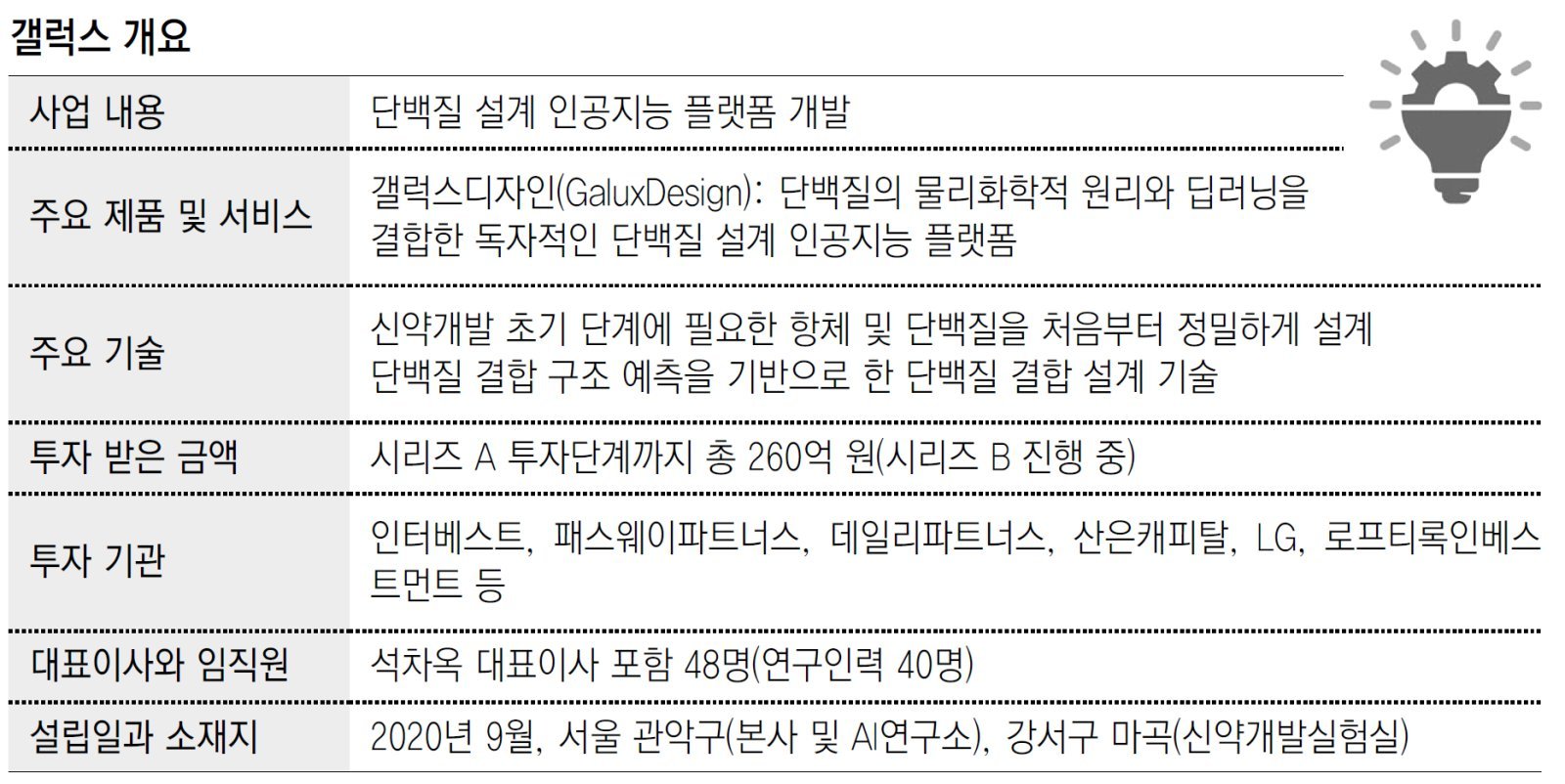
Galux has attracted investments totaling KRW 26 billion so far. It is collaborating with 17 partners, including global big pharma, Celltrion, LG Chem, and Hanall Biopharma. On December 1, it signed a joint development contract with Celltrion for a next-generation autoimmune disease treatment based on multi-antibody.
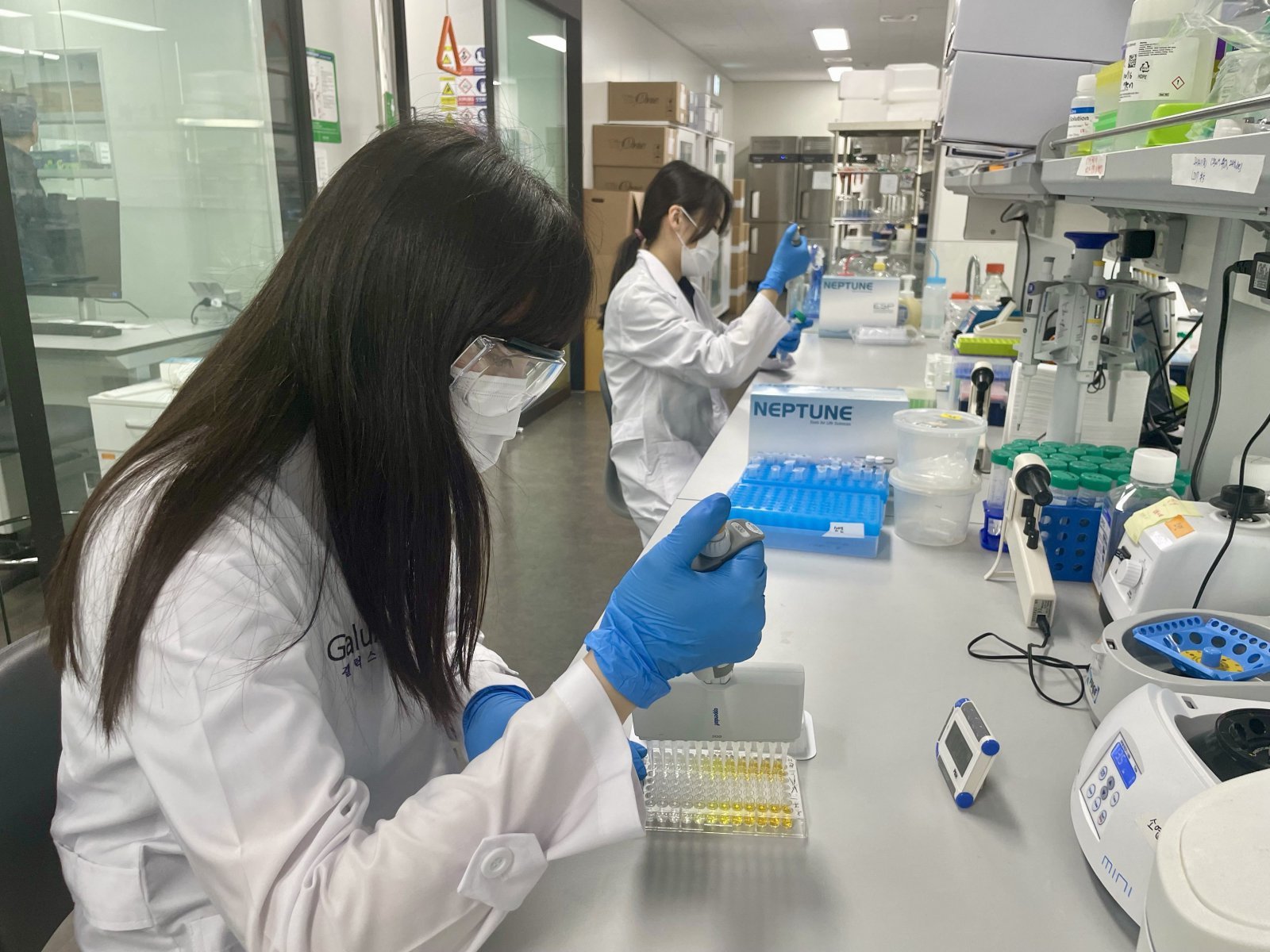
Researchers at Galux's new drug development laboratory in Magok-dong, Gangseo-gu, Seoul, are creating designed antibodies into actual antibodies. Provided by Galux
Galux aims to enter clinical trials for AI-designed protein drugs by establishing large-scale partnerships with big pharma by 2027.
While the increased success rate of candidate substance exploration is a significant achievement, there is still a long way to go to streamline the entire drug development process. Even if protein design is well-executed, unexpected reactions can occur in the body, or they may bind to entirely unintended sites. Efficient production of protein therapeutics is also important.
Vice President Park stated, "The era where I can pre-design and combine proteins with desired characteristics through de novo design has just opened," adding, "We will enhance not only candidate substance exploration but also clinical success rates with AI drug development technology." While Galux focuses on antibody therapeutics, it is also conducting research and development on other protein therapeutics, such as enzyme therapies and cytokines.
ⓒ dongA.com. All rights reserved. Reproduction, redistribution, or use for AI training prohibited.
Popular News