Third-generation leaders in the ramen industry focus on expanding overseas markets
Nongshim and Ottogi target the U.S., Samyang Foods focuses on Europe
Orion aims for a new factory in Russia by 2027
Local residents are taking commemorative photos at a pop-up store hosted by Samyang Foods at the Westfield Century City, a large shopping mall in Los Angeles, USA.
The domestic food industry is expanding its investments in the Americas. This trend is attributed to the successful establishment of various Korean foods such as ramen, kimchi, and snacks in the Americas, influenced by K-culture. However, risks such as regulations and war remain, and companies are showing strategic differences by focusing on traditional core food export countries like China and Russia.
According to industry sources on the 3rd, third-generation owners in their 30s have recently been appointed to key management positions in the domestic ramen industry, including Nongshim and Samyang Foods. Nongshim promoted Shin Sang-yeol, Executive Director of the Future Business Office (32), to Vice President, and Samyang Foods promoted Jeon Byung-woo, Chief Operating Officer (COO) (31), to Executive Director.
The major responsibilities of Vice President Shin Sang-yeol and Executive Director Jeon Byung-woo include discovering new businesses and expanding overseas markets. Attention is focused on the North American and European markets overseas. This is because the preference for Korean food is increasing not only in China, which was the main market, but also in the Americas and Europe.
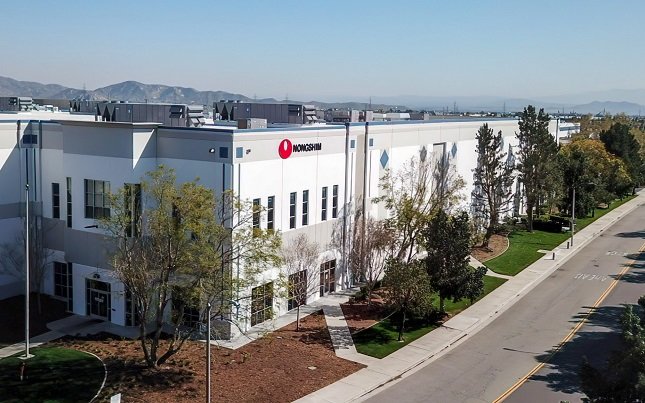
Nongshim's second factory in Rancho Cucamonga, California, USA.
Currently, Nongshim operates two factories in the United States, capable of producing a total of 1.01 billion ramen packs annually. Nongshim, having noticed the growth trend in the Americas early on, established a factory in Los Angeles, USA, in 2005. It began operating its second factory in the United States in 2022, 17 years later.
Nongshim's sales in the Americas increased by 38% to KRW 576 billion in the first year of the second factory's operation, and grew by another 10% to KRW 635.2 billion the following year. Sales in the Americas increased by 53% within two years of the second factory's operation.
Samyang Foods has completed its 'global three bases' strategy, extending beyond China and the United States to Europe. In July last year, it established a European sales corporation in Amsterdam, Netherlands, and achieved cumulative sales of EUR 80 million (approximately KRW 140 billion) in the third quarter of this year. Recently, through its logistics subsidiary Samyang Logistics, it completed the registration of Samyang Logistics Europe, which is responsible for warehousing and transportation in Amstelveen. This entity is expected to supply products purchased by the sales corporation from the domestic headquarters to local wholesalers and consumer channels.
Kim Jung-soo, Vice Chairman of Samyang Foods, also chose Germany as the first global field management site in the second half of last month, showing a focus on the European market. The promotion of Shin Kyung-ho, head of the European corporation, to an executive (Executive Director) in the regular executive appointments for 2026 reflects the group's expectations.
Additionally, Ottogi entered the United States in 2005, establishing the sales corporation Ottogi America, and launched the production corporation Ottogi Food America in 2023, 18 years later. It is currently preparing to establish a production plant by 2027. SPC, which operates Paris Baguette, and CJ Foodville's Tous Les Jours are also building baking factories in the United States.
On the other hand, Orion's overseas sales are growing, centered on Russia and China. Orion's overseas sales accounted for 68.8% of the total in the third quarter of this year. Despite the war risk, the Russian corporation's sales in the third quarter increased by 44.7% to KRW 89.6 billion, and operating profit increased by 26.9% to KRW 11.7 billion compared to the same period last year, showing the largest growth. The operating rate of the Russian factory was an average of 100.0% until the third and fourth quarters of last year, but it recorded 117.6% during the same period this year.
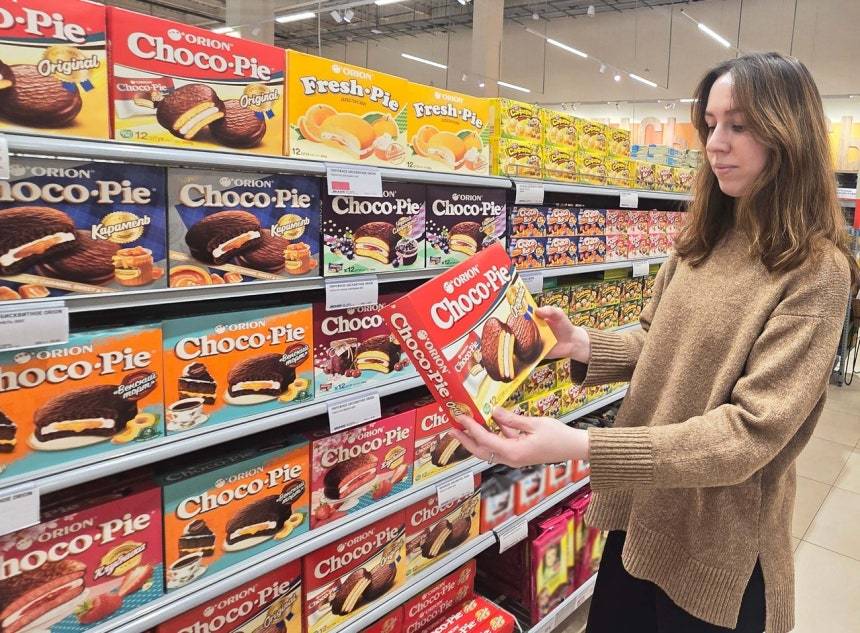
Choco Pies are displayed on a shelf in a Russian supermarket.
Orion's popularity in Russia is thanks to Choco Pie. The diversification of products tailored to local demand, such as Choco Pie Watermelon and Fresh Pie Passion Fruit, was successful. Despite increasing the factory operating rate to 117%, the supply is insufficient. As a result, Orion is investing KRW 240 billion to build a new factory within the Tver factory. Once completed in 2027, the annual production capacity is expected to double.
Orion also considers China a key market. It has seven production subsidiaries in China, and Pan Orion Corporation, their holding company, is a major subsidiary of Orion Holdings. With continued business success in China, Orion received a dividend of KRW 133.4 billion from Pan Orion Corporation for the first time in 29 years since the establishment of the Chinese subsidiary last year. Orion plans to continue its growth by launching planned products to meet gift demand ahead of the Chinese New Year, 'Chun Jie,' in February next year.
Similarly, Lotte Wellfood, which also produces Choco Pie, expects its Russian subsidiary's sales to exceed KRW 80 billion for the first time this year. Sales of the Russian subsidiary increased by 23.7% to KRW 78.3 billion by the third quarter of this year compared to the same period last year.
Meanwhile, according to the Korea International Trade Association's New York branch, the U.S. F&B market was approximately USD 1.88 trillion (about KRW 2,800 trillion) last year, accounting for about 20% of the global F&B market, making it the largest market in the world. The United States became the largest single export destination for Korean agricultural products in the first half of last year, surpassing China. This is due to a 17% increase in Korean food exports to the U.S., highlighting the strategic importance of the U.S. market. Korean food exports to the U.S. recorded double-digit growth rates in major categories such as ramen, kimchi, processed rice products, snacks, and beverages.
ⓒ dongA.com. All rights reserved. Reproduction, redistribution, or use for AI training prohibited.
Popular News