Official Agreement Reached After 10 Years of Negotiation
Impact of Foot-and-Mouth Disease-Free Certification
First Export Volume Worth KRW 280 Million
Challenge to Resume Exports to Japan After 15-Year Hiatus… Aiming for CSF-Free Status by 2029
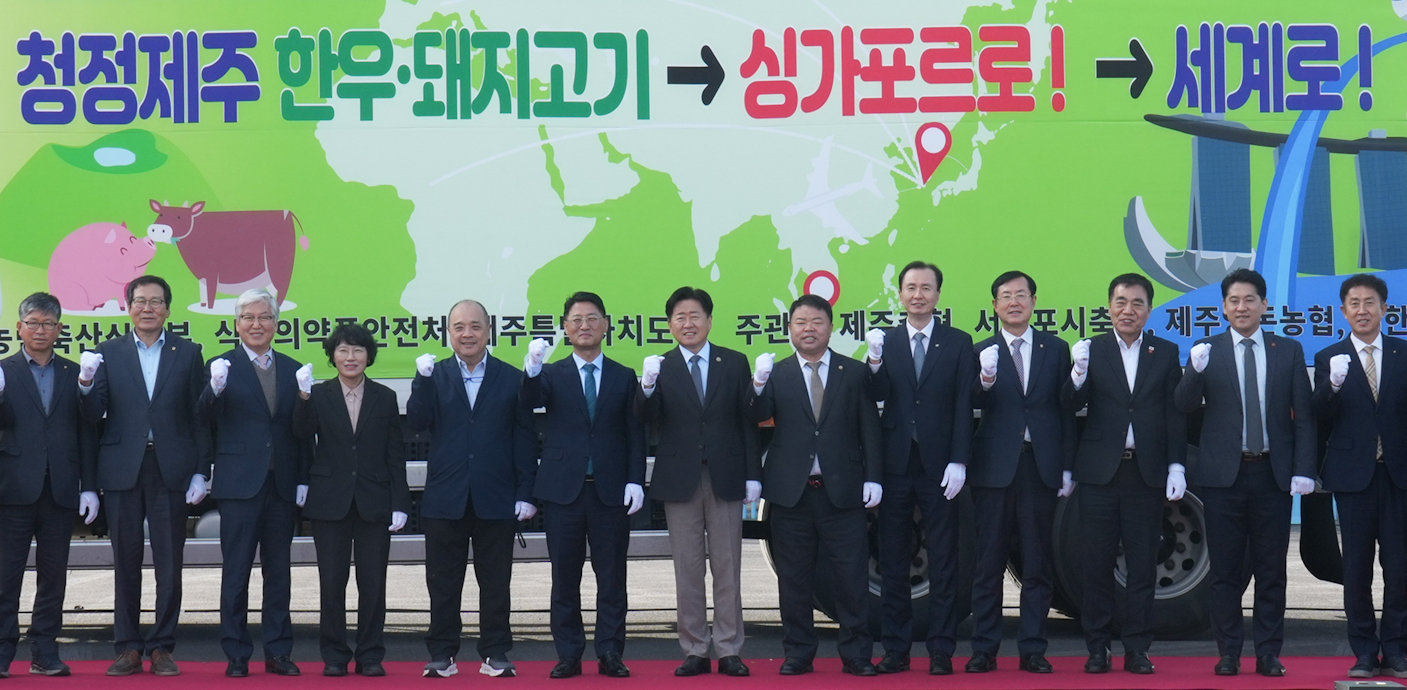
The first shipment ceremony of Jeju beef and pork exports to Singapore held at Jeju Port on the 1st. The initial volume is 4.5 tons (worth approximately KRW 280 million). Provided by Jeju Province
Singapore, where the primary industry accounts for less than 1%, has very stringent standards for the hygiene and quarantine of agricultural and livestock products. Jeju Province has been promoting beef and pork exports since 2014, but issues such as Classical Swine Fever (CSF) have repeatedly arisen, causing setbacks.
Singapore has required the World Organisation for Animal Health (WOAH) certification of a disease-free zone as a precondition for importing Jeju livestock products. The export, which had been stagnant for over a decade, gained momentum when Jeju obtained Foot-and-Mouth Disease-free status at the WOAH General Session in May this year.
The Singapore Food Agency (SFA) also visited Jeju in August to inspect slaughterhouses and processing plants, approving six locations as export facilities. Subsequently, during a summit between President Lee Jae-myung and Singapore Prime Minister Lawrence Wong on the 2nd of last month, the export negotiations for Jeju beef and pork to Singapore were officially concluded.
Jeju beef and pork have embarked on their first export journey to Singapore, a decade after initial attempts to enter the market. Jeju Special Self-Governing Province held a shipment ceremony at Jeju Port on the 1st to commemorate the first export of Jeju beef and pork to Singapore. The export facilities include Jeju Livestock Cooperative (slaughterhouse), Seogwipo City Livestock Cooperative (processing plant), Jeju Pig Farmers Cooperative (slaughter and processing plant), Daehan F&B (processing plant), and Montrock (processing plant), with an initial export volume of 4.5 tons (worth KRW 280 million).
Singapore, ranked 4th globally in GDP per capita, relies heavily on imports for its livestock supply. The meat market is also growing at an average annual rate of 5.5% (from USD 3.1 billion in 2019 to USD 3.9 billion in 2023), and this export is expected to further develop Jeju's livestock production, processing, and distribution system.
Jeju Province is also aiming to resume exports to Japan, which have been suspended since 2010. Jeju was the first in the nation to be recognized as a disease-free zone for livestock infectious diseases in 1999, entering the Japanese market, but exports were halted in 2000 due to nationwide outbreaks of CSF and Foot-and-Mouth Disease (FMD). Although Jeju exports temporarily resumed in 2004 and 2009, they were halted again in 2010. In response, the Ministry of Agriculture, Food and Rural Affairs announced last month a plan to strengthen disease prevention management for pig farming and aims to establish Jeju as a CSF-free zone by 2029.
Oh Young-hoon, Governor of Jeju, stated, “Jeju has become the first and only region in Korea to export beef and pork to Singapore,” adding, “Recognizing the competitiveness of Jeju livestock products, we will actively work on establishing local distribution networks and supporting marketing to expand sales channels.”
Song Seong-ok, Director of the Gwangju Food and Drug Administration, commented, “Exporting our livestock products to Singapore, which has strict import standards, will further enhance the global status of Korea's livestock product safety management system.”
ⓒ dongA.com. All rights reserved. Reproduction, redistribution, or use for AI training prohibited.
Popular News