※ Seoul National University of Science and Technology's Startup Support Group provides promising startups with office space, mentoring, networking, and commercialization support through its Business Incubation Center to aid their growth. 'Startup in Science and Technology University' shares the stories of startups aspiring to leap forward, with the university's Business Incubation Center as their home.
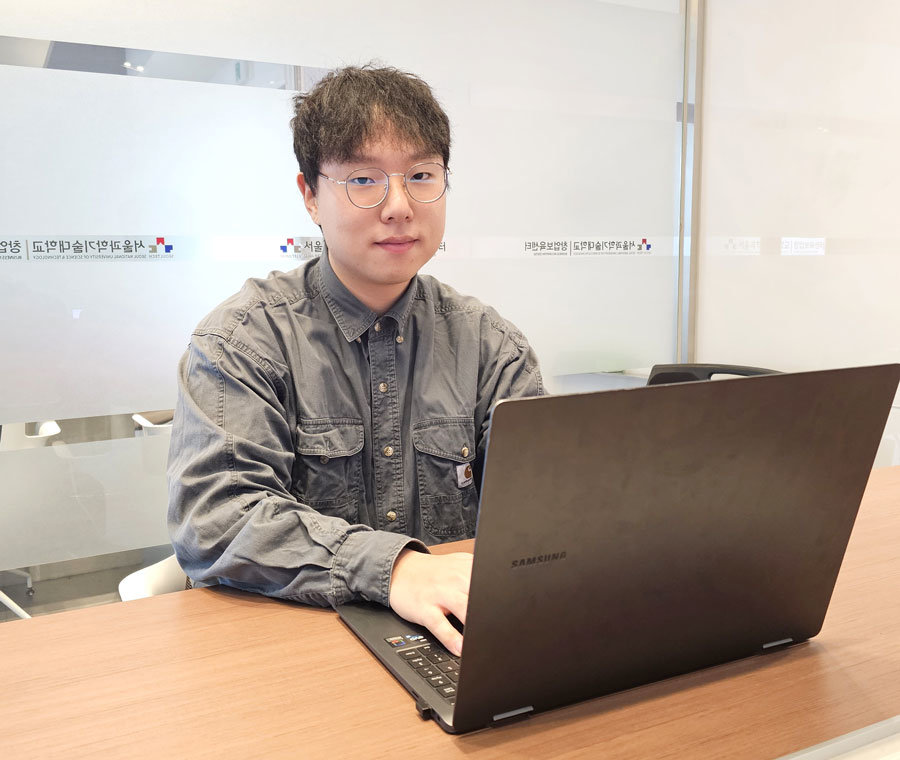
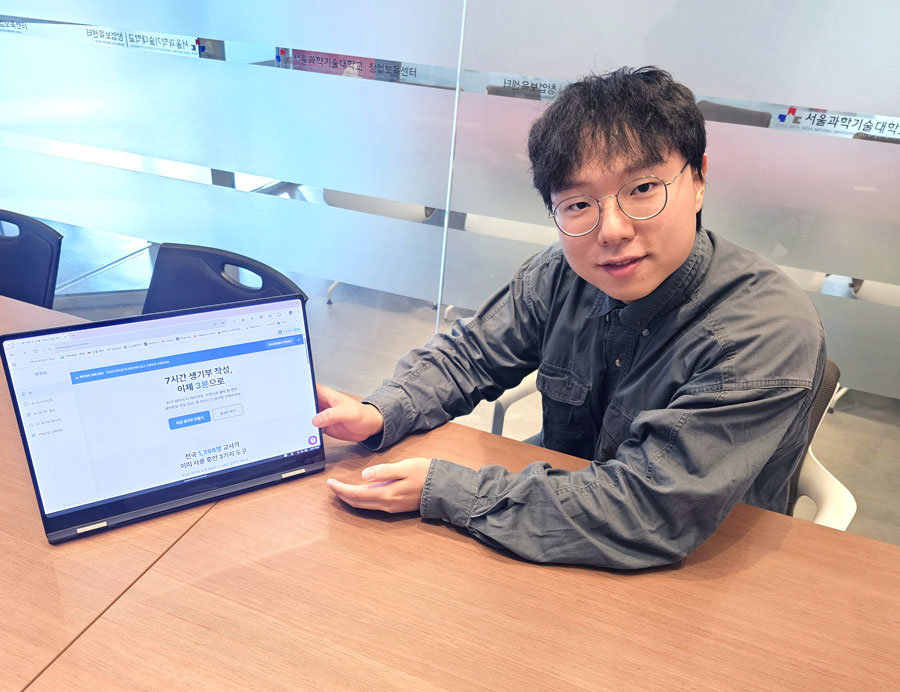
Kang Yeon-gu, CEO of Plactical / Source=IT Donga
The workload for teachers is increasingly burdensome. Particularly, writing student records requires understanding the annually changing guidelines from the Ministry of Education and reflecting each student's characteristics, which demands significant time and effort. Moreover, the process is cumbersome as it requires multiple rounds of review even after completion.
'Plactical (CEO Kang Yeon-gu)' is a startup created to address these challenges faced by teachers. Their developed 'WhatQuiz AI' goes beyond simply generating documents with generative AI; it focuses on verifying the quality of student records written by teachers and suggesting improvements. Their goal is to enhance teachers' work efficiency with AI, ultimately allowing them to dedicate more time to students. The press met with Kang Yeon-gu, CEO of Plactical, to discuss the present and future of WhatQuiz AI.
- The company is specialized in AI services for the education sector, which is intriguing. How did you start in this field? I'm curious about the journey to entrepreneurship.: We are currently developing an AI assistant tool called 'WhatQuiz AI' for teachers. Starting with a startup club during university, we received support from programs like the Preliminary Startup Package and Youth Startup Academy, which helped us build and grow the company.
Initially, we attempted various businesses like coding education apps, mostly in the education sector. As we conducted business, I found that education suited my preferences. Meanwhile, AI emerged as a trend, and since my research field was also AI, I started the current business by combining education and AI. Plactical was established in September 2023, and next year marks our third year.
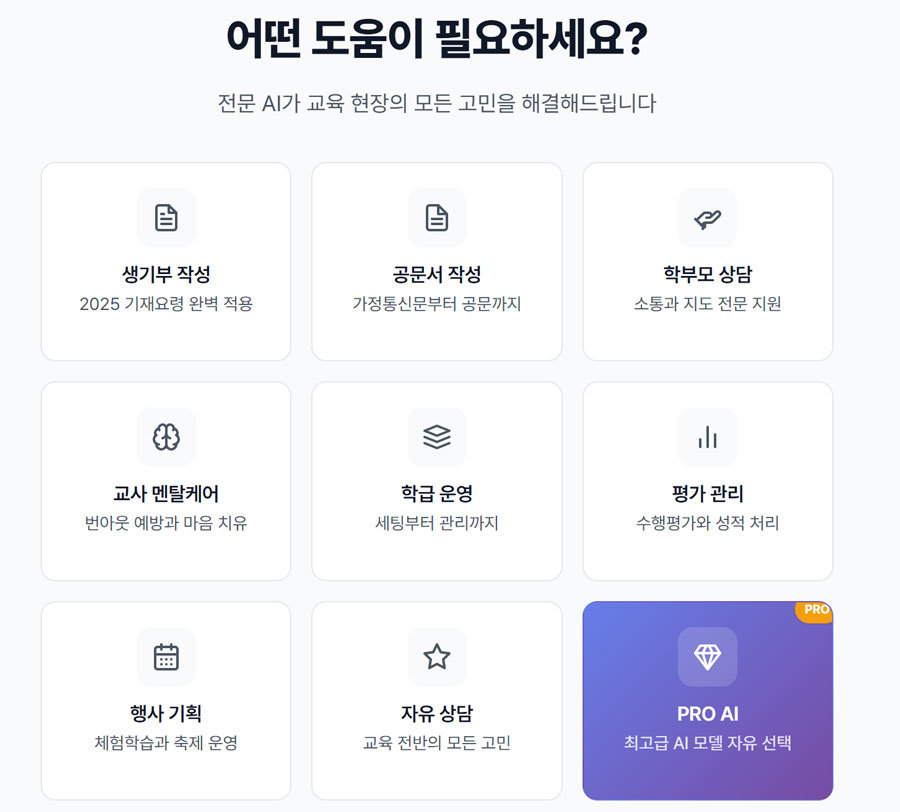
- Educational AI is typically thought of as a learning solution for students, but WhatQuiz AI is developed for teachers, which is interesting. What exactly is the service? Please explain its main features.: Broadly speaking, it is an AI that assists with teachers' administrative tasks. It helps with tasks such as writing official documents, designing and grading performance assessments, and generating and reviewing school life records, which are challenging for teachers.
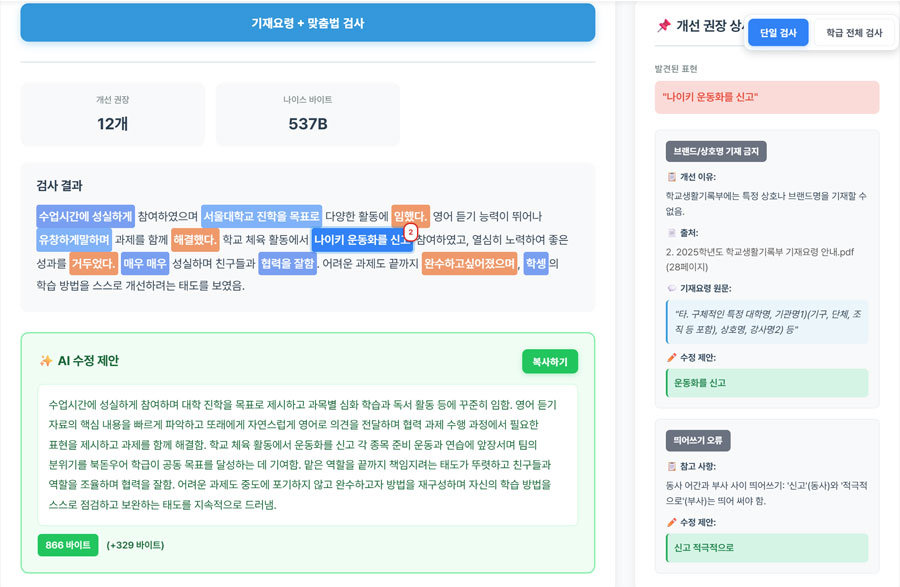
The most well-received feature is generating and reviewing school life records. AI can check the guidelines issued annually by the Ministry of Education. These guidelines exceed 100 pages, making it difficult for teachers to fully grasp them. Our service allows AI to learn these guidelines and automatically check if the created school life records adhere to the regulations and if there are any errors.
Various functions provided by WhatQuiz AI / Source=Plactical
- How is the service used specifically? Is it utilized in a conversational format like typical generative AI services?: As you mentioned, there is a method of communicating in natural language. Those who find it convenient can use it that way. However, since some find it difficult, we also offer a button-click method. Since everyone has different preferences, we have prepared various methods.
For example, if teachers have their school life records in Excel format, they can upload the file, and the AI can review and suggest improvements at once. It's also possible to request reviews by entering one sentence at a time or using a conversational format like "Can you review this sentence?"
Of course, there is also a feature for generating from scratch. However, since such features are already prevalent in other services, we don't consider it our unique differentiation point. Our core focus is on 'verification.'
- Can't similar functions be used in general AI services like ChatGPT?: In fact, our main competitor is GPT. Many teachers are already using GPT. However, the biggest issue with GPT is that it is too global and general-purpose, meaning it doesn't know the latest domestic regulations like the 2025 student record guidelines.
We have accurately trained data specialized for the Korean education field. While GPT's versatility allows it to be used anywhere, this versatility can also be a disadvantage. We differentiate ourselves by being a service exclusively for Korean teachers.
Recently, personalization and customization have become crucial in all services. This trend is not only in AI services but also in clothing, food, and almost every field. Our service reflects this trend by aiming to provide a customized AI service optimized for the work of Korean teachers.
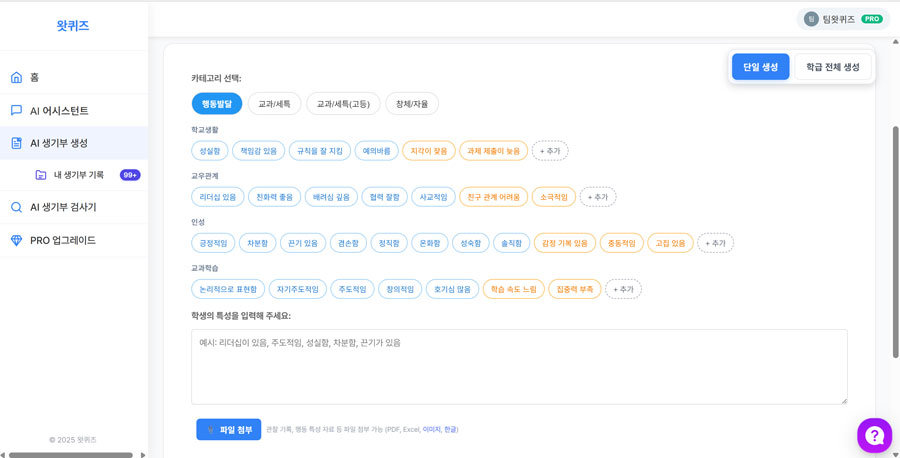
One of the main features of WhatQuiz AI, the school life record generation function / Source=Plactical
- There are already many generative AI-based services in the market. What is the unique differentiation of WhatQuiz AI?: The biggest differentiation is that while most companies focus on 'generation,' we focus on 'verification.' Instead of focusing on how to create better, we focus on how to catch and suggest modifications to what humans have written more precisely.
Teachers have had a negative perception of AI writing for them. However, they have shown a very positive response to AI assisting with what they have written. Originally, teachers conduct reviews of student records with 10 or 20 fellow teachers in multiple rounds. Despite this, mistakes occur, and AI helps simplify this review process.
This helps catch mistakes humans can make and makes student evaluations more objective and high-quality. Ultimately, our goal is to reduce the time teachers spend on reviews so they can dedicate more time to students.
- I'm curious about the technical aspect. Did you develop the AI model yourself, or are you using existing AI?: We did not develop the AI model from scratch. The LLM (Large Language Model) field is already sufficiently advanced, so we utilized existing verified models. We use a multi-LLM approach, applying technology that combines OpenAI's GPT, Anthropic's Claude, and Google's Gemini.
Simply put, we have created our own AI model by selecting only the advantages of existing verified services like GPT, Claude, and Gemini. By complementing each model's weaknesses, we have created results optimized for the work of Korean teachers.
Supports teachers meticulously like a real colleague, enhancing the completeness of the results / Source=Plactical
- To provide truly valuable AI services, a philosophy about AI's essential role is needed. What is the ultimate goal of this service?: AI should not just take away human jobs. It should help people focus on more creative and innovative tasks, which should be AI's ultimate goal. That's what our company aims for.
Therefore, rather than replacing work, we are focusing on making simple labor more quality-oriented and time-saving. By reducing the time teachers spend on reviewing student records, they can communicate and guide students more, which is the value we pursue.
- How is the service structured? Is it built or cloud-based?: It is in the form of SaaS (Software as a Service), meaning it is cloud-based. It is provided as a web service, so no separate setup or installation is required. It can be used quickly anywhere with internet access. It is even available on mobile, allowing teachers to use it conveniently on the go.
We use Google's cloud technology. Google's cloud technology is well-verified in the global market, so it is reliable in various aspects such as stability, security, and scalability. As long as Google is not compromised, it is considered safe.
- I heard the service was officially launched in June this year. What is the response from the field?: We have been continuously updating since the launch. In fact, the service has changed so much that it could be said to be completely different from its appearance in June.
We have organized a teacher advisory group to listen to their opinions monthly, and by actively reflecting this data, new features are added and improved every month. Initially, the focus was on creating test papers or quizzes, but later added features for writing official documents, supporting parent consultations, generating school life records, and recently enhancing the verification function for school life records. All of this is the result of consistent updates.
Customer response is also quite positive. MAU (Monthly Active Users) has increased about 30 times compared to June. In June, there were about 100 users per month, but now about 3,000 are using it. Especially, about 1,000 teachers are the core user group actively utilizing our service.
This growth trend continues every month. Users' responses are positive, and they consistently provide feedback for better service and spread the word to others. It seems a virtuous cycle has been created.
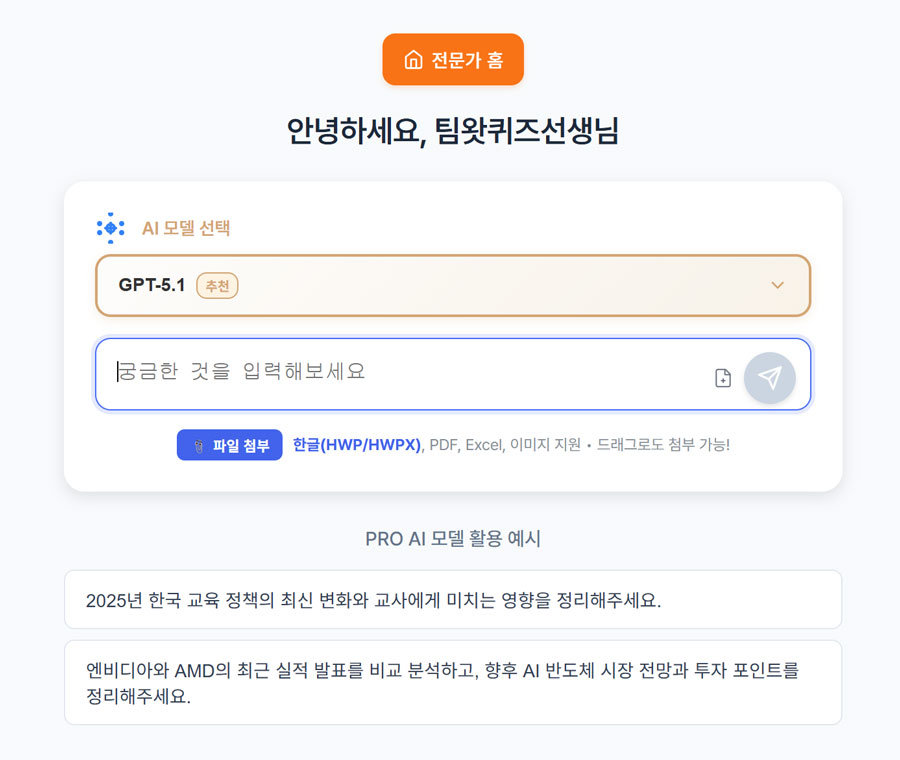
Paid users can also use the latest AI models such as Gemini 2.5 Pro, GPT-5.1, sonnet 4.5 / Source=Plactical
- How is the business model structured? I'm curious about the monetization strategy.: We provide most of the main features for free. By actively reflecting teachers' opinions, most features are available for free.
The difference between free and paid lies in convenience. In the free service, file attachments are not possible, and you have to repeat 10 times to perform 10 tasks. In contrast, with the paid service, you can attach files and process multiple tasks at once.
Additionally, paid customers can freely use the latest AI models such as Gemini 2.5 Pro, GPT-5.1, and sonnet 4.5. This allows for results that reflect relatively more recent trends.
In summary, free users can use the main features without much inconvenience, but those who want better convenience and challenging results choose the paid service. If you want sufficiently verified results, free is enough.
From the company's perspective, this year is more about gathering users and listening to their opinions rather than generating revenue. We expect to start generating significant revenue from the third quarter of next year at the earliest.
If the current trend continues, revenue will naturally be generated. Currently, we are focusing on improving service quality and solidifying the user base.
- Running a startup is not easy. What challenges have you faced, and how are you overcoming them?: Since the first launch in June, the most challenging part has been worrying about "Why aren't customers using this product?" and "Why aren't we growing faster?" Of course, these concerns still exist.
However, I think I found the answer in recent months. By continuously listening to and accepting customer opinions, I experienced the service improving. I realized that customer-centric product development is the answer.
Moving forward without shortcuts or tricks, operating the company based on principles and fundamentals is ultimately the answer. Although it is a textbook method, I learned from experience that it is truly effective.
Kang Yeon-gu, CEO of Plactical / Source=IT Donga
- I heard you are enhancing your specialized capabilities through Seoul National University of Science and Technology's support program. What are your impressions?: Seoul National University of Science and Technology's support program has been particularly helpful in terms of promotion and marketing. For small companies like us, marketing is actually quite costly. We faced difficulties in this area, but receiving help from a large institution was really empowering.
In fact, among startups, there are often cases where they are confident in technology or solution development but relatively less familiar with business operations, especially in marketing. We were the same. Through the university's support program, we were able to communicate with many people and institutions, strengthening our network.
The mentoring program provided by experts was also useful. The opportunity to promote our solution on various platforms and channels was most impressive. I would strongly recommend such programs to other startups.
- Please share your future plans and aspirations.: We will continue to grow as an AI assistant tool platform for teachers. There may be areas where our product is lacking or unsatisfactory. However, since we are growing by listening to teachers' feedback every month, we ask for continued interest in WhatQuiz AI.
Improving and evolving through continuous feedback, that is our identity. We will always strive to be a company that does not settle for the present and continues to develop. We want to give back to teachers with an upgraded service and ultimately contribute to improving the quality of education in Korea.
IT Donga Reporter Kim Young-woo (pengo@itdonga.com)
ⓒ dongA.com. All rights reserved. Reproduction, redistribution, or use for AI training prohibited.
Popular News