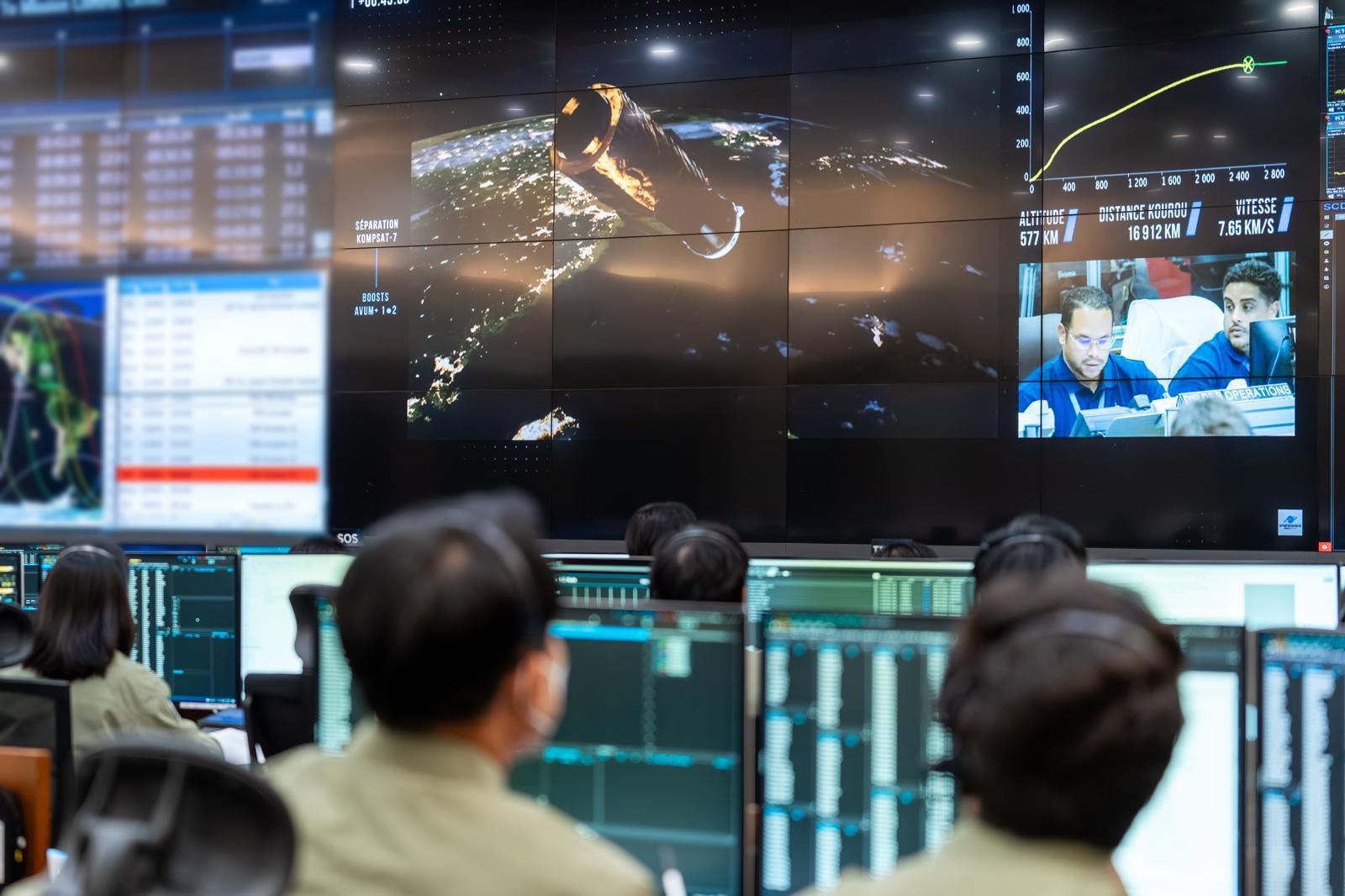
On the 2nd, researchers at the Korea Aerospace Research Institute's Satellite Comprehensive Control Room in Daejeon are conducting control operations for the Multi-Purpose Satellite No. 7. Provided by KARI
The Multi-Purpose Satellite No. 7 (Arirang 7), following the Korean launch vehicle Nuri, was successfully launched and settled into orbit, completing communication with the ground.
The Aerospace Administration and the Korea Aerospace Research Institute announced on the 2nd that Arirang 7 was successfully launched at 2:21 a.m. from the Guiana Space Centre in French Guiana, South America. The local time was 1:21 p.m. on the 1st.
Arirang 7 was launched into space aboard Europe's space launch vehicle 'VEGA-C'. Lee Sang-gon, the project director of the Multi-Purpose Satellite No. 7 at KARI, stated, “The satellite was launched as planned at 2:21:25 a.m., and about 44 minutes later, it separated from the launch vehicle and entered its designated orbit. Approximately 25 minutes after that, it was confirmed to be operating normally.”
Arirang 7 conducted communications sequentially with the southernmost ground station in Antarctica, Troll, followed by the northernmost ground station in Svalbard. After communicating with overseas ground stations about ten times, it successfully communicated with the Daejeon KARI ground station at 1:40 p.m.
This successful launch is evaluated as evidence that Korea's satellite technology has reached a global level. Arirang 7 was developed entirely with domestic technology throughout the entire process of design, assembly, testing, and verification of its system, body, and payload. It is equipped with world-class high-precision observation capabilities. The electro-optical camera (AEISS-HR) can capture ultra-high-resolution images, recognizing objects as small as 30 cm. It can distinguish whether a vehicle on the ground is a compact car or a truck.
Lee Sang-cheol, President of KARI, emphasized, “Arirang 7, successfully launched today as a result of years of investment and effort, is a world-class Earth observation satellite. It is significant that we can obtain high-precision satellite imagery for precise map-making, land management, and disaster response through our own capabilities.” The images sent by Arirang 7 are expected to be utilized in earnest from the second half of next year.
Meanwhile, the Aerospace Administration and KARI announced that they successfully communicated with 9 out of 12 CubeSats launched through the fourth launch of Nuri. Nuri successfully launched on the 27th of last month, carrying the Next-Generation Medium Satellite No. 3 and 12 CubeSats as secondary payloads, placing all 13 satellites into a 600 km orbit.
On the day of the launch, successful communications were established with five satellites: ETRI-SAT (Electronics and Telecommunications Research Institute), JACK-003 and JACK-004 (CosmoWorks), Inha-ROSAT (Inha University), and K-HERO (KAIST). On the 28th, three more satellites, SPIRON (Sejong University), COSMIC (Ujurotech), and Sejong 4 (Hancom InSpace), successfully communicated for the first time, followed by SNUgLite-3 (Seoul National University) on the 29th.
The satellites that have not yet established initial communication are EEE Tester-1 (KARI), PURSAT (Quaternion), and V-1000 (SpaceLynx). Continuous attempts will be made to communicate with these satellites.
ⓒ dongA.com. All rights reserved. Reproduction, redistribution, or use for AI training prohibited.
Popular News