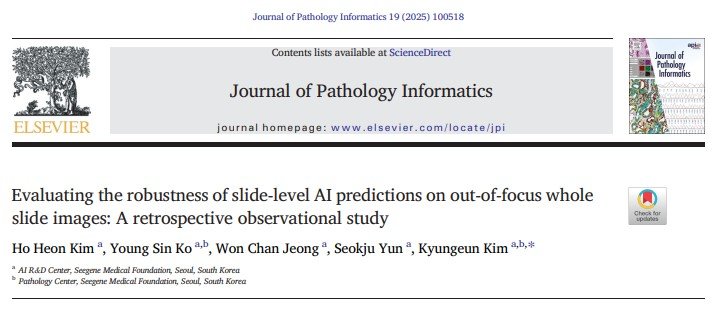
A paper by researchers from Seegene Medical Foundation has been published in an SCI(E)-level international academic journal. Provided by Seegene Medical Foundation
Seegene Medical Foundation, a specialized medical institution for disease testing, announced on the 1st that a research paper involving AI Research Institute researcher Kim Ho-heon, Senior Pathology Deputy Director and Acting Research Director Ko Young-shin, and Pathology Deputy Director and Chief Medical Officer Kim Kyung-eun has been published in an SCI(E)-level international academic journal.
The paper, titled "Evaluation of Focus Blur in Slide Images and AI Prediction Performance: A Retrospective Observational Study," involving researchers from Seegene Medical Foundation's AI Research Institute, was published in the November 2025 issue of the 'Journal of Pathology Informatics.'
Seegene Medical Foundation has introduced and is operating the SeeDP (Seegene Digital Pathology), a quality management system for histopathological diagnosis. Through this system, AI conducts a secondary review of the pathologist's interpretation results to detect potential diagnostic errors early and prompt re-evaluation. This aims to enhance diagnostic accuracy and improve consistency. Currently, the service has been expanded to include AI-based histopathological diagnosis for the top 10 cancers.
The core of this study is to understand how frequently occurring slide focus defects, specifically partial blurring, in actual histopathological diagnosis settings affect the final slide-level predictions of pathology AI models. It has gained attention for systematically verifying this using various scanners and AI models.
The research team retrospectively analyzed 7,529 slide images generated by two types of organs and two types of scanners, along with the prediction values of four types of pathology AI models processing these images. The results confirmed that there was no significant difference in prediction concordance at typical levels of blurring.
Additionally, the research team confirmed that there was no statistically significant correlation between the ratio of blurred areas and prediction discrepancies. Particularly, in additional experiments using Z-stack (a set of photos taken at various focal points), it was found that even with a focus plane deviation of about ±6㎛, the interpretative accuracy of AI slides was maintained, indicating that the representation itself was well preserved.
Thus, the research team confirmed through actual data that commonly observed focus blurring does not significantly degrade the diagnostic performance of slide-level pathology AI, except in extreme cases. This suggests that AI can be used stably without relying excessively on image quality selection or AI development for focus blur restoration.
Chun Jong-ki, Chairman of Seegene Medical Foundation, stated, "We will continue to contribute to the popularization of AI-based precision medicine and the establishment of global standards through empirical research and technological innovation that can be directly applied in clinical settings."
ⓒ dongA.com. All rights reserved. Reproduction, redistribution, or use for AI training prohibited.
Popular News