In January 2017, at the Consumer Electronic Show (CES) 2017 held in Las Vegas, USA, the South Korean startup 'Mangoslab' received the Best Innovation Award, drawing global attention. The product they showcased was the portable printer 'Nemonic,' which prints memos written on smart devices onto sticky notes. The industry praised this product for 'maximizing the advantages of digital and analog while naturally integrating them.'
Nine years later, in 2026, Mangoslab once again claimed the honor of the CES Best Innovation Award. This time, they introduced the AI portable braille printer 'Nemonic DOT,' which helps anyone easily print and use braille. This product is expected to go beyond integrating the advantages of digital and analog, breaking down the barriers between disability and non-disability.
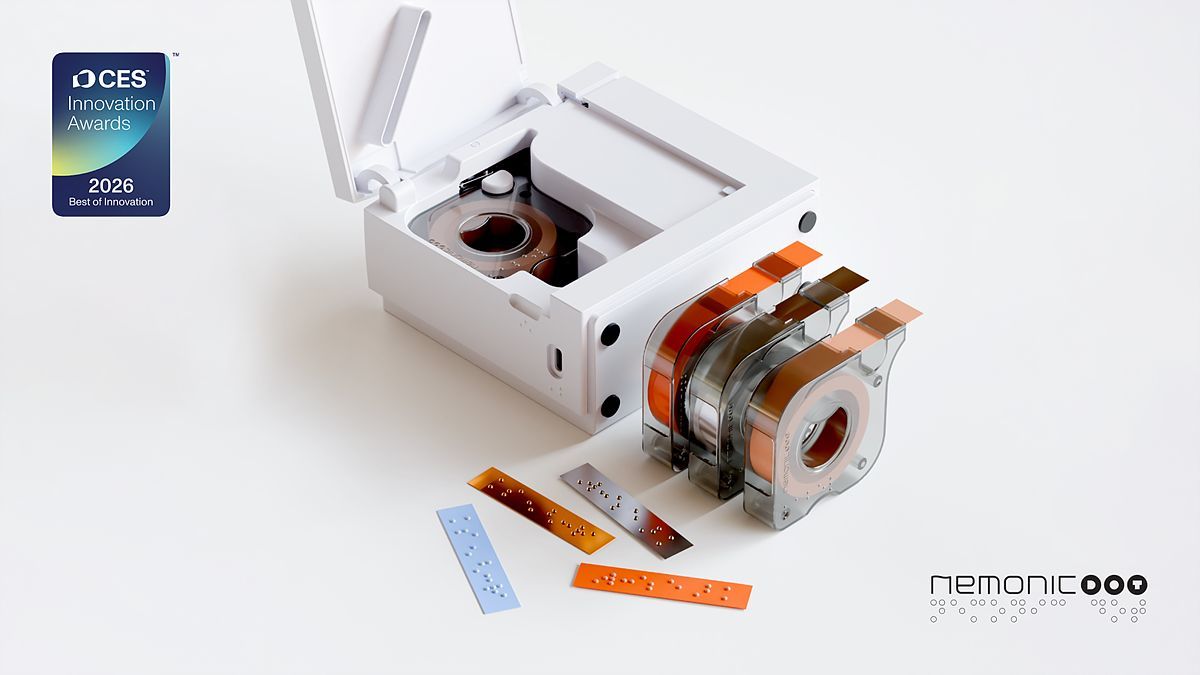
Mangoslab Nemonic DOT, winner of the CES 2026 Best Innovation Award / Source=Mangoslab
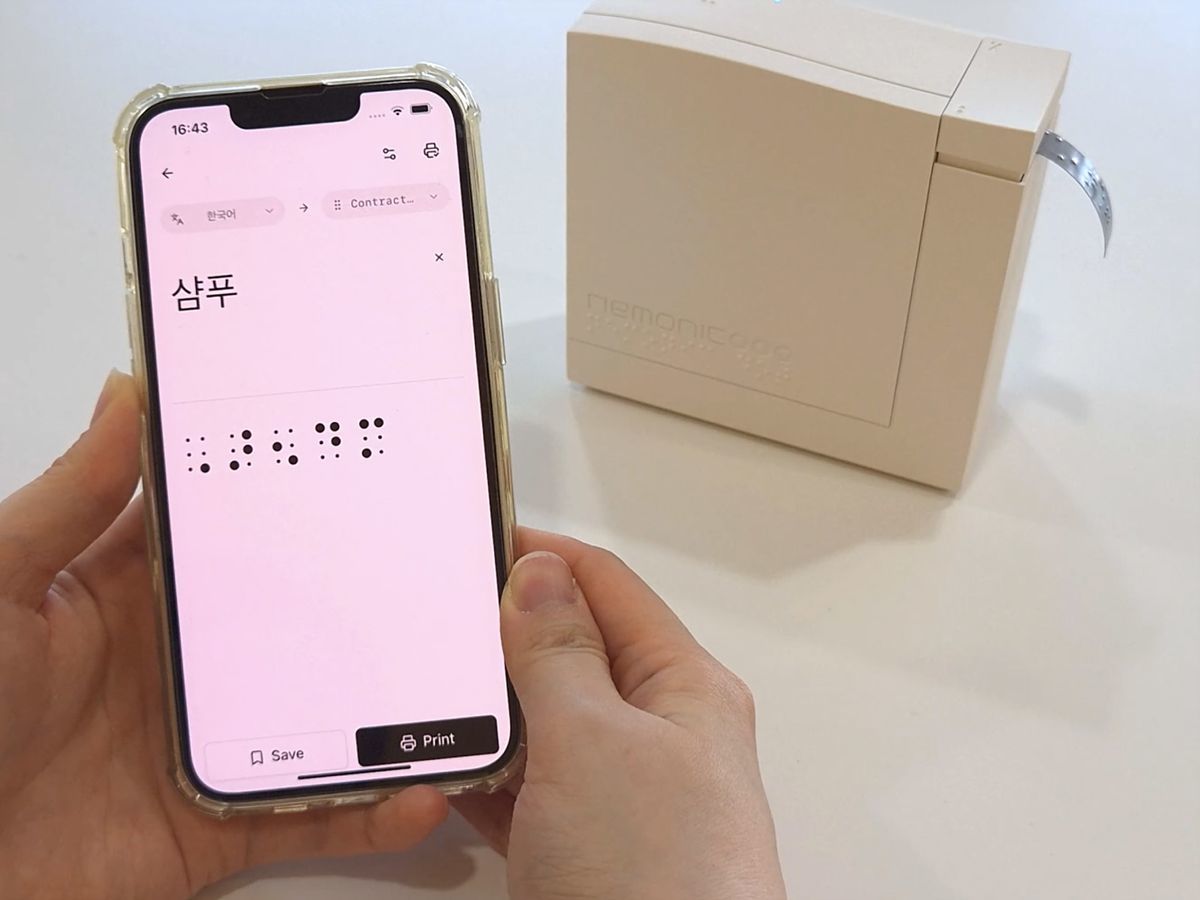
The appearance of the Mangoslab Nemonic DOT resembles a portable photo printer. However, its usage and output are quite unique. After installing the app with the same name on a smart device, users can 'speak' the word to be printed, and Nemonic DOT automatically converts the word into 'braille' and prints it on 'various papers.' The dedicated app is also activated by voice.
Previously, there were portable braille printers, but they had many inconveniences. First, the control system was in braille, so only those who knew braille could use it. Similarly, due to the limitations of the control system, it was impossible to input the 8-line braille used in some countries. The method involved printing braille on paper, but the height of the printed braille often did not reach the national average of 0.6mm, making it difficult to read or prone to damage during use.
Nemonic DOT prints braille by recognizing voice / Source=Mangoslab
In contrast, the Mangoslab Nemonic DOT allows words to be input for printing without a control system, using voice. It is usable not only by the visually impaired but also by those who do not know braille at all. It supports both the widely used 6-line and 8-line braille and can print on metal labels as well as plastic. With a uniform braille height of 0.6mm, it is easy to read.
What motivated Mangoslab to conceive and develop Nemonic DOT? CEO Jung Yong-soo of Mangoslab conceived a new product combining a braille printer and Nemonic after seeing the second Braille Development Basic Plan by the Public Procurement Service in 2023. This idea became clearer after meeting pharmacist Lee Cheol-hee, who is also a braille translator and proofreader. Lee Cheol-hee was involved in activities to attach braille labels to medicines and donate them for the visually impaired. Although there were regulations for braille labeling on medicines, the braille often got damaged during distribution, making it difficult for the visually impaired to read.
CEO Jung Yong-soo of Mangoslab introducing Nemonic DOT / Source=Mangoslab
Pharmacist Lee Cheol-hee has always insisted that braille labels should be attached not only to over-the-counter medicines but also to prescription drugs. Some prescription drugs have ingredients that should not be touched, but the visually impaired cannot distinguish them. Caregivers or family members are not always with the visually impaired. Therefore, braille labeling is essential for the visually impaired to safely take medication. To attach braille labels to dispensed drugs, pharmacists had to print braille themselves. Moreover, existing braille printers were not compatible with pharmacy computer systems, meaning pharmacists needed to know braille. Lee Cheol-hee realized that the existing system had limitations in providing medication guidance.
Subsequently, CEO Jung Yong-soo realized the necessity of an easy-to-use braille printer for both pharmacists and the visually impaired. The visually impaired use braille labels not only for dispensed drugs but also for distinguishing everyday items like cooking spices and cosmetics. The same applies to apartment entrance doors, stairs, and wall pads. However, the performance of braille printers for these purposes was unsatisfactory. The most critical issue was that creating braille labels required knowledge of braille, making it difficult for caregivers or non-disabled individuals to create braille labels.
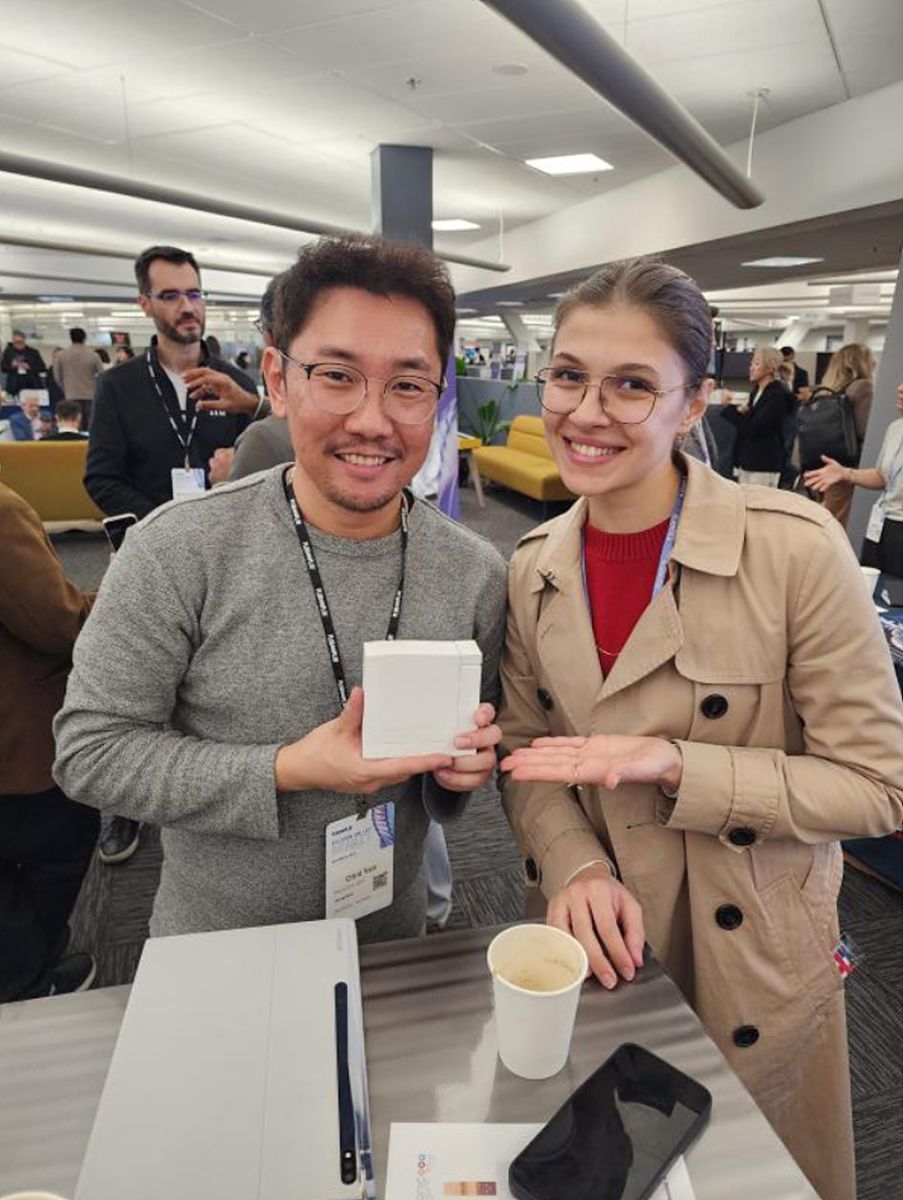
Mangoslab introducing Nemonic DOT at the Plug and Play Summit / Source=Mangoslab
Recognizing the market demand for portable braille printers, CEO Jung Yong-soo solidified the concept of Nemonic DOT. It is a product that helps anyone, whether they know braille or not, easily print braille and attach it to dispensed drugs, everyday items, and various indoor and outdoor locations. It is a product useful for both the visually impaired and non-disabled individuals. He then identified related patents and competing products and devised the structure of Nemonic DOT.
The employees of Mangoslab, including CEO Jung Yong-soo, have extensive experience researching software in Samsung Electronics' Wireless Business Division and printing structures in the Printing Business Division. This led to the development of Nemonic DOT's unique AI natural language voice recognition and braille code conversion functions, as well as its unique braille printing function inspired by automotive engine structures.
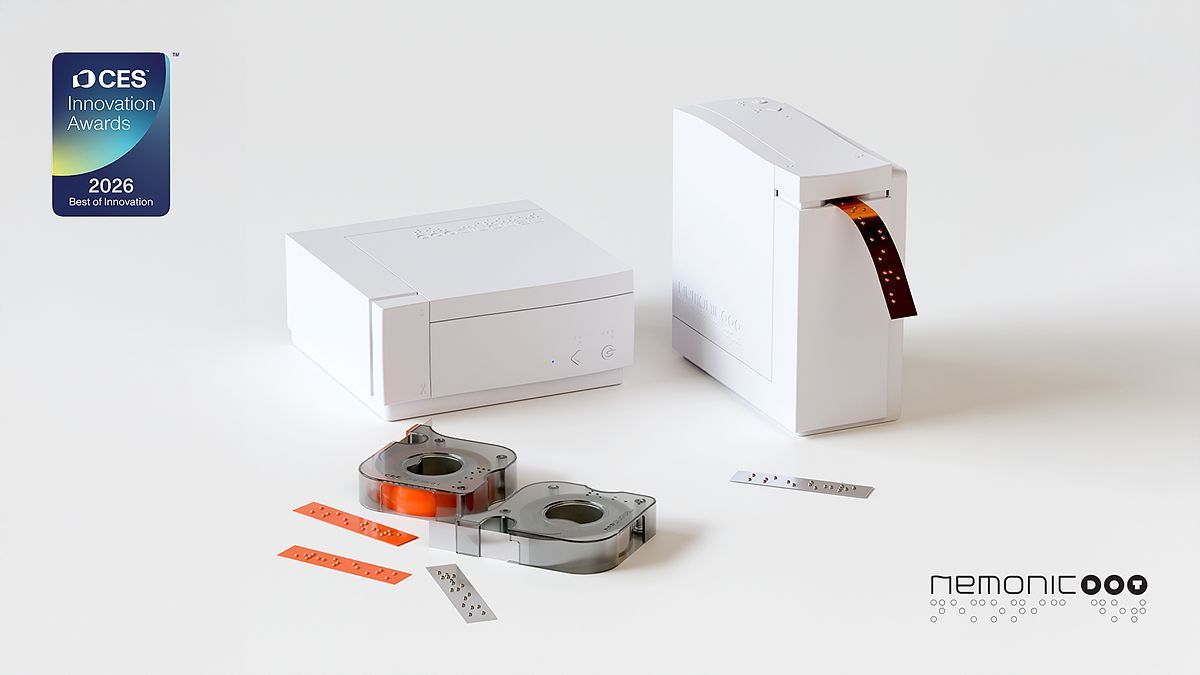
The Mangoslab Nemonic DOT is compact. It has a built-in battery, allowing users to carry it around and conveniently print braille labels whenever needed. It can print braille on plastic and metal (non-toxic copper material) labels. Braille labels for entrance doors or outdoor structures need to be durable. Paper labels are easily damaged, but plastic or metal labels are sturdy and can be used for a long time. The height of the braille print is also high, reducing the risk of damage and making it easy to read.
Nemonic DOT prints braille by recognizing voice / Source=Mangoslab
Most importantly, this product allows anyone to print braille using only their voice. It is not only easy to use but also usable by those who do not know braille at all. Of course, users can also type in the dedicated app to print braille labels. It is expected to naturally expand the scope of braille usage.
As a winner of the Best Innovation Award, Mangoslab will exhibit Nemonic DOT at CES 2026. They will also set up an exhibition booth at the CES Seongnam Pavilion in collaboration with Seongnam City. Furthermore, they aim to officially launch this product in both domestic and international markets in the first half of 2026. CEO Jung Yong-soo primarily targets pharmacies, hospitals, and public institutions. Pharmacies equipped with the Mangoslab Nemonic DOT will help visually impaired individuals take medication more easily by adding braille to dispensed drugs, as previously mentioned. The same applies to patient medication guidance and patient information braille labeling in hospitals. Mangoslab Nemonic DOT will also be effective in public institutions that need to ensure accessibility for the visually impaired. It allows for easy printing and attachment of braille labels to objects or spaces at any time.
Mangoslab plans to open the API of Nemonic DOT to ensure smooth integration with existing systems. This will bring the distinctiveness of braille labels to all industrial sectors using labels, such as retail, logistics, and inventory management. It will also play a role in adding braille to apartment entrance doors, wall pads, and kiosks.
Mangoslab Nemonic DOT, winner of the CES 2026 Best Innovation Award / Source=Mangoslab
Mangoslab plans to distribute Nemonic DOT globally to usher in a new era of braille. It envisions a time when anyone can create braille as needed and use it easily, with braille being used as a common language, eliminating the barriers between the visually impaired and non-disabled individuals. To achieve this, they aim to make Nemonic DOT a medium that helps integrate braille into the social infrastructure of Korea and beyond.
CEO Jung Yong-soo stated, "Mangoslab Nemonic DOT is an innovative product that transforms braille from an auxiliary tool into an everyday language. We will distribute this product in Korea and worldwide to enhance accessibility for the visually impaired. Furthermore, we aim to create a world where braille is not an act of consideration but a standard of everyday life, an everyday language."
ⓒ dongA.com. All rights reserved. Reproduction, redistribution, or use for AI training prohibited.
Popular News