[SeoulTech x IT Donga Joint Planning] The Preliminary Startup Package Support Project (hereinafter referred to as the Preliminary Startup Package) is a major startup support project by the Ministry of SMEs and Startups and the Korea Institute of Startup & Entrepreneurship Development, aimed at assisting the launch of promising ideas. The Startup Support Group at Seoul National University of Science and Technology will serve as the host institution for the 2025 Preliminary Startup Package, aiding the growth and development of new companies. IT Donga, in collaboration with the SeoulTech Startup Support Group, examines the promising startups that are currently growing.
Quantum computers are computers capable of faster computation than traditional computers by utilizing the principles of quantum mechanics. Quantum computers are largely divided into superconducting-based and optical-based systems, depending on the method of implementing quantum characteristics. Overseas, research in each area is actively progressing. However, the domestic quantum computer industry is focused on superconducting-based quantum computers. Dongwook Cheon, CTO of OptiQLabs, points to the domestic research culture, which is sensitive to trends and emphasizes marketability, as the cause.
To improve this research culture, CTO Dongwook Cheon co-founded OptiQLabs, a specialized company in optical-based ion trap quantum computers, with CEO Sungjae Jung. Based on the technical skills he accumulated while working as a researcher in Japan for a long period, he is developing a laser system, a core component of ion trap quantum computers. OptiQLabs aims to develop ion trap quantum computers with its own technology, contributing to the activation of the domestic ion trap quantum computer field.
CTO Dongwook Cheon was interviewed about ion trap quantum computers, the domestic research environment, and OptiQLabs' laser system.
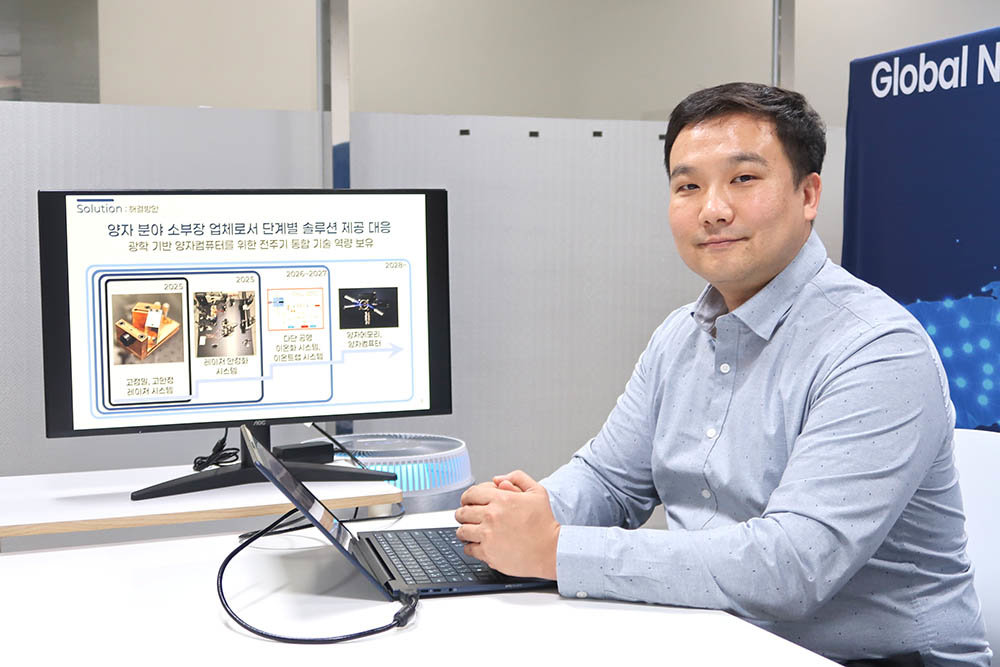
Dongwook Cheon, CTO of OptiQLabs / Source=IT Donga
Founded to Activate the Domestic Ion Trap Quantum Computer IndustryIT Donga: Hello, CTO Dongwook Cheon. Please introduce yourself first.
CTO Dongwook Cheon: Hello, I am Dongwook Cheon from OptiQLabs. I pursued a master's degree in Electrical and Electronic Engineering at Sungkyunkwan University and worked as a researcher at the Korea Institute of Science and Technology (KIST) for about three years. In 2013, I went to Japan as a scholar of the Ministry of Education, Culture, Sports, Science and Technology and obtained a Ph.D. in Nuclear Engineering from the University of Tokyo. Subsequently, I worked as a postdoctoral researcher in Nuclear and Electrical Engineering at the University of Tokyo and as a special researcher at the Japan Atomic Energy Agency (JAEA). My main research areas are ionization systems, ion traps, and optical systems.
However, due to a personal injury, I returned to Korea for physical and mental treatment. Initially, I planned to go back after treatment, but due to the COVID-19 pandemic and family encouragement, I decided to settle in Korea.
IT Donga: What led you to join OptiQLabs?
CTO Dongwook Cheon: After deciding to settle in Korea, I searched for jobs related to ion trap quantum computers, my field of expertise. However, it was not easy because the Korean quantum computer industry is focused on superconducting quantum computers. Students researching ion trap-related fields were also worried about their future after graduation. I wanted to address the issues I felt in the Korean quantum computer industry. However, the domestic startup ecosystem was unfamiliar to me due to my long overseas stay. Then, I met CEO Sungjae Jung, and after discussing, we found common ground and co-founded OptiQLabs.
Ion Trap Quantum Computers: High Stability and Operable at Room TemperatureIT Donga: Ion trap quantum computers are somewhat unfamiliar. Could you explain what they are?
CTO Dongwook Cheon: Quantum computers are computers that process information using the principles of quantum mechanics. The basic unit of information processing in traditional computers is the bit, which can only have values of 0 and 1. By controlling these in specific patterns, repetitive calculations are performed quickly. In contrast, the basic unit in quantum computers is the qubit, which uses quantum characteristics such as positive (+), negative (-), and superposition states. These are defined as 0, 1, and intermediate states, and operations are performed using them. Because three states are used, quantum computers are faster than traditional computers. They offer superior performance in terms of computational load, result derivation time, and energy consumption during the derivation process.
Quantum computers are largely divided into superconducting-based and optical-based systems, depending on the method of implementing quantum characteristics. Ion trap quantum computers use optical technology, where atoms are ionized through methods such as high heat, high-energy collisions, and laser resonance, then trapped in a radio frequency (RF) electromagnetic field, and quantum characteristics are implemented by controlling the ion state with lasers.
Ion trap quantum computers are more stable than superconducting quantum computers because they control ionized atoms with lasers. Additionally, unlike superconducting quantum computers that require maintaining an ultra-low temperature environment, they can operate at room temperature, allowing for immediate system operation.
Of course, there are disadvantages. The system size, efficiency, and technical difficulty vary depending on the ionized elements and ion generation methods. Maintaining the appropriate state of the electromagnetic field for the ion trap is not easy, and the system size is relatively large due to the use of multiple laser systems.
CTO Dongwook Cheon explaining ion trap quantum computers / Source=IT Donga
IT Donga: You mentioned earlier that research on ion trap quantum computers is not active in Korea. What is the reason?
CTO Dongwook Cheon: Compared to foreign countries, quantum computer-related research in Korea is concentrated on superconducting quantum computers. The manufacturing production system is also tailored to this area. I believe this concentration is due to the Korean research environment and ecosystem being sensitive to trends and emphasizing marketability. This is why research on ion trap quantum computers has not been activated.
The same applies to optical technology related to ion trap quantum computers. Optical technology does not directly apply to specific industrial sites but serves as a stepping stone to lead other industries or research to a higher level. Therefore, it seems to receive less attention or focus compared to other fields.
OptiQLabs Laser System with 100kHz LinewidthIT Donga: After hearing the explanation, I'm more curious about OptiQLabs. What kind of company is OptiQLabs?
CTO Dongwook Cheon: OptiQLabs is a company specializing in optical-based ion trap quantum computers. Our ultimate goal is to produce ion trap quantum computers with our own technology. For this, a highly stable laser system capable of precisely controlling ion qubits is necessary. Therefore, we are first developing a highly stable, narrowband high-precision laser system.
OptiQLabs Laser System MVP / Source=IT Donga
IT Donga: Please introduce the OptiQLabs laser system.
CTO Dongwook Cheon: Laser systems are largely divided into gas, crystal vibration, and semiconductor-based diode methods depending on the light source generation method. We are developing a laser system based on the semiconductor diode method. By increasing laser output through mirror reflection, it is easier to control wavelengths compared to other methods. Although it is more challenging to implement than other methods, it has various advantages such as system size, cost, customization, and output wavelength stability.
Particularly, the ability to reduce linewidth is a strength. Using this, we have reduced the laser linewidth to 100kHz. This is a level similar to the linewidth of commercially available laser systems for ion trap quantum computers. We aim to reduce it to several tens of kHz and eventually to a few kHz. Having experienced the production and control of laser systems in related fields during my research days, I believe it is fully achievable.
IT Donga: What is the current development stage?
CTO Dongwook Cheon: We completed the development and internal testing of the Minimum Viable Product (MVP) last September, and we are currently working on system upgrades and packaging based on the MVP. We are producing two types of laser systems, 'IonSeed-G001' and 'IonSeed-IF001'.
IonSeed-G001 is a basic laser system with a simple structure that is easy to implement compared to other systems. IonSeed-IF001 divides the wavelength handling area and laser output enhancement area, generating more stable wavelengths and allowing fine adjustments compared to existing laser systems. It is suitable for ionization and ion trap parts.
In addition, we are building a network and ecosystem for component procurement in the domestic environment, major component production, and not only the laser system but also a stabilization system that controls laser wavelengths.
IT Donga: You are currently receiving support from the SeoulTech Preliminary Startup Package Scale-up Program. What kind of support have you received?
CTO Dongwook Cheon: As a technology-based startup, we lack professional knowledge in non-technical areas such as business operations and management. SeoulTech provides comprehensive support for the shortcomings of early-stage startups like us. Networking related to investment, education on patents and IR, and preparation of materials have been particularly helpful. By participating in various programs at SeoulTech step by step, we have been able to grow significantly.
CTO Dongwook Cheon explaining OptiQLabs laser system / Source=IT Donga
IT Donga: Lastly, please tell us about OptiQLabs' future plans.
CTO Dongwook Cheon: By 2026, we aim to develop not only the laser system and laser stabilization system but also the ionization system. Through this, we plan to supply laser systems to domestic and international research institutions and global manufacturers related to ion trap quantum computers. By 2027, we aim to establish an ion trap system with our own technology, and by 2030, our goal is to directly produce ion trap quantum computers. Through this, we aim to grow into a specialized company in ion trap quantum computers recognized in the global market.
Moreover, we hope that our growth will lead to the activation of research in ion trap quantum computers or optical-related industries in Korea. We hope that through this, talented individuals in related fields will have ample opportunities to grow in Korea. Quantum computer technology is already close at hand. We hope that active interest and investment in the quantum computer industry will continue, just as with artificial intelligence (AI).
IT Donga Reporter Manhyuk Han (mh@itdonga.com)
ⓒ dongA.com. All rights reserved. Reproduction, redistribution, or use for AI training prohibited.
Popular News