Interview with Han Jae-hong, Director of KAIST Space Research Institute
Aiming for Korea's first space debris removal technology
High utility in satellite manipulation and neutralization
Requires advanced technology and workforce stabilization
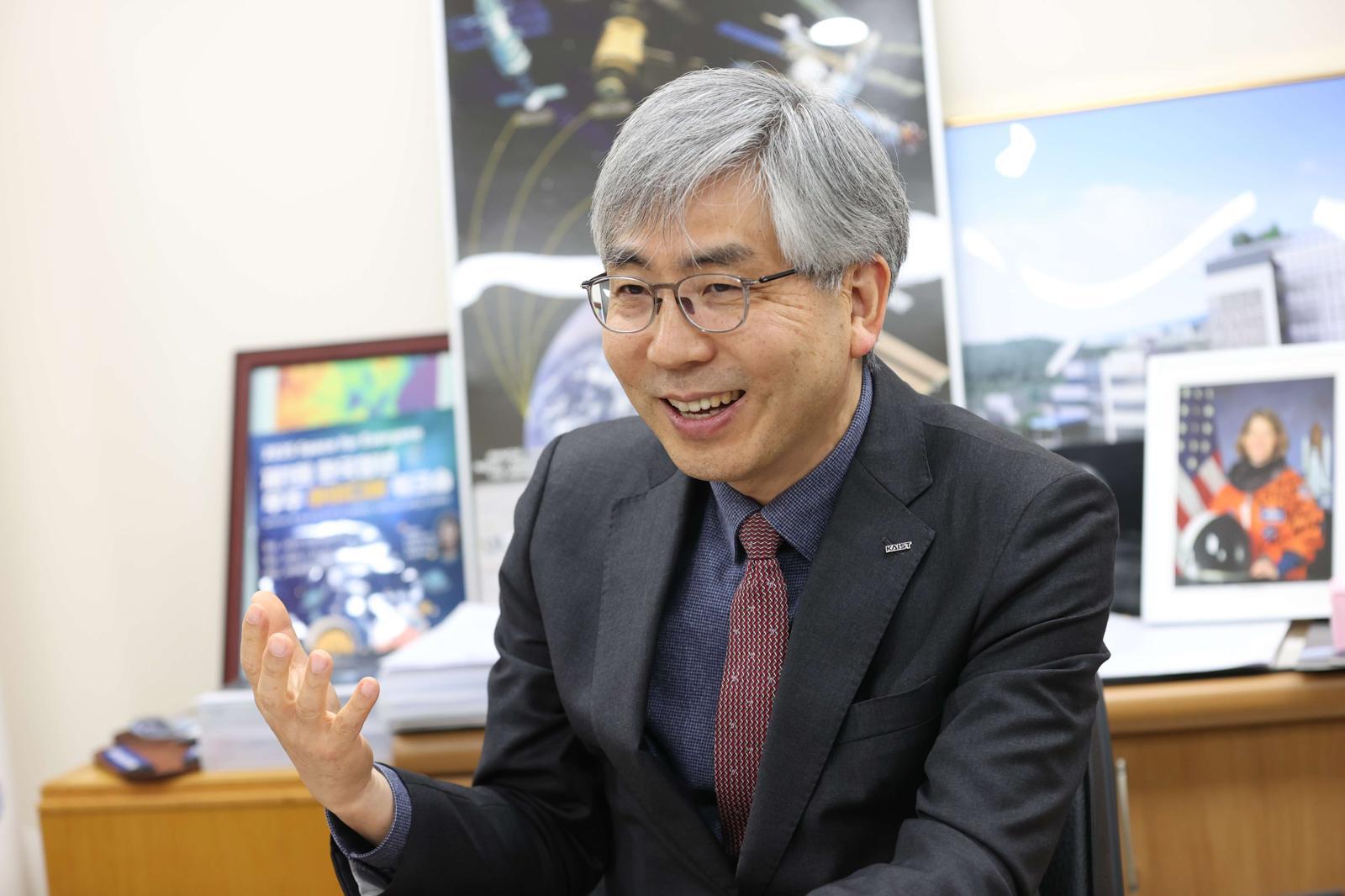
On the 25th of last month, Han Jae-heung, Director of the KAIST Space Research Institute, stated at KAIST in Daejeon that they will continue challenges like the KITSAT-1 based on the accumulated knowledge and technology in space, physics, quantum, and artificial intelligence (AI) at KAIST. Provided by KAIST
“South Korea's first satellite, ‘KITSAT-1,’ was born at the KAIST Satellite Technology Research Center, the predecessor of the KAIST Space Research Institute. At that time, it was a challenge to develop the country's first satellite. Now, the KAIST Space Research Institute, which opened just over a year ago, will once again design and execute challenging space missions such as developing space debris removal technology (active control technology) and asteroid exploration.”
On the 25th of last month, Han Jae-heung, Director of the KAIST Space Research Institute, stated at KAIST in Daejeon that they will continue challenges like the KITSAT-1 based on the accumulated knowledge and technology in space, physics, quantum, and artificial intelligence (AI) at KAIST. The goal is to become an integrated platform that connects the Space Aviation Administration (Space Agency), research institutions, and industry, conducting core technology research, demonstration, and talent cultivation. The KAIST Space Research Institute was launched in September last year, centered around the KAIST Satellite Technology Research Center, to consolidate KAIST's space technology development capabilities.
The KAIST Space Research Institute consists of the Satellite Technology Research Center, the Space Technology Innovation Talent Development Center, the Space Service and Manufacturing Research Center (ISMRC), and the Space Cybersecurity Research Center.
Director Han stated, “I believe it is time for South Korea to undertake challenging space missions,” and introduced that “space debris removal technology (active control technology) development, asteroid exploration, space service and manufacturing orbital infrastructure construction, and high-performance, high-efficiency space mobility technology are the strategic technologies the Space Research Institute will focus on in the future.”
The institute will first secure space debris removal technology, a first in the country. Space debris removal technology involves collecting or removing defunct satellites and launch debris floating in Earth's orbit. It can prevent satellite collision risks and be used to move satellites to desired orbits or capture and neutralize satellites in space, making it a technology that can be converted into a strategic and military tool. A satellite developed by applying space debris removal technology, which approaches and captures target objects with four robotic arms, will be launched on the 6th Nuri rocket launch in 2027 to verify the technology.
Director Han stated, “To operate space debris removal technology, high-level science and technology are needed, such as navigation that can approach within a few meters of the target, robotics that accurately captures the target, and mathematics and dynamics that approach the optimal orbit using minimal fuel,” and added, “KAIST has been developing this since 2020, and the technology level is high.”
The institute will also focus on space service and manufacturing research centered around ISMRC. The goal is to establish the concept of a Korean-style unmanned space station and orbital platform and secure next-generation space pioneering core technologies such as robotics-based space manufacturing and material retrieval.
The KAIST Space Research Institute finds it difficult to increase its staff due to institutional constraints, with about two-thirds of the current 60 personnel being non-regular employees. Director Han emphasized the need for stable personnel as challenging missions are set. Having taught students as a professor in the Department of Aerospace Engineering at KAIST since 2003, Director Han explained, “I will create a space workforce training system that can educate through practice that there are diverse missions beyond the ‘fear education’ of adhering to security regulations and large dangerous projects in the space field.”
ⓒ dongA.com. All rights reserved. Reproduction, redistribution, or use for AI training prohibited.
Popular News