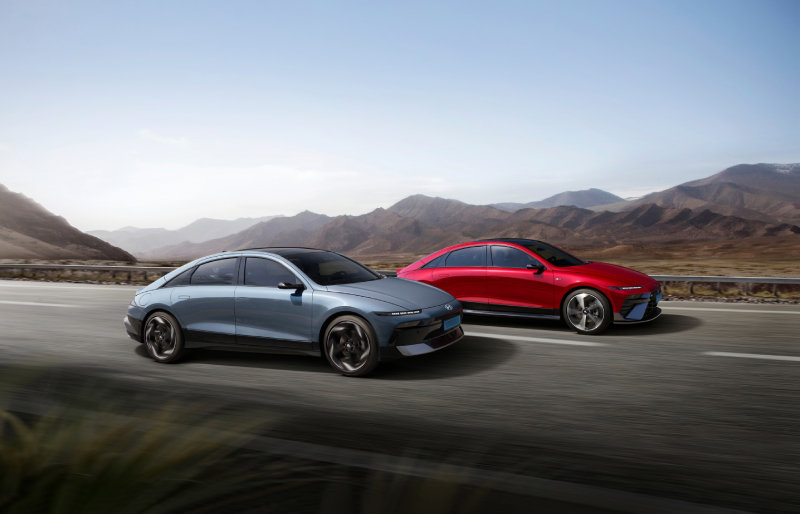
Hyundai Motor Group unveils the electric vehicles ‘The New Ioniq 6’ (left) and ‘The New Ioniq N Line’ with advanced technology to address safety concerns. Provided by Hyundai Motor Group
Recently, as the domestic electric vehicle market shows renewed vitality, efforts by domestic manufacturers to directly tackle consumer concerns such as “electric vehicles are similar to electronic products and vulnerable to errors” and “they cause motion sickness, reducing the fun of driving” are gaining attention. Companies presenting new solutions based on innovative technology are credited with leading the recovery of previously sluggish electric vehicle sales.
According to Kaizuyu Data Research Institute, out of 126,787 new car registrations in the country in August, 23,269 units (18.4%) were electric vehicles. Additionally, a survey by the Korea Automobile & Mobility Industry Association indicated that 21.1% of the 7.73 million vehicles sold worldwide from January to May this year were electric vehicles. This suggests that the slowdown in electric vehicle demand is stabilizing and consumer interest is rising again.
Electric vehicles are often referred to as ‘smartphones on wheels’ due to their concentration of advanced technology. However, concerns about the risk of malfunction inherent to electronic devices have been consistently raised. In particular, there is significant anxiety about unintended sudden acceleration, often attributed to errors in the electric vehicle motor system.
● Technology to Address Sudden Acceleration and Motion Sickness Concerns In response, Hyundai Motor Group is focusing on developing technology to alleviate safety concerns surrounding electric vehicles. For instance, Hyundai’s electric vehicle ‘The New Ioniq 6’ is equipped with a ‘Pedal Misoperation Safety Assist’ function to prevent accidents caused by pedal misoperation. This function helps prevent sudden acceleration when the driver mistakenly presses the accelerator instead of the brake, thereby reducing accident risk. Additionally, it uses ultrasonic sensors to monitor the surroundings in real-time. If an obstacle is detected within 1.5 meters in front or behind, and the driver suddenly presses the accelerator, the system recognizes this as a malfunction, suppresses acceleration, and emits a warning sound.
The Kia EV5, in addition to this technology, features Hyundai Motor Group’s first acceleration limit assist function. This function provides a warning message via cluster popup and voice when the driver depresses the accelerator pedal deeply for an extended period while driving at speeds below 80 km/h, thereby limiting acceleration.
Alongside safety devices, technologies to reduce motion sickness are also being introduced. These cater to passengers who feel nauseous when riding in electric vehicles. The ‘Smooth Mode’ applied to the Ioniq 6 suppresses the electric vehicle’s characteristic rapid acceleration and abrupt deceleration when the foot is lifted off the pedal, stabilizing the vehicle’s movement. In Smooth Mode, the response of the accelerator pedal is more gradual, maintaining a smoother driving texture. The initial acceleration is designed to build up gradually, reducing discomfort for passengers and enhancing long-distance travel convenience.
● Beyond Safety and Convenience to Driving Enjoyment Despite efforts to improve the safety and convenience of electric vehicles, many misconceptions persist. For example, there is a prevailing perception that electric vehicles are at a disadvantage compared to traditional internal combustion engine vehicles regarding air conditioning systems, which include heating, cooling, dehumidification, air purification, and battery thermal management. Internal combustion vehicles recycle waste heat from the engine, whereas electric vehicles use battery power for air conditioning, leading to higher power consumption and perceived inefficiency.
However, these limitations can also be overcome with technology that reduces unnecessary energy consumption by recognizing the vehicle’s occupancy status. For instance, the ‘Smart Zone’ technology applied to the Ioniq 6 detects the presence of passengers by sensing weight and seatbelt usage under the seats and automatically controls the air conditioning operation area. This ensures that heating and cooling are activated only in necessary seats, conserving energy while providing a comfortable travel environment for all passengers. For example, if the driver is alone and presses the Smart Zone button, the air conditioning operates only in the driver’s seat, and if passengers subsequently occupy the front or rear seats, the air conditioning in those areas is activated without additional operation.
The primary purpose of introducing such new technologies is consumer safety and convenience. Furthermore, efforts to ensure driving enjoyment are also evident. For instance, electric vehicles can accelerate immediately upon pedal depression, allowing for smoother driving compared to internal combustion engine vehicles. However, some consumers have criticized this for reducing the fun of driving.
To enhance driving enjoyment, Hyundai Motor Group has introduced dedicated technologies to its high-performance vehicle lineup, the N brand models. The ‘Ioniq 5 N’, launched in July 2023, features the virtual shifting system ‘N e-Shift’ and the virtual sound system ‘N Active Sound Plus’. N e-Shift controls the motor to provide the feel of shifting in internal combustion engine vehicles, allowing drivers to experience similar shift shocks and sensations. N Active Sound Plus creates realistic virtual sounds inside and outside the vehicle based on driving information such as RPM, speed, and torque.
Thus, controversies surrounding the safety, ride comfort, and efficiency of electric vehicles are being gradually resolved through technological evolution. A Hyundai Motor Group representative emphasized, “We are developing meticulous technology that does not overlook even the smallest inconveniences of drivers and passengers, ensuring that electric vehicles are not just a means of transportation but a safe and enjoyable travel experience.”
ⓒ dongA.com. All rights reserved. Reproduction, redistribution, or use for AI training prohibited.
Popular News