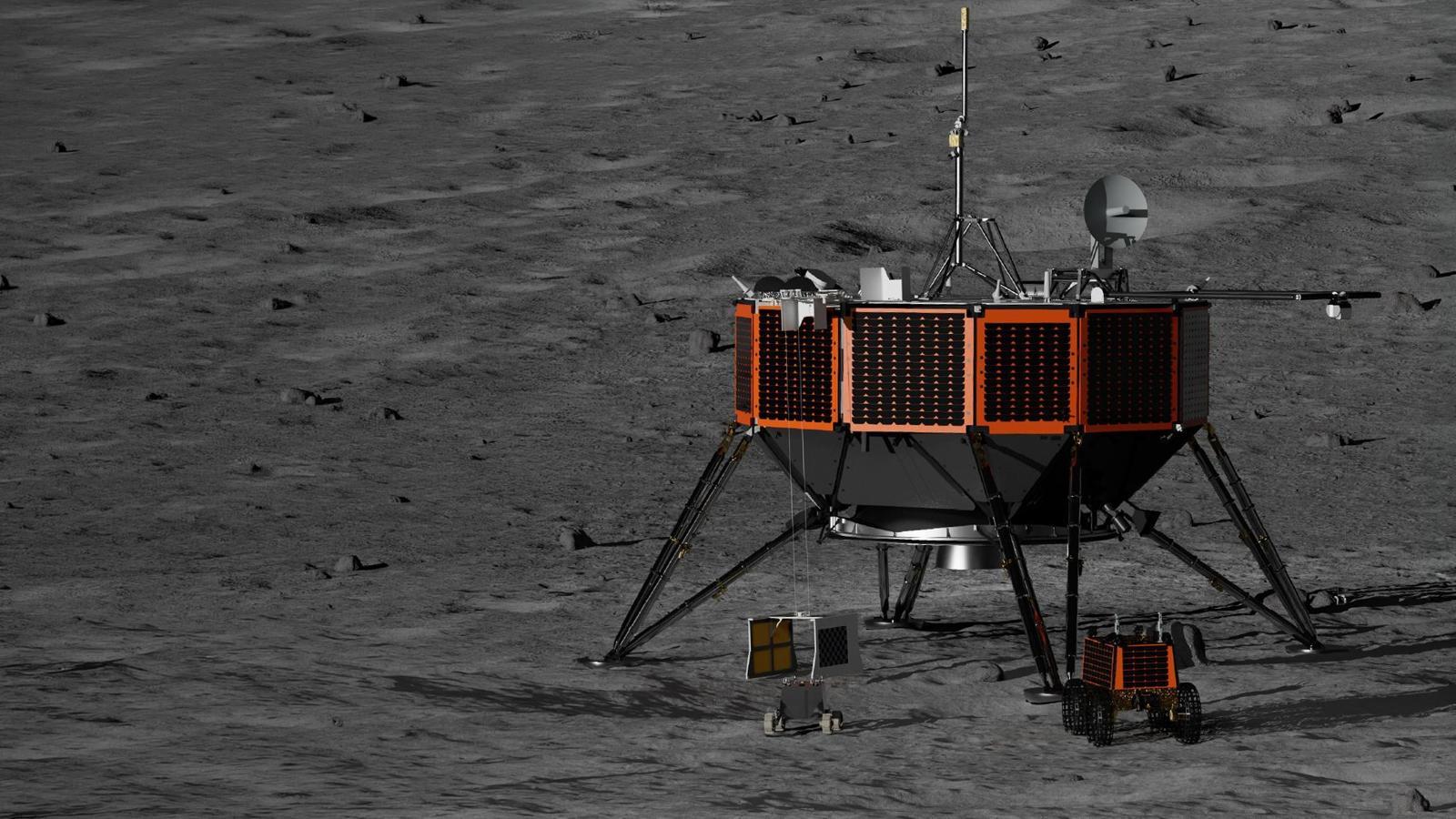
Concept image of the private lunar lander of U.S. company Intuitive Machines, which will carry the domestically developed Lunar Surface Space Radiation Detector (LVRAD). The lander aims to touch down in the lunar south polar region in 2030. Provided by NASA
The Lunar Surface Space Radiation Detector (LVRAD), which Korea is independently developing, will head to the lunar south pole in 2030 aboard a private lander deployed for the U.S. National Aeronautics and Space Administration (NASA)’s lunar exploration program. Data collected by LVRAD will be used to analyze the impact of space radiation, a major risk factor for long-duration crewed lunar missions, on the human body.
The Korea AeroSpace Administration (KASA) announced on the 17th that it signed an implementation agreement on the 14th to mount the domestically produced space radiation detector on a NASA commercial lunar lander. Under the agreement, LVRAD, being developed by the Korea Astronomy and Space Science Institute, will be completed in 2027 as a flight model for actual space missions and then sent to the United States. It will subsequently be mounted on a lunar lander of U.S. private space company Intuitive Machines and transported to the surface of the lunar south pole in 2030.
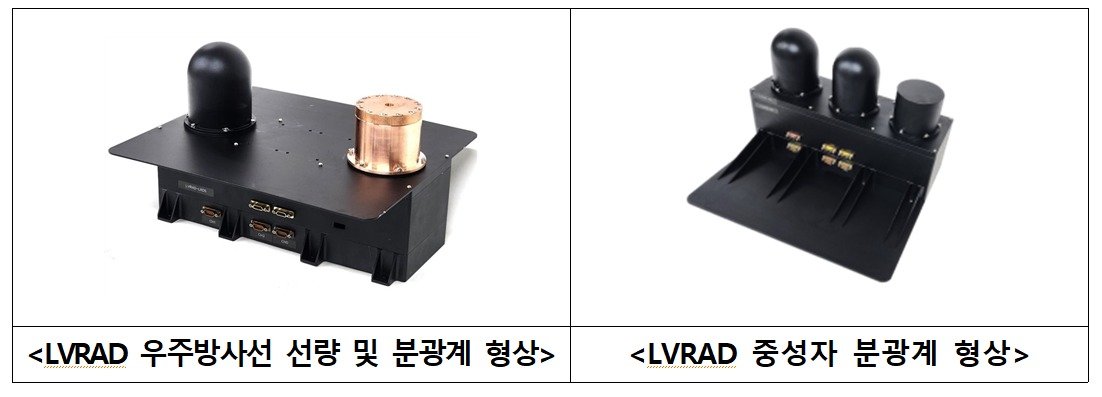
Configuration of the Lunar Surface Space Radiation Detector (LVRAD)’s space radiation dosimeter and spectrometer (left) and neutron spectrometer (right). Provided by KASA
LVRAD will precisely measure the transmission of space radiation and the neutron environment on the lunar south polar surface. The airless lunar surface is directly exposed to high-energy particles arriving from the Sun and the galaxy. Space radiation can damage human cells and is regarded as a key variable that determines the health of astronauts staying on the Moon for extended periods and the safety of exploration missions. The measurement data will be used to assess astronauts’ radiation exposure risk and to enhance the design and operational safety of both crewed and uncrewed spacecraft. Oh Tae-seog, Administrator of KASA, stated, “KASA will steadily expand international cooperation to advance lunar exploration technology and broaden its contribution to the international community in the field of space science.”
Kim Jae-hyung
AI-translated with ChatGPT. Provided as is; original Korean text prevails.
ⓒ dongA.com. All rights reserved. Reproduction, redistribution, or use for AI training prohibited.