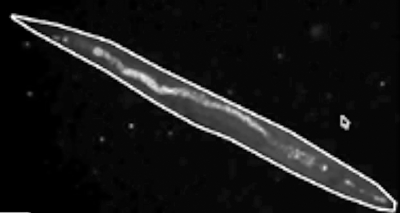
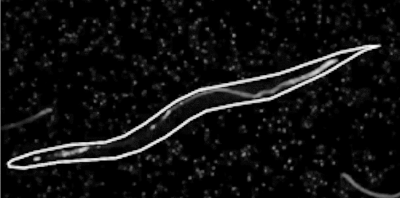
Comparison between Caenorhabditis elegans in the space microgravity environment and Caenorhabditis elegans in a simulated microgravity environment. Courtesy of Yonsei University
Emitting red fluorescence indicating bacterial infection. Courtesy of Yonsei University
In 1968, during the Apollo 7 mission, all three astronauts came down with colds. A Korean research team has produced findings that help explain why astronauts are vulnerable to infections, proving that space is an environment where bacterial infections occur more readily than on Earth.
On the 30th, Professor Jin-Il Lee’s team in the Department of Integrative Biosciences and Biotechnology at Yonsei University announced that it had confirmed that Caenorhabditis elegans sent into space are more susceptible to bacterial infection than those on Earth, and that the results were published in May in the international journal “NPJ Microgravity.”
As global competition in space development intensifies to realize long-term stays on the Moon and space travel to Mars, questions are growing over how microgravity conditions affect astronauts’ health.
Caenorhabditis elegans, a type of nematode, is suitable for studying immunological responses that occur in the space environment. Professor Lee explained, “The innate immune system of Caenorhabditis elegans is regulated through two major protein pathways, ‘TGF-β’ and ‘p38 MAP kinase,’” adding, “Interestingly, the human innate immune system is also regulated by these two signaling pathways.”
The research team, through the MME2 space experiment sponsored by the European Space Agency (ESA), sent normal Caenorhabditis elegans and mutant Caenorhabditis elegans with impaired immune function to the International Space Station (ISS), where a space microgravity environment can be reproduced, together with the bacterium Enterobacter. The intestines of the nematodes sent into space were genetically engineered to emit red fluorescence when infected with Enterobacter.
As a result of the experiment, Caenorhabditis elegans sent into space emitted more red fluorescence than those on Earth, indicating that they were more heavily infected by bacteria in the space environment. Both normal and mutant worms were more susceptible to bacterial infection in space.
Previous studies have shown that in the space environment the TGF-β pathway in Caenorhabditis elegans is suppressed, allowing bacteria to proliferate more readily. The team additionally confirmed that the p38 MAP kinase pathway, which does not function when the worms are infected with Enterobacter on Earth, is activated in space. This suggests that when TGF-β function is switched off, p38 MAP kinase becomes compensatorily activated. In mutant Caenorhabditis elegans in which the p38 MAP kinase pathway was blocked, both the TGF-β and p38 MAP kinase pathways were shut down in the space environment, leading to even easier infection.
The research team also used a “3D clinostat,” a device that simulates microgravity, on the ground to reconfirm that Caenorhabditis elegans are more heavily infected by bacteria under microgravity conditions. They further identified “immune effector genes” that are activated via the p38 MAP kinase pathway when Caenorhabditis elegans are in a microgravity environment. Immune effector genes encode proteins that directly combat bacteria.
Professor Lee said, “Although the immune effector genes of nematodes and humans themselves differ, this study is meaningful in that it suggests a direction for enhancing astronauts’ immunity,” and added, “If immune effector genes specialized for microgravity are identified, it will be possible to develop methods to boost immunity in space and to establish safety and health management guidelines for space travelers.”
The team is currently also studying the direct effects of microgravity on bacteria. To elucidate the mechanisms by which bacterial pathogenicity increases in the space environment, clinostat experiments are underway. The goal is to eventually conduct space missions using private spaceflight or space stations.
ⓒ dongA.com. All rights reserved. Reproduction, redistribution, or use for AI training prohibited.
Popular News