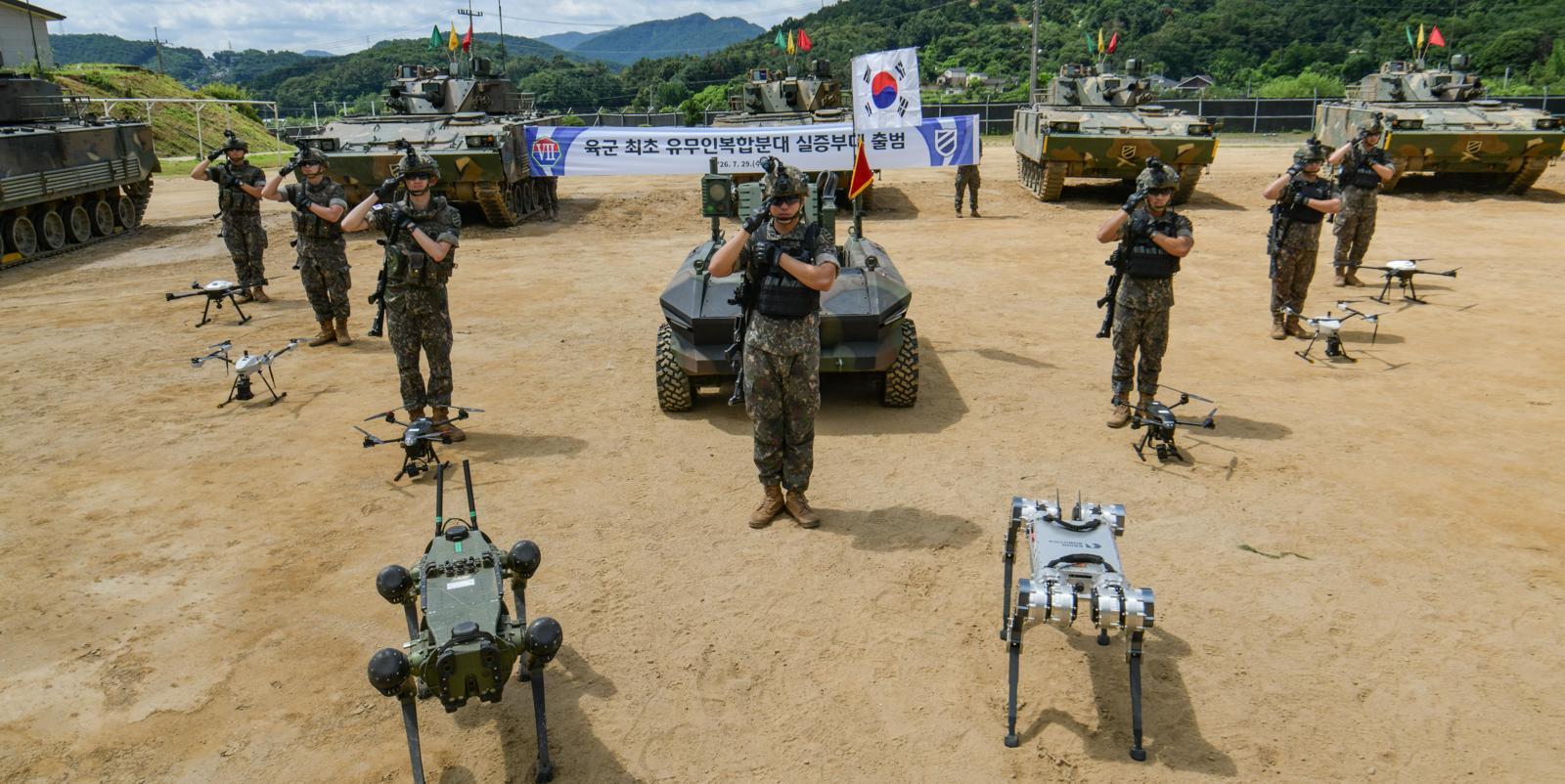
At the inauguration ceremony of the Manned-Unmanned Teaming Squad demonstration unit held at the 11th Maneuver Division’s Iron Horse Unit in Hongcheon, Gangwon Province, on the 29th, service members stand in formation and salute together with unmanned systems such as legged robots and drones. Provided by the Army
The Army has created a “Manned-Unmanned Teaming Squad,” which integrates four types of unmanned systems—combat drones, legged robots, multipurpose unmanned vehicles, and autonomous vehicles—into a single team with soldiers, and has begun combat experimentation. The Army announced that on the 29th it held an “Inauguration Ceremony for the Manned-Unmanned Teaming Squad Demonstration Unit” at the 11th Maneuver Division in Hongcheon, Gangwon Province. This is the first time the Army has integrated soldiers with various unmanned systems at the squad level for demonstration and validation.
The Manned-Unmanned Teaming Squad is organized into eight personnel based on the current squad structure, consisting of four combat soldiers and four unmanned system operators. The demonstration unit will operate in squad formations by combining soldiers with drones, legged robots, multipurpose unmanned vehicles, and autonomous vehicles according to mission requirements. For basic missions, drones and legged robots will be deployed, while for reconnaissance missions, multipurpose unmanned vehicles and legged robots will be used. The Army explained that for support missions, it plans to combine legged robots and autonomous vehicles to verify operational effectiveness.
Unmanned systems are deployed ahead of soldiers into hazardous areas to identify threats such as enemy forces and obstacles. The acquired information is shared with soldiers, who then carry out missions by following procedures for surveillance and reconnaissance, search and security, and target identification and engagement based on that information.
Through this demonstration, the Army plans to concretize a future combat concept in which unmanned systems take on surveillance and reconnaissance, target information acquisition, and missions in hazardous areas, while soldiers focus on decision-making and command and control. The accumulated data and soldiers’ feedback will be reflected in equipment performance improvements, unit organization, and the development of training and education systems.
This demonstration is part of the “Army TIGER Plus” plan that the Army is pursuing with a target year of 2040. Army TIGER Plus is a plan to prepare for future battlefields by adding artificial intelligence (AI), drones and counter-drone capabilities, robotics, and cyber and electromagnetic capabilities to the existing Army TIGER concepts of mobility, networking, and intelligence. Lee Kyung-jin, Director of Policy at Army Headquarters, said, “Based on operational experience and demonstration results, the Army will further specify force structure, equipment, and combat procedures that are suited to our operational environment.”
ⓒ dongA.com. All rights reserved. Reproduction, redistribution, or use for AI training prohibited.
Popular News