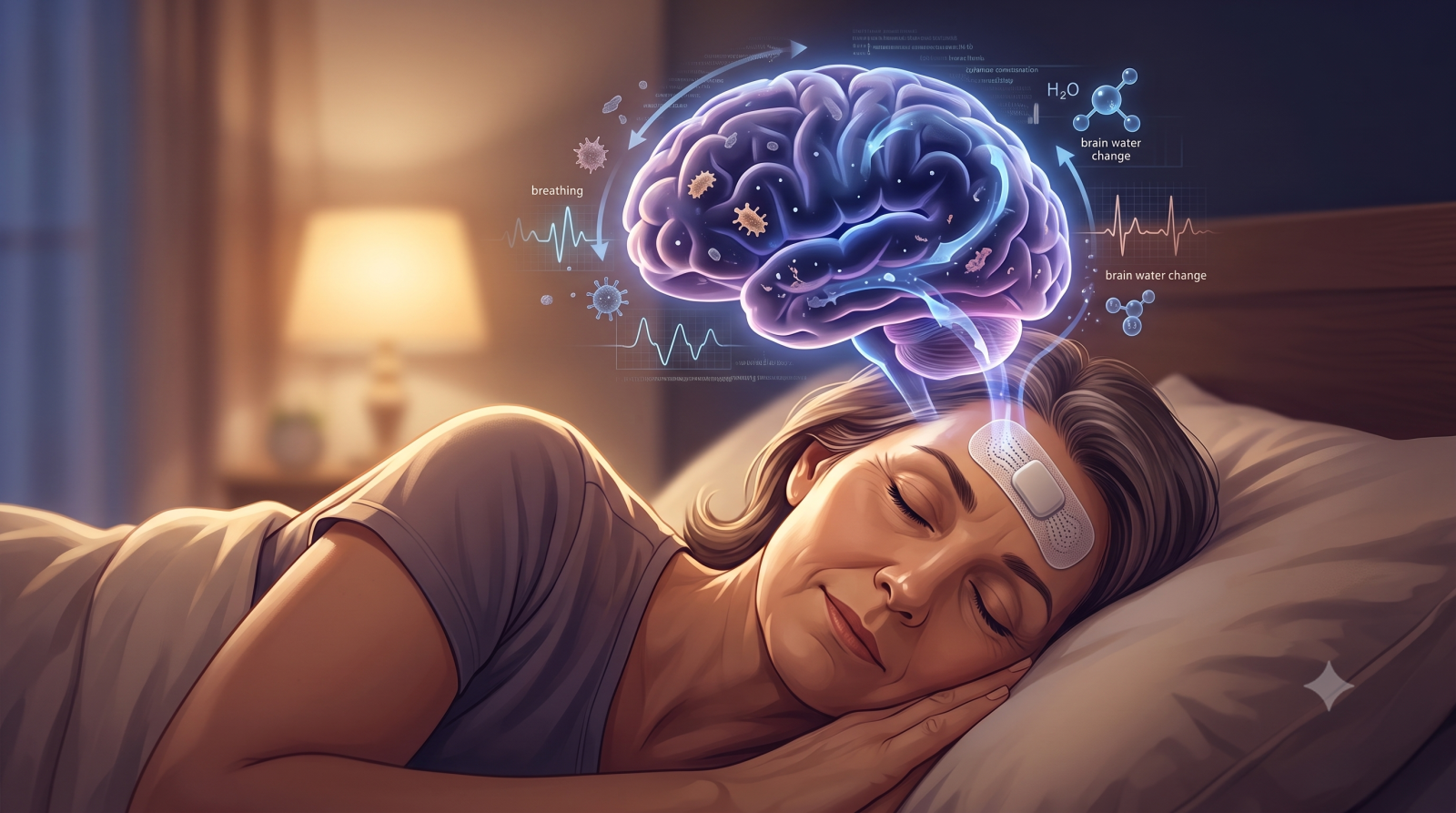
A graphic visualizing real-time monitoring of the brain’s waste clearance (“brain cleaning”) process and physiological changes during comfortable sleep at home using a wireless wearable sensor attached to the forehead. Image created with the generative AI Gemini.
While a person sleeps, the brain carries out so‑called “brain cleaning,” flushing away waste accumulated during the day. Until now, wearable devices have largely been limited to measuring sleep duration or heart rate, but it is expected that in the future people will be able to observe at home the changes taking place in the brain during sleep.
The neurology team led by Professor Chang‑Ho Yun at Seoul National University Bundang Hospital announced on the 9th that, in collaboration with Professor Woon‑Hong Yeo’s team at the Georgia Institute of Technology, it has developed a wireless wearable device capable of continuously measuring changes in brain fluid during sleep.
As recent studies have increasingly shown a link between sleep deprivation and dementia risk, the “glymphatic system,” through which the brain autonomously clears waste during sleep, has emerged as an important area of brain health research. The glymphatic system is a mechanism by which cerebrospinal fluid flows through brain tissue and removes waste products such as amyloid‑β, and it is known to be most active during deep sleep.
However, until now, changes in cerebrospinal fluid and brain water content could only be assessed using large‑scale equipment such as magnetic resonance imaging (MRI). Because measurements had to be taken in a laboratory setting, it was difficult to repeatedly observe what changes occurred in the brain during normal sleep at home.
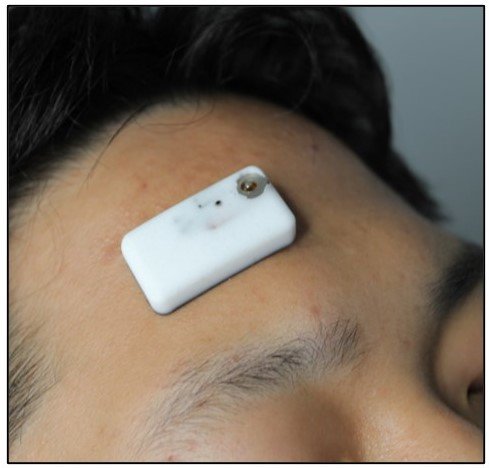
The device developed by the research team is a soft, wireless, wearable near‑infrared spectroscopy (NIRS) sensor that is attached to the forehead. It measures changes in water and blood flow in brain tissue by analyzing light absorption, and uses flexible materials that conform naturally to the skin so that it does not disturb sleep and can continuously collect data throughout the night.
The researchers conducted 16 overnight measurement sessions at home with four healthy adults. At the same time, they analyzed brain waves and eye movements to identify sleep stages and then compared these with changes in brain water content.
Analysis showed that the brain water signal consistently shifted in a particular direction whenever the sleep stage changed. The signal increased when transitioning from wakefulness or rapid eye movement (REM) sleep to deep non‑REM (NREM) sleep, and decreased when shifting from NREM sleep back to REM sleep. These changes occurred almost simultaneously with the timing of sleep stage transitions identified via brain waves.
The soft wireless near‑infrared spectroscopy (NIRS) wearable device developed by the research team
The device also captured physiological rhythms during sleep, such as breathing and heart rate, in addition to changes in brain water. In NREM sleep, breathing and heart rate remained stable, whereas in REM sleep they became more irregular, consistent with previously known physiological changes during sleep.
● Observing brain changes that smartwatches cannot detect
Most wearables currently on the market, such as smartwatches and smart rings, measure metrics like sleep duration, heart rate, and blood oxygen saturation. By contrast, the key difference with this device is that it aims to indirectly observe changes in brain water and glymphatic system activity during sleep.
Whereas conventional sleep studies focus on evaluating “how long a person slept” and “how much deep sleep they had,” this study represents a new attempt to examine how the brain’s recovery process unfolds during sleep, the team explained.
(From left) Professor Chang‑Ho Yun of the Department of Neurology at Seoul National University Bundang Hospital, Professor Woon‑Hong Yeo of the Georgia Institute of Technology
Professor Yun stated, “Developing a tool that allows observation of glymphatic system activity in a natural sleep environment has been a longstanding challenge in neurological disease research,” adding, “We are currently building datasets involving both healthy individuals and patients with cognitive impairment, and we are conducting follow‑up studies to determine how treatments for sleep apnea and cognitive behavioral therapy for insomnia affect the brain cleaning process.”
He went on to say, “If the technology advances through comparative validation against standard tests, it could be used as a new observational tool not only for research into sleep disorders, aging, and cognitive decline, but also for assessing treatment effectiveness.”
However, this is an initial study conducted with only four healthy adults. Further research and validation involving a larger population will be necessary before the device can be applied in real‑world clinical settings.
The findings of this study were published in the international journal Science Advances.
ⓒ dongA.com. All rights reserved. Reproduction, redistribution, or use for AI training prohibited.
Popular News