Offline CJ Olive Young stores in the U.S.
AI-powered ‘Skin Scanning Zone’ for skin analysis draws 10,000 visitors in just two and a half months
Korean dermatological science captivates U.S. consumers
K-beauty skincare sales far outpace French brands
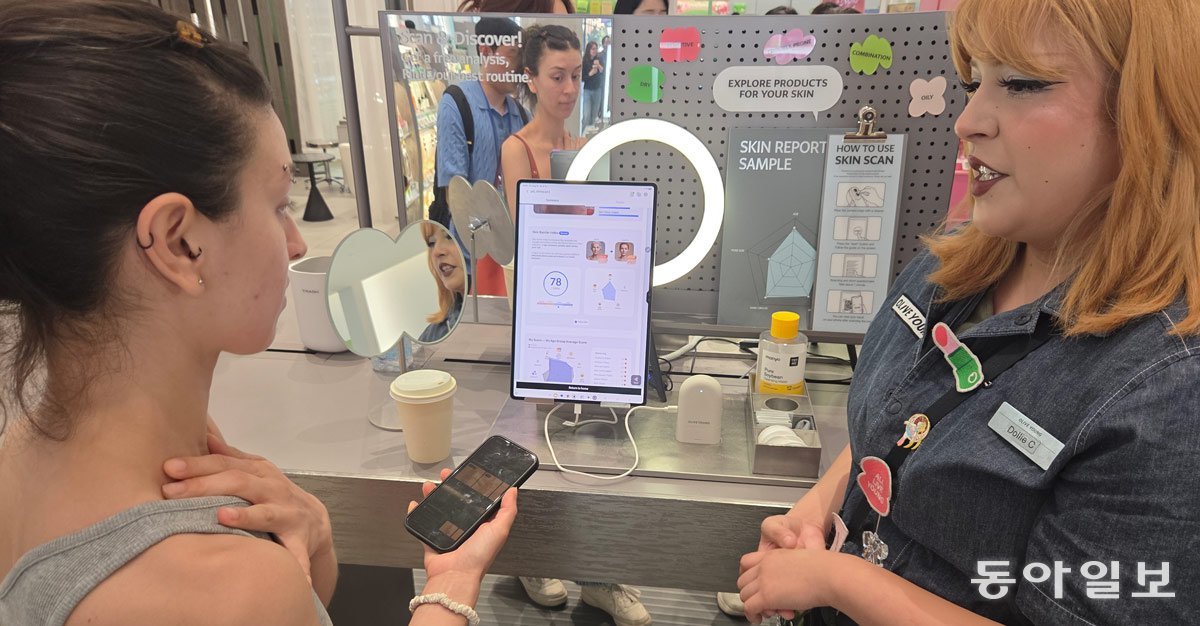
Product recommendations after skin scanning Customer Leticia Gutierrez, who visited the Olive Young Pasadena store in California, United States, on the 14th (local time), is being recommended products by a staff member that can replenish insufficient skin moisture through a skin scan. Skin scanning, which is drawing attention locally, is a technology that uses artificial intelligence (AI) to analyze skin concerns such as moisture, acne bacteria, and dark circles. Pasadena = Reporter Lee So-jeong sojee@donga.com
“Korea’s skin analysis technology is truly impressive. It identifies everything from pore density and temperature to wrinkles, so I can purchase products that are perfectly suited to my skin.”
On the 14th (local time) at CJ Olive Young’s Pasadena store in California, USA. As soon as the store opened at 10 a.m., 27-year-old Leticia Gutierrez rushed to the “skin scanning zone” and made this comment while checking the results of her skin analysis conducted by artificial intelligence (AI). Ani Zigneian, the staff member in charge of skin scanning, said, “About 200 customers undergo analysis every day,” adding, “They range from 13-year-olds to people in their 60s, and their nationalities are very diverse.”
● K-beauty spreads ‘K-skin care’ in the U.S. The Pasadena store is Olive Young’s first offline outlet opened in the United States, launched this May. It spans a total floor area of 803㎡ (about 240 pyeong) and sells more than 5,000 products from some 400 Korean cosmetics brands. Olive Young dedicated a quarter of the store to the “skincare” category.
The skin scanning zone, which uses AI to analyze a customer’s skin condition across 12 criteria including moisture, acne bacteria, dark circles, skin barrier, pore size, wrinkles, redness, and sebum, has become a major talking point on social networking services (SNS). Store employees said, “Some customers drive over two hours just to get a skin scan.” Since the store opened on May 29, the cumulative number of users reached 10,000 by the first week of August.
In the past, K-beauty gained popularity in the U.S. market through the “novelty” of previously unseen products such as cushion foundations and sheet masks. Recently, it has evolved into what is assessed as a “scientification” phase, in which AI-based skin condition diagnosis and functional ingredients such as PDRN, hyaluronic acid, and cica are used as the basis for proposing skin care routines.
A visit to the store that day showed K-beauty going beyond simple product sales to promoting Korean skin science and captivating consumers. Having already triggered a skincare boom in a U.S. beauty market once dominated by color cosmetics, it is now presenting new skin care routines to the American market based on personalized analysis and advanced ingredients.
Customers encountered in the store cited functionality as the key strength of K-beauty. Yolasca Cabrera (51), visiting for the second time, said, “I first came along with my niece, who is crazy about K-culture, and happened to buy a lotion, which turned out to be of very high quality, so I came back,” adding, “The body lotion I wanted to buy was sold out on the online mall, so I came in person to see if it was available offline.”
Kang Myeong-ji, MD Team Leader at Olive Young’s U.S. subsidiary, said, “Skincare is the category that American consumers most expect from Korean products,” adding, “More than 1,500 people visit the Pasadena store per day on average, and more than half of them are non-Korean customers.”
● Korean basic skincare products overtake France in the U.S. market K-beauty, backed by technological prowess, is also reshaping the supply structure of the U.S. skincare market. According to statistics from the U.S. International Trade Commission (USITC), U.S. imports of Korean basic skincare products last year totaled USD 1,397.69 million (about KRW 1.98 trillion), accounting for 28.0% of total imports. Imports from France amounted to USD 736.89 million (14.8%), roughly half the level of Korea. Korea first surpassed France in 2024, and the gap widened further last year.
According to market research firm Mintel, the number of new skincare product launches in the U.S. made in Korea has increased by 20% since 2020, whereas launches of products made in the U.S. have decreased by 16%. Mintel analyzed, “The increase in Korean-made products signals the advent of the ‘K-beauty 3.0’ era,” adding, “K-beauty is evolving from products that relied on exotic novelty to skincare solutions based on advanced technology.”
Domestic cosmetics companies are strengthening their research and development (R&D). Aestura, the derma brand of Amorepacific, has developed technology that can diagnose 33 skin issues, going beyond existing analysis of pores, wrinkles, and hyperpigmentation.
ⓒ dongA.com. All rights reserved. Reproduction, redistribution, or use for AI training prohibited.
Popular News









 About Dong-A Ilbo