[K-Defense, Taking Flight on the Global Stage] HD Hyundai Heavy Industries
Establishing a ‘K-Naval Ship Belt’ from Ulsan to Peru
Capable of Building Five Aegis Destroyers a Year Domestically
Co-developing Unmanned Surface Vessels with U.S. Firm Anduril
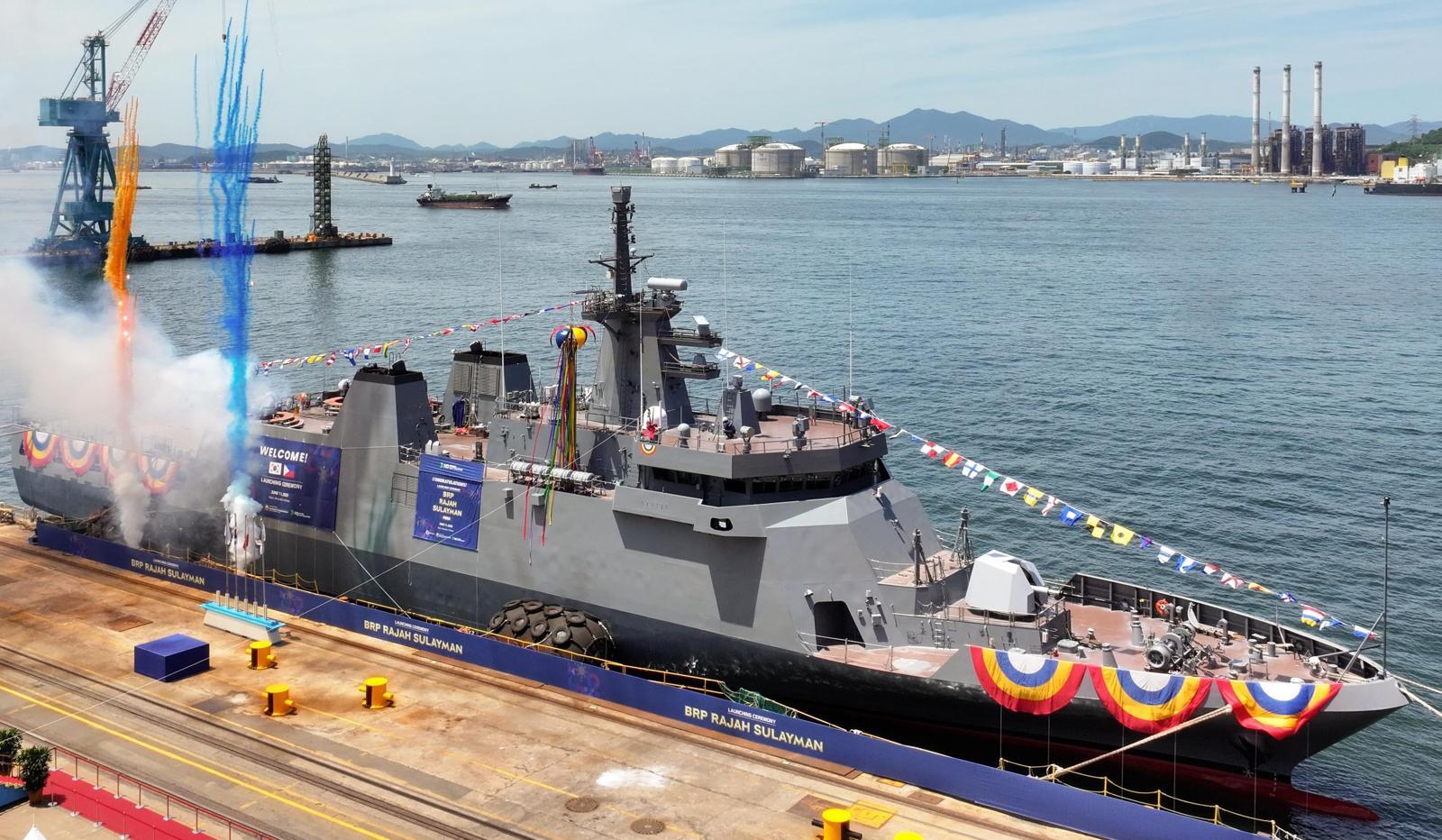
The 2,400-ton Philippine offshore patrol vessel BRP Rajah Sulayman delivered by HD Hyundai Heavy Industries in January. Provided by HD Hyundai Heavy Industries
HD Hyundai, which holds the first and largest record for naval vessel exports in the Korean shipbuilding industry, is intensifying its drive into overseas defense markets by actively pursuing global cooperation.
HD Hyundai Heavy Industries is advancing its “Pan-Pacific Belt Vision” by establishing regional overseas footholds in Peru, the Philippines, Saudi Arabia, the United States and other areas of the world through the signing of partnerships in each overseas base, the establishment of local construction systems, and the standardization of technology-transfer packages in the global defense market.
As part of this strategy, HD Hyundai Heavy Industries signed a “Letter of Intent (LOI) on Joint Development and Construction of Submarines for Peru” with the Peruvian state-owned SIMA shipyard in 2024. The two parties are aiming to conclude a joint development contract this year, and HD Hyundai Heavy Industries plans to carry out joint development work at its Ulsan yard together with the Peruvian Navy and SIMA engineers to complete the basic and detailed design of a new submarine optimized to the requirements of the Peruvian Navy. The two sides are already jointly building four vessels, including multipurpose frigates, patrol vessels, and amphibious support ships.
HD Hyundai Heavy Industries is actively participating in the Philippine Navy’s modernization program, regarded as one of the success stories of Korean naval vessel exports. Since 2013, the Philippine government has been pursuing a modernization project to acquire multiple vessels to modernize and strengthen the capabilities of its navy, and HD Hyundai Heavy Industries has won orders for a total of 12 vessels, including frigates, patrol vessels, and offshore patrol vessels.
In February this year, it delivered the BRP Rajah Sulayman, the first of six offshore patrol vessels ordered by the Philippine Navy, approximately five months ahead of schedule. In March last year, it successfully launched the BRP Diego Silang, the second 3,200-ton Philippine patrol vessel. HD Hyundai Heavy Industries has so far delivered all vessels it has won ahead of schedule, demonstrating strong competitiveness not only in performance and cost but also in delivery timelines.
In parallel, the company is actively participating in the Saudi government’s naval modernization program. In February this year, HD Hyundai Heavy Industries took part in “WDS 2026,” the largest international defense exhibition in the Middle East, where it showcased a total of eight types of vessels, including the 6,000-ton export-type frigate “HDF-6000.” In line with Saudi government policy, it presented a phased localization plan optimized for local construction in Saudi Arabia and announced plans to consider gradually increasing the local construction ratio of the HDF-6000, centered on the Saudi IMI shipyard, which was established through a joint investment by HD Korea Shipbuilding & Offshore Engineering and Saudi state-owned company Aramco, if it wins the frigate order.
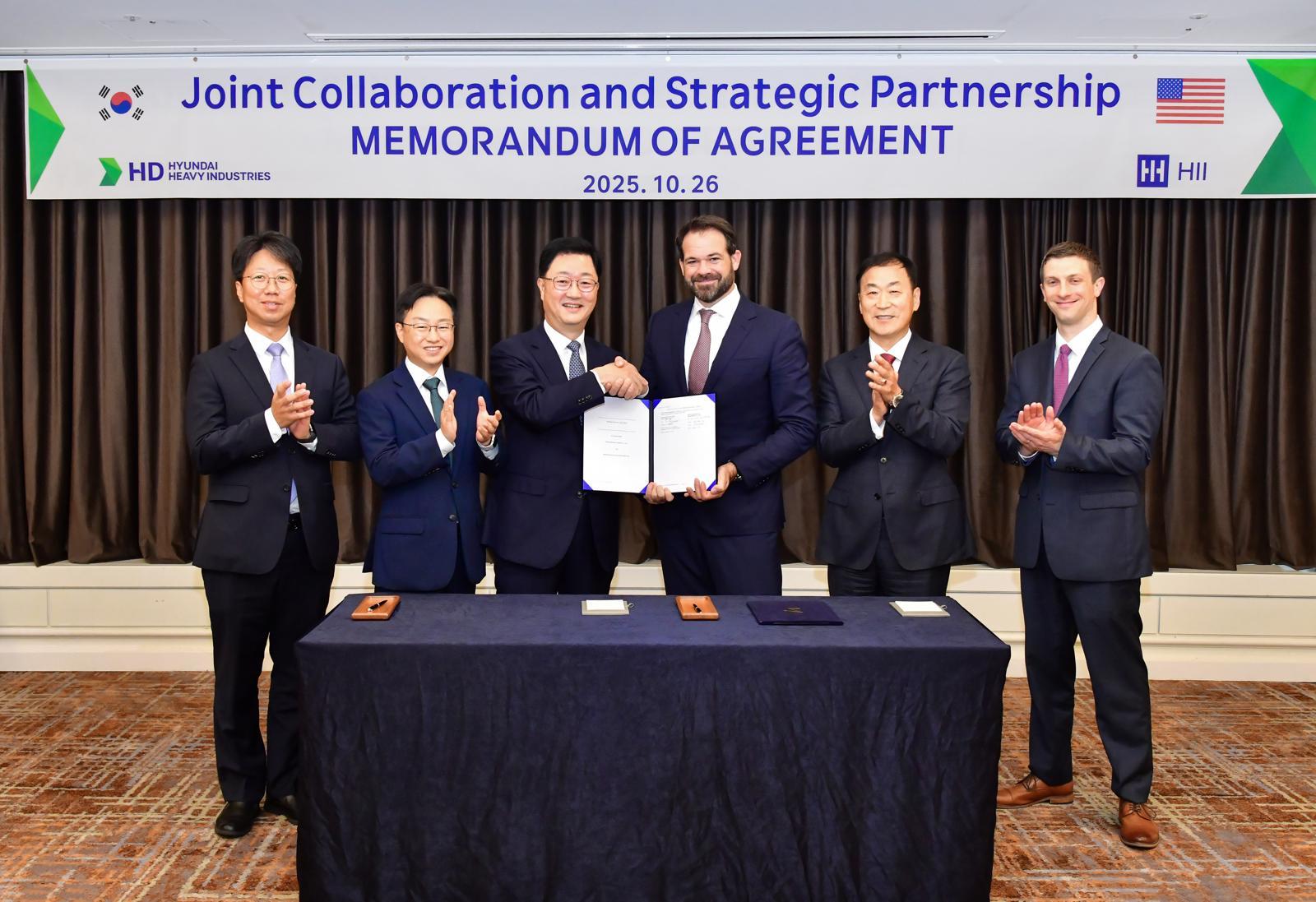
HD Hyundai and Huntington Ingalls signed a Memorandum of Agreement (MOA) on cooperation in commercial and naval shipbuilding at the Lahan Select Hotel in Gyeongju, North Gyeongsang Province, where “APEC 2025” was held last October.
HD Hyundai Heavy Industries is also taking proactive steps in cooperation between the Korean and U.S. shipbuilding industries. In October last year, at the Lahan Select Hotel in Gyeongju, where “APEC 2025” was held, it signed a Memorandum of Agreement (MOA) with Huntington Ingalls, the largest defense shipbuilder in the United States, for the construction of the U.S. Navy’s “Next-Generation Fleet Replenishment Oiler.” The two companies plan to cooperate on the design and construction of the U.S. Navy’s next-generation fleet replenishment oiler and further share know-how and capabilities to improve construction costs and delivery schedules across both commercial and naval ship segments.
In addition, HD Hyundai Heavy Industries signed an MOA with U.S. AI defense company Anduril Industries for cooperation on naval vessel development and agreed to jointly develop prototypes of unmanned surface vessels (USVs) to be introduced separately in the Korean and U.S. markets. The two parties plan to mutually supply HD Hyundai’s AI-powered ship autonomy technology and ship design and construction capabilities, and Anduril’s autonomous mission execution system solutions.
HD Hyundai Heavy Industries is the only Korean shipbuilder that has led the basic design of the country’s latest Aegis destroyers (Sejong the Great-class and Jeongjo the Great-class), and over the past 50 years it has contributed to strengthening and advancing the Navy’s capabilities through domestic naval vessel development. Starting with the research and development of ROKS Ulsan, the Republic of Korea’s first domestically produced combat ship, in 1976, it went on to build all of the Ulsan-class frigate Batch-I, II and III vessels.
In February this year, three Jeongjo the Great-class Aegis destroyers—ROKS Jeongjo the Great, ROKS Dasan Jeong Yakyong, and ROKS Daeho Kim Jongseo—either built or under construction by HD Hyundai Heavy Industries, gathered at the company’s Ulsan shipyard. HD Hyundai Heavy Industries designated the day as “Aegis Destroyer Day,” invited the commanding officers of the three Aegis destroyers, and expressed its appreciation. In 2024, HD Hyundai Heavy Industries built and delivered to the Navy ROKS Jeongjo the Great, the first ship in the Jeongjo the Great-class Aegis destroyer series. In September last year, it held the launch ceremony for ROKS Dasan Jeong Yakyong, the second 8,200-ton state-of-the-art Aegis destroyer (KDX-III Batch-II), which is scheduled to be delivered to the Navy in December this year. The last vessel, ROKS Daeho Kim Jongseo, is under construction at the Ulsan shipyard and is scheduled for delivery to the Navy in December 2027.
The latest Jeongjo the Great-class Aegis destroyer is 170 meters long, 21 meters wide, and has a displacement of 8,200 tons, with a maximum speed of 30 knots (about 55 km/h), making it one of the most advanced combat ships in existence. Compared with the existing Sejong the Great-class (7,600 tons), its target detection and tracking capabilities have more than doubled, and it is equipped with interception functions, positioning it as a core asset of the “sea-based three-axis system” for responding to North Korea’s nuclear and missile threats.
HD Hyundai Heavy Industries is assessed as being capable, on its own, of carrying out the construction of approximately 1.6 Aegis destroyers per year in the United States, and up to 5 per year if constructed in Korea. In addition, it became the first Korean shipbuilder to seek to sign a Multi-Ship Repair Agreement (MSRA) with the U.S. Navy and obtained qualification in July last year. In April last year, it signed a Memorandum of Understanding (MOU) with Huntington Ingalls, the leading U.S. maritime and defense shipbuilder, to accelerate cooperation in naval and commercial shipbuilding, laying the foundation for a strategic maritime and defense partnership between Korea and the United States. In August and December last year, it won MRO (maintenance, repair and overhaul) contracts from the U.S. Navy for the fleet replenishment oiler USNS Alan Shepard and the 41,000-ton dry cargo/ammunition ship USNS Cesar Chavez.
Meanwhile, following the integration of HD Hyundai Heavy Industries and HD Hyundai Mipo in December last year, HD Hyundai set a target of achieving annual defense sales of KRW 10 trillion by 2035. The plan is to maximize production efficiency by combining HD Hyundai Heavy Industries’ naval vessel construction technology and project management know-how with HD Hyundai Mipo’s medium-sized docks, facilities, and workforce.
ⓒ dongA.com. All rights reserved. Reproduction, redistribution, or use for AI training prohibited.
Popular News








 About Dong-A Ilbo