[Young-Old&] Regenerative medical products using iPS cells
Conditional approval for heart failure and Parkinson’s disease treatments
Global market projected at KRW 47 trillion by 2032
US and China rapidly expanding clinical trials… Korea to accelerate development from this year with regulatory easing
Japan has become the first country in the world to approve a treatment based on induced pluripotent stem cells (iPSCs). Twenty years after the emergence of iPS cells, expectations are rising that they will open a new horizon for intractable diseases that have been difficult to treat.
On 6 March, Japan’s Ministry of Health, Labour and Welfare announced that it had approved the manufacture and sale of two regenerative medicine products using iPS cells for the treatment of heart disease and Parkinson’s disease. These are the world’s first therapies derived from iPS cells. The approved treatments are “Reheart,” a severe heart failure therapy developed by Cuorips, a start-up from Osaka University, and “Amchepri,” a Parkinson’s disease therapy developed by Sumitomo Pharma.
● Japan secures ‘world’s first’ iPSC therapy title
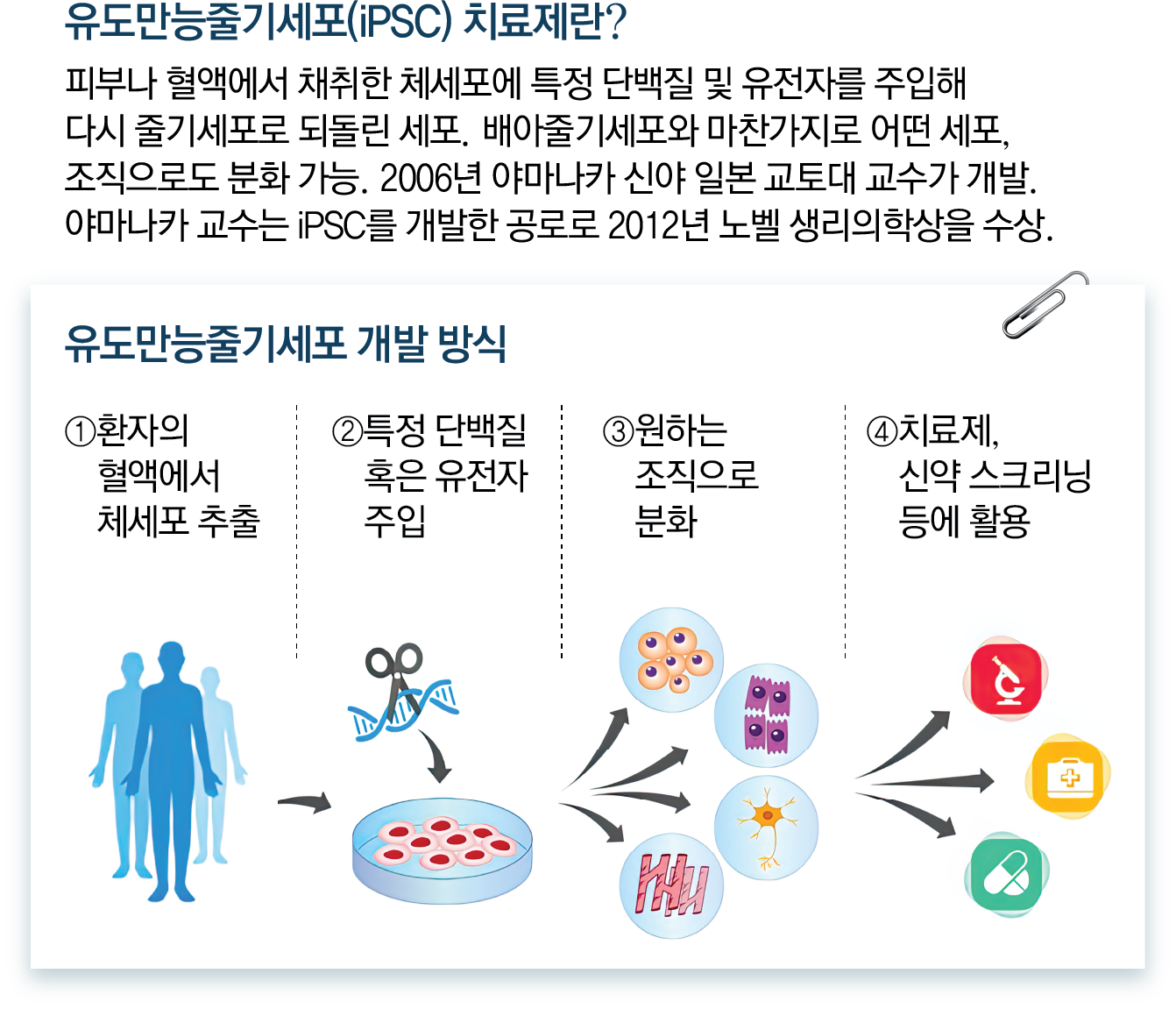
iPS cells are somatic cells taken easily from adult skin or blood that are reverted to “stem cells” by introducing specific proteins (Yamanaka factors). In effect, somatic cells, which are fully matured and fixed in form like adults, are converted back into pluripotent stem cells that resemble children capable of becoming anything. Because stem cells can differentiate into any cell type and be used to repair already damaged tissue, iPS cells have long been regarded as a breakthrough candidate for a wide range of intractable diseases.
Both of the newly approved therapies were developed using this principle. Parkinson’s disease is a condition in which neurons in the brain that produce dopamine are damaged, causing muscles to gradually stiffen. For Amchepri, blood cells are taken from a Parkinson’s disease patient and reverted to iPS cells, which are then induced to differentiate into dopamine-producing precursor cells. These dopamine-producing precursor cells are subsequently transplanted into the patient’s brain. Reheart is also produced by creating iPS cells from somatic cells derived from heart failure patients and differentiating them into cardiac muscle cells. These then grow into clumps of up to 100 million cells that help support the function of the heart muscle.
Japan has allowed conditional approval so that patients can access the therapies quickly. Under this system, approval is granted after confirming safety and efficacy with fewer trial participants than would normally be required for a standard drug approval. Companies must analyse treatment outcomes over seven years after commercialization and obtain full approval from health authorities. According to the Asahi Shimbun, clinical trials for Amchepri involved seven patients, while those for Reheart involved eight.
● US and China also expanding trials to capture KRW 40 trillion-class market
With the launch of the world’s first iPS cell therapies, global development competition is expected to intensify further. Market research firm Global Market Insights forecasts that the global stem cell therapy market will grow from USD 11.8 billion (about KRW 17.6304 trillion) in 2022 to USD 31.5 billion (about KRW 47 trillion) in 2032.
According to a review paper published last year in the international journal Cell Stem Cell, as of 2024 there were 115 clinical trials of iPS cell therapies approved by regulatory authorities. Of these, 38% were being conducted in the United States, 15% in China, and 12% in Japan.
In January this year, the US National Institutes of Health (NIH) announced plans to reduce reliance on research using human embryonic stem cells and expand clinical trials related to iPS cells. The NIH and the California Institute for Regenerative Medicine (CIRM) invest more than KRW 2 trillion each year in stem cell research, including iPS cells. In China, iPS cells were designated as an innovative technology in the “Made in China 2025” plan announced last year.
In Korea, regulations on low-risk research have been eased since January this year, following the enforcement of the amended Act on the Safety and Support of Advanced Regenerative Medicine and Advanced Biological Products (Advanced Regenerative Bio Act). A representative of a domestic stem cell development company stated, “There is still a long way to go compared with Japan, but as regulations have been significantly relaxed compared with the past, the development of stem cell therapies, including iPS cell-based therapies, is expected to accelerate in Korea as well.”
ⓒ dongA.com. All rights reserved. Reproduction, redistribution, or use for AI training prohibited.
Popular News









 About Dong-A Ilbo