Abnormal signals detected by comparison with empty exam room baseline… Alerts and location sent to proctors
Designed not to monitor communications or collect personal data… Limited detection for non-transmitting storage-only cameras
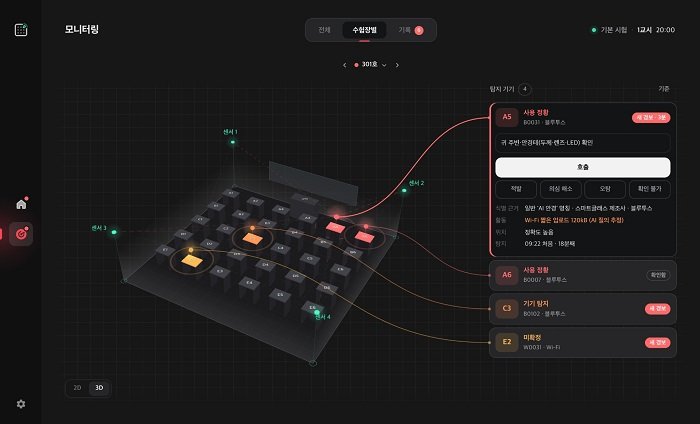
Mori’s FairRoom wireless signal detection system control screen. Photo courtesy of Mori
Content protection artificial intelligence (AI) startup Mori (CEO Kim Gyu-seok) announced on the 18th that it has unveiled “FairRoom,” a system that detects electronic devices that could be used for exam cheating?such as AI smart glasses and ultra-compact wireless cameras?through wireless signals. The company stated that it took into account the limitations of identifying small devices using only visual inspections or metal detectors.
According to Mori, FairRoom detects radio waves from low-power Bluetooth (BLE), Wi-Fi, mobile communications, and analog video transmitters through sensors installed in examination rooms. It records the wireless environment of an empty examination room before the test and then analyzes newly occurring signals or changes in signal movement.
When an abnormal signal is detected, an alarm and approximate location are displayed on the control screen, and the system is said to assess the level of suspicion by combining signal characteristics by device type with multiple analytical results. Proctors then refer to this information to decide whether to take action. A control program is also provided to enable integrated monitoring of conditions across multiple examination rooms.
The company stated that FairRoom analyzes only header information and signal strength, and does not inspect the content of communications. Device identification addresses are pseudonymized, no personal information on test-takers is collected, and records are destroyed after the retention period expires.
The company also acknowledged technical limitations. Storage-type cameras that do not transmit radio waves are difficult to detect, and cheating cannot be definitively determined based solely on abnormal signals, so existing proctoring procedures must be used in parallel. It added that verification of detection accuracy and the potential for false positives in real-world environments is also necessary.
Mori, founded in March 2025, has been operating an image security service that disrupts unauthorized AI training, and stated that it applied signal analysis principles such as watermark detection, developed in that business, to FairRoom.
Mori is preparing on-site tests and is currently recruiting pilot institutions, including permanent computer-based testing (CBT) centers, with plans to provide the service on a subscription basis in the future.
CEO Kim Gyu-seok said, “AI glasses are now becoming difficult to distinguish by appearance alone,” adding, “We have developed a tool that can be used for exam management by detecting wireless signals that proctors cannot easily confirm with the naked eye.”
ⓒ dongA.com. All rights reserved. Reproduction, redistribution, or use for AI training prohibited.
Popular News









 About Dong-A Ilbo