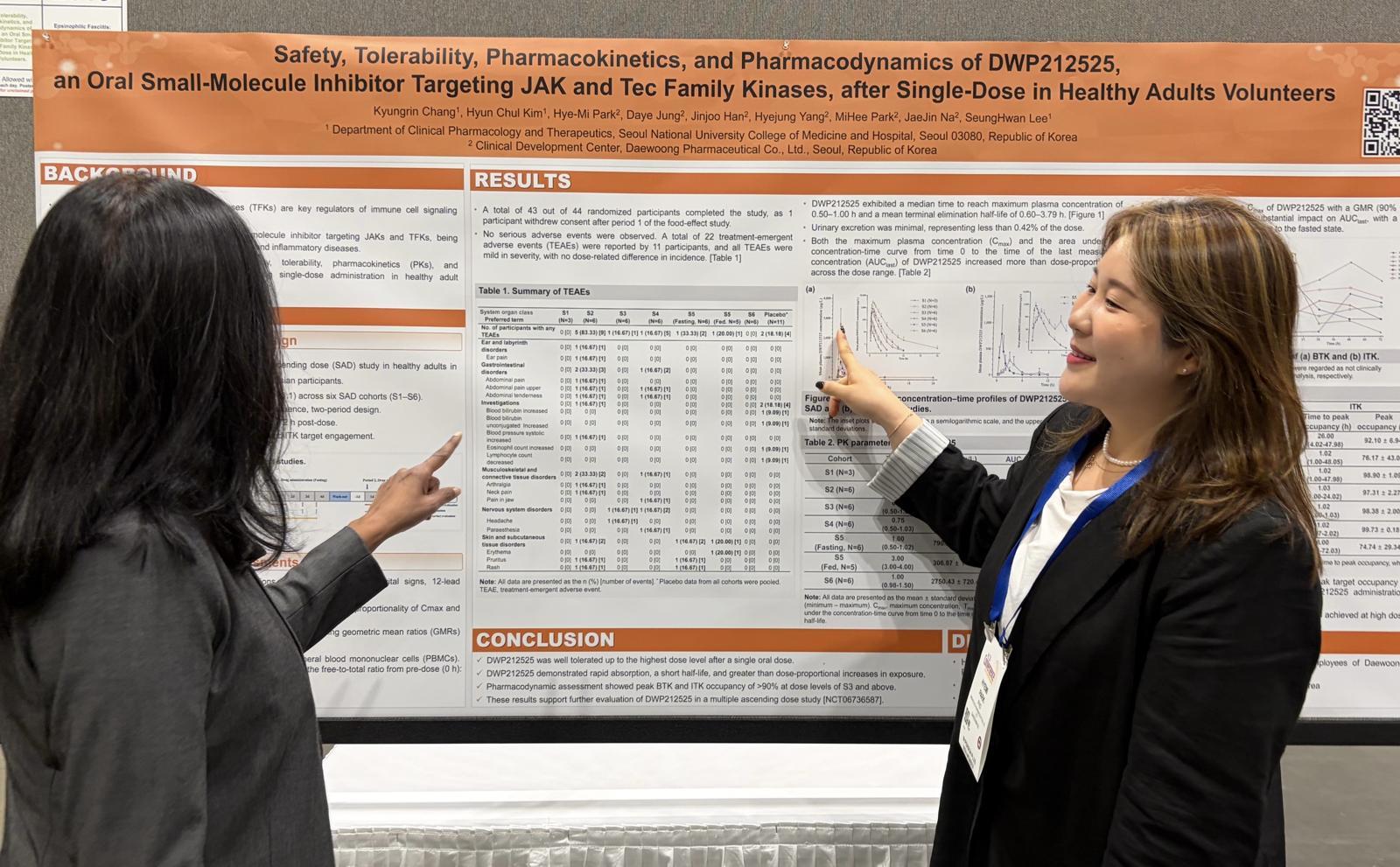
Park Hye-mi, PL at Daewoong Pharmaceutical’s Clinical Development Center, presents Phase 1 clinical trial results for the autoimmune disease drug candidate plodicitinib (DWP212525) at ACR Convergence 2026. Provided by Daewoong Pharmaceutical
Daewoong Pharmaceutical has confirmed a high level of binding to key target proteins and initial safety results in a Phase 1 clinical trial of ‘plodicitinib’, a new drug candidate for autoimmune diseases currently under development.
Daewoong Pharmaceutical announced on the 17th that it presented the interim Phase 1 results of plodicitinib (DWP212525) at the “American College of Rheumatology Annual Scientific Meeting (ACR Convergence) 2026” held in Orlando, Florida, United States.
Plodicitinib is an oral new drug candidate being developed for the treatment of autoimmune and inflammatory diseases. It is characterized by its simultaneous targeting of three proteins: JAK3, which regulates the activation and function of immune cells, and ITK and BTK, which are involved in T-cell and B-cell activation, respectively.
Whereas many existing therapies suppress either T cells or B cells, plodicitinib is designed to modulate signals involved in the activation of both types of immune cells. Based on this, Daewoong Pharmaceutical is reviewing the potential to expand development to various autoimmune diseases such as rheumatoid arthritis, systemic lupus erythematosus, and Sjogren’s syndrome.
At this conference, results were disclosed from the single ascending dose (SAD) part of a first-in-human Phase 1 trial conducted in 44 healthy adults.
Analysis showed that the maximum target occupancy of the main targets BTK and ITK each exceeded 90%. Target occupancy is an indicator of the extent to which a drug binds to its intended protein. The company stated that these results provide initial pharmacodynamic evidence that the drug acts on its targets in the human body.
In the pharmacokinetic assessment, systemic exposure to the drug increased as the administered dose increased. In the safety assessment, no serious adverse events were observed, and all adverse events that occurred after administration were confirmed to be mild. There was no clear difference in the incidence of adverse events according to dose escalation.
However, as this is an early-phase clinical study conducted in healthy adults, the actual therapeutic effect in patients with autoimmune diseases must be confirmed through subsequent clinical trials.
Daewoong Pharmaceutical has completed the single ascending dose study and is currently conducting a multiple ascending dose (MAD) study. The company aims to complete the overall Phase 1 program in the first quarter of 2027.
Professor Lee Seung-hwan of the Department of Clinical Pharmacology at Seoul National University Hospital, who is overseeing the clinical trial, said, “In the single ascending dose study conducted in healthy adults, no meaningful safety issues such as serious adverse events were identified,” adding, “It is expected that the multiple ascending dose study will also show favorable tolerability.”
Park Sung-soo, CEO of Daewoong Pharmaceutical, said, “The observation of high target occupancy of major targets in this study is a meaningful early result for the continuation of subsequent clinical development,” and added, “We will secure clinical data through the multiple ascending dose study and expand development potential and global development opportunities across various autoimmune diseases.”
ⓒ dongA.com. All rights reserved. Reproduction, redistribution, or use for AI training prohibited.
Popular News









 About Dong-A Ilbo