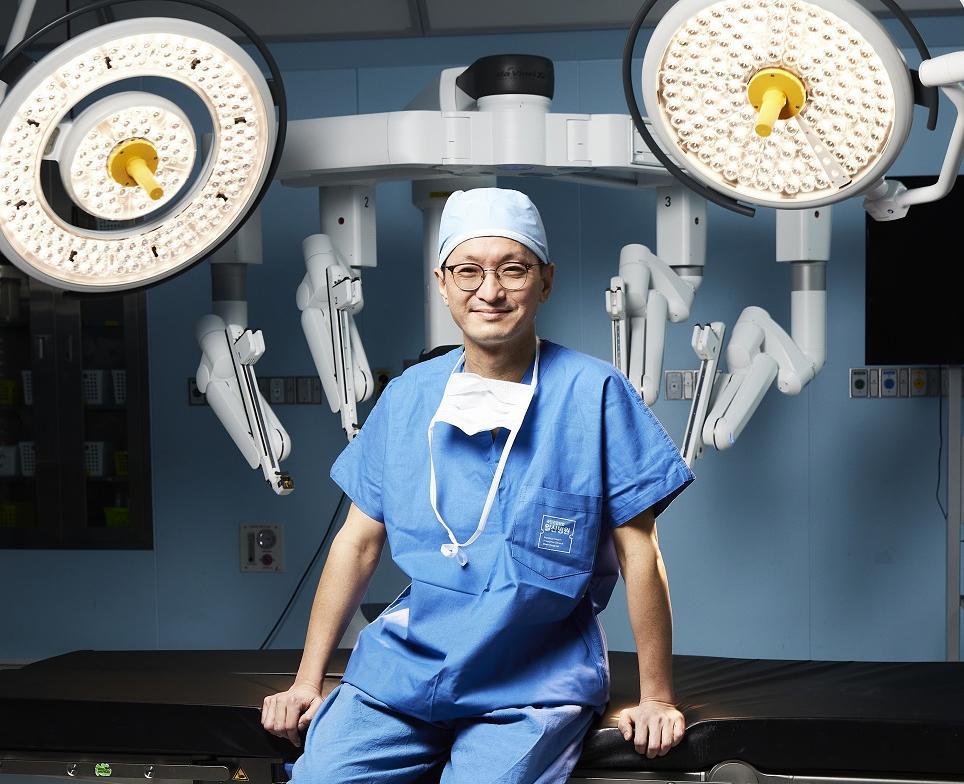
Professor Lee Hyoung-soon, Department of Surgery, National Health Insurance Service Ilsan Hospital. Provided by NHIS Ilsan Hospital
The National Health Insurance Service Ilsan Hospital (Director: Han Chang-hoon) has become the first in Gyeonggi Province to achieve 200 cases of robotic hernia surgery, including inguinal and abdominal wall hernias.
Ilsan Hospital introduced the da Vinci Xi robotic surgery system in 2016, and additionally installed the da Vinci SP, a single-port robotic surgery system, in August last year. The da Vinci SP inserts a camera and multiple surgical instruments through a single incision about 2.5 cm in size. It is designed to enable precise surgery even in narrow and deep spaces.
A hernia is a condition in which tissue or organs in the abdominal cavity protrude through a weakened area of the abdominal wall. The surgical method varies depending on the location and size of the hernia and whether there has been prior surgery. The Department of Surgery at Ilsan Hospital has accumulated experience by applying robotic surgery to a variety of abdominal wall hernias, including inguinal hernias, umbilical hernias, and incisional hernias.
Robotic surgery is characterized by the ability to observe the surgical field in detail through magnified three-dimensional images and to use jointed surgical instruments that move like a human wrist. This helps perform precise dissection and suturing while confirming the anatomical structure of the abdominal wall.
The accumulated clinical experience has also led to research. The surgical team of Professors Lee Hyoung-soon and Jung Sung-woo of the Department of Surgery at Ilsan Hospital published “Practical Guidelines for Robotic Laparoscopic Inguinal Hernia Repair,” which systematically organizes the procedure for robotic inguinal hernia surgery, in the international journal Journal of Surgical Innovation and Education in June last year.
The researchers organized the entire surgical process step by step, from patient positioning and robot docking to peritoneal incision, hernia sac dissection, mesh insertion, and peritoneal closure. They explained that the robot’s three-dimensional magnified images and jointed instruments can help perform precise dissection and suturing in the narrow preperitoneal space. However, they emphasized that appropriate patient selection and standardized surgical techniques are important for stable surgical outcomes.
Professor Lee Hyoung-soon said, “We have accumulated experience with more than 200 cases by applying robotic surgery not only to inguinal hernias but also to various abdominal wall hernias,” and added, “With the introduction of the da Vinci SP, single-port surgery has been added as an option, so we will apply the most appropriate surgical method for each patient by considering the advantages of both the Xi and SP systems, and continue research to standardize robotic hernia surgery techniques.”
ⓒ dongA.com. All rights reserved. Reproduction, redistribution, or use for AI training prohibited.
Popular News










 About Dong-A Ilbo