Samsung Electronics KRW 27 trillion, SK hynix KRW 6 trillion
Up 52% and 98% year-on-year
All-out push to defend No.1 in AI chips such as HBM
Micron’s R&D investment limited to KRW 3 trillion
South Korea’s memory chipmakers, including Samsung Electronics and SK hynix, recorded the largest-ever increases in research and development (R&D) spending in the first half (January–June) of this year. The move is seen as an effort to leverage the artificial intelligence (AI)-driven memory “supercycle” to further widen their technological lead over overseas competitors in the United States, China, and elsewhere.
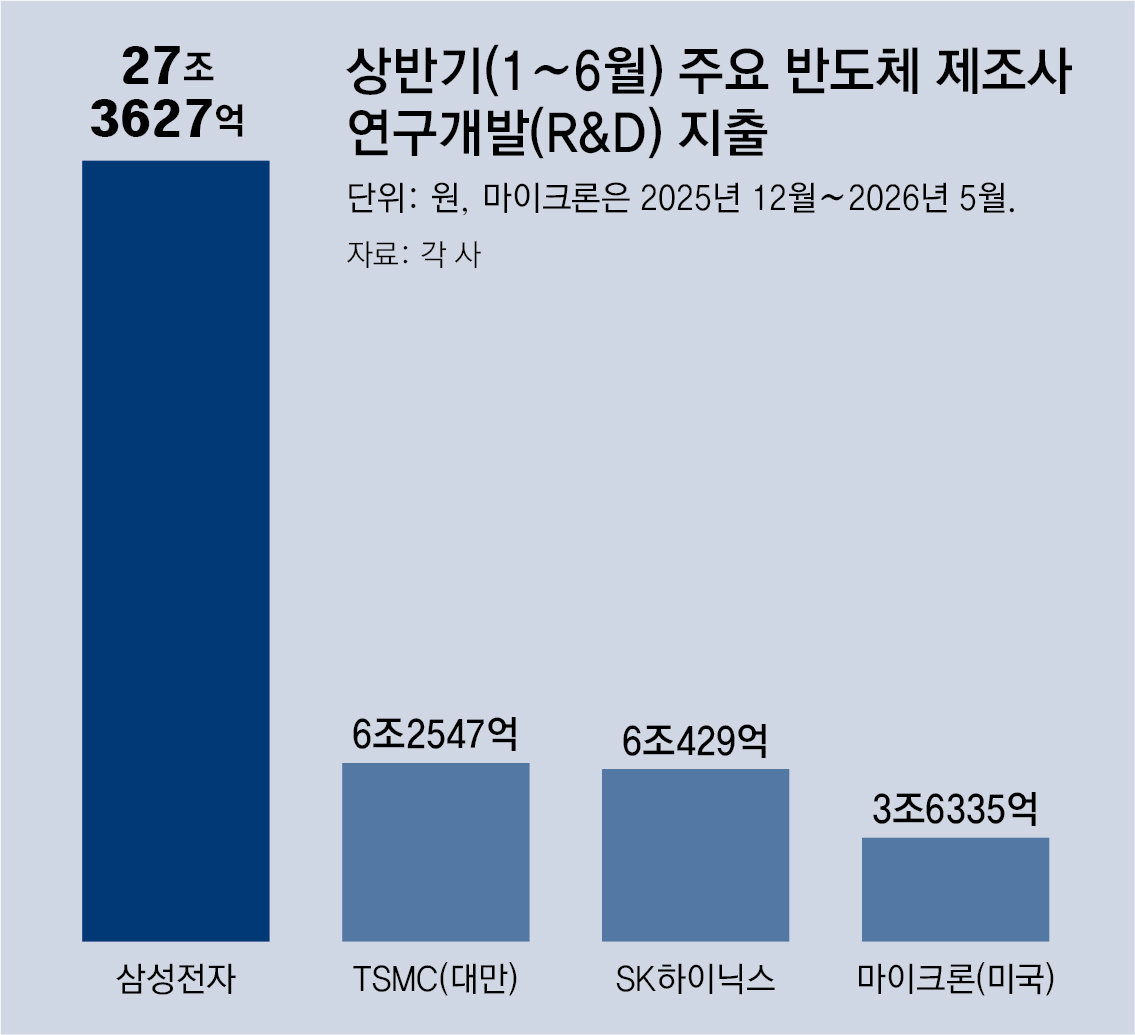
● Samsung KRW 27 trillion, SK hynix KRW 6 trillion vs. Micron KRW 3 trillion
According to the Financial Supervisory Service’s electronic disclosure system on the 17th, Samsung Electronics and SK hynix posted R&D investments of KRW 27,362.7 billion and KRW 6,042.9 billion, respectively, in the first half of this year, up 51.5% and 98.4% from a year earlier. Both the growth rates and absolute increases are all-time highs for the two companies. SK hynix’s first-half R&D spending is already approaching last year’s full-year level of KRW 6,732.6 billion. The Samsung figure includes not only the semiconductor (DS) division but also the Device eXperience (DX) division covering mobile and home appliances; isolating semiconductors alone would likely show an even higher R&D growth rate.
The latest R&D growth rates for the two domestic memory chipmakers are exceptionally steep by historical standards. An analysis of semiannual reports from 1999, when companies began filing business reports through electronic disclosure, through this year shows that, excluding this year, the average annual R&D growth rates were 13.6% for Samsung Electronics and 12.5% for SK hynix. Their previous record highs were 31.0% for Samsung (2010) and 52.6% for SK hynix (2008). At the current pace, the two firms’ full-year R&D growth rates for this year are also expected to be the highest on record.
The R&D investment scale of South Korean semiconductor firms is overwhelming even in comparison with the entire global chip manufacturing sector. U.S.-based Micron Technology, Samsung’s biggest rival in DRAM, spent USD 2.566 billion (approximately KRW 3,633.5 billion) on R&D in the first half of its fiscal year (December 2025–May 2026), equivalent to about 13% of Samsung’s and 60% of SK hynix’s outlays. In terms of R&D as a share of revenue, Samsung and SK hynix posted 9.0% and 4.6%, respectively, compared with Micron’s 3.9%, indicating that Korean firms are allocating a larger portion of their earnings to technology development.
In non-memory manufacturing, U.S. Intel, an integrated device manufacturer (IDM) similar to Samsung Electronics, spent USD 6.743 billion (approximately KRW 9,541.3 billion) on R&D in the first half, an 8.6% decline from a year earlier. Taiwan’s TSMC, the world’s largest foundry, invested TWD 140.930 billion (approximately KRW 6,254.7 billion) in R&D during the same period, up 19.6%. Previously, TSMC’s R&D spending significantly exceeded that of SK hynix, but this year’s sharp increase at SK hynix has brought the two companies to roughly comparable levels.
● All-out push to defend top position in AI chips such as HBM
Samsung Electronics and SK hynix are channeling their expanded R&D budgets into developing cutting-edge memory process technologies. Highlighting its R&D achievements, Samsung stated that it has begun mass production and shipment of the “world’s first and highest-performance sixth-generation high bandwidth memory (HBM4) featuring state-of-the-art DRAM.” This refers to the products it began supplying to Nvidia in February. The company also noted that, for seventh-generation HBM4E, it “shipped the industry’s first 12-high stack samples.”
SK hynix also cited advanced DRAM for servers and mobile devices as its major first-half R&D achievements. The company emphasized that it had developed the world’s first mobile low-power DRAM (LPDDR6) based on the latest process technology. The product targets “on-device AI,” in which AI capabilities are embedded directly in devices such as smartphones and tablets.
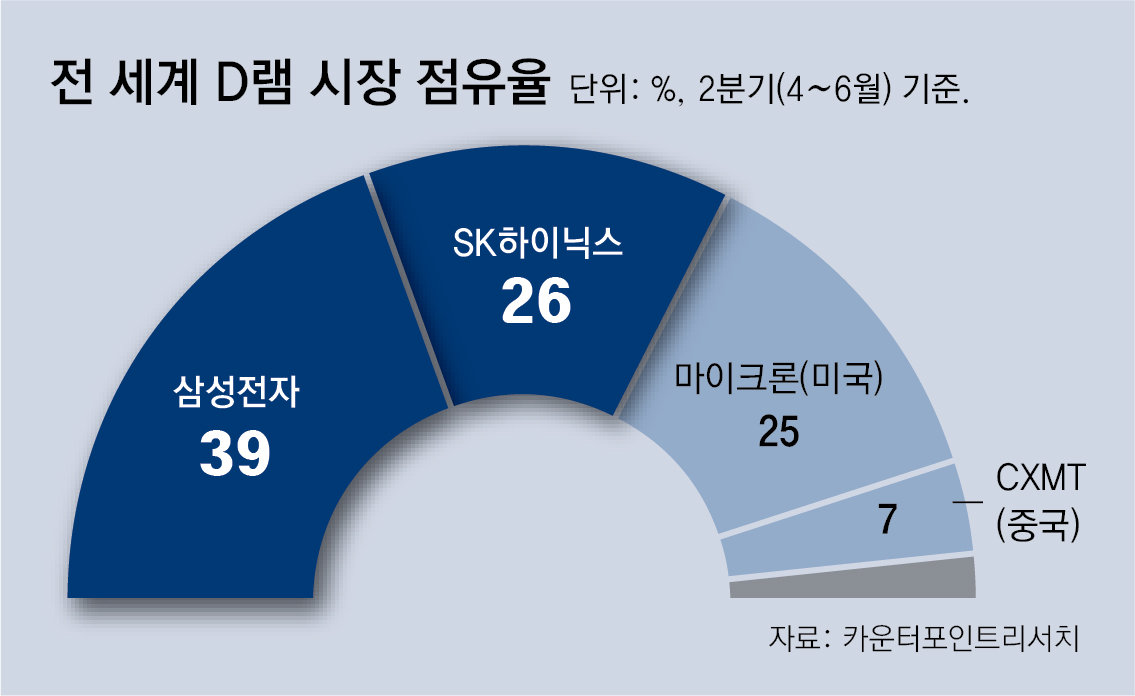
The DRAM products currently in mass production at Samsung Electronics and SK hynix are widely regarded as more advanced than those of their main U.S. rival, Micron. Even at identical leading-edge process nodes, the Korean firms demonstrate higher manufacturing yields (share of non-defective products), faster data processing speeds, and superior power efficiency. This is a key reason major Big Tech companies including Nvidia prefer Korean memory first. Compared with ChangXin Memory Technologies (CXMT), China’s leading DRAM supplier, the technology gap is estimated at roughly three to six years. The DRAM currently mass-produced by CXMT is based on technology that Samsung and SK hynix commercialized in 2019.
Domestic firms are accelerating not only R&D but also capacity expansion to block latecomers from entering the market amid a global memory shortage. Samsung’s DS division invested KRW 25,603.0 billion in production facilities in the first half, up 23.5% from a year earlier. SK hynix increased its facility investments from KRW 11,249.0 billion to KRW 17,595.0 billion over the same period, a 56.4% rise.
Lee Jong-hwan, professor in the Department of System Semiconductor Engineering at Sangmyung University, said, “As the AI semiconductor market grows and competition intensifies, Korean companies must move even faster than before to widen their lead over competitors,” adding, “Only by further increasing R&D investment can Korea’s semiconductor industry secure dominance in the market going forward.”
ⓒ dongA.com. All rights reserved. Reproduction, redistribution, or use for AI training prohibited.
Popular News







 About Dong-A Ilbo