Interview with Kim Kang-hak, leader of Kakao’s ‘Kanana’
Reading KakaoTalk context to propose schedules first
Protecting privacy with on-device AI
Competing with Apple and Google in proactive AI
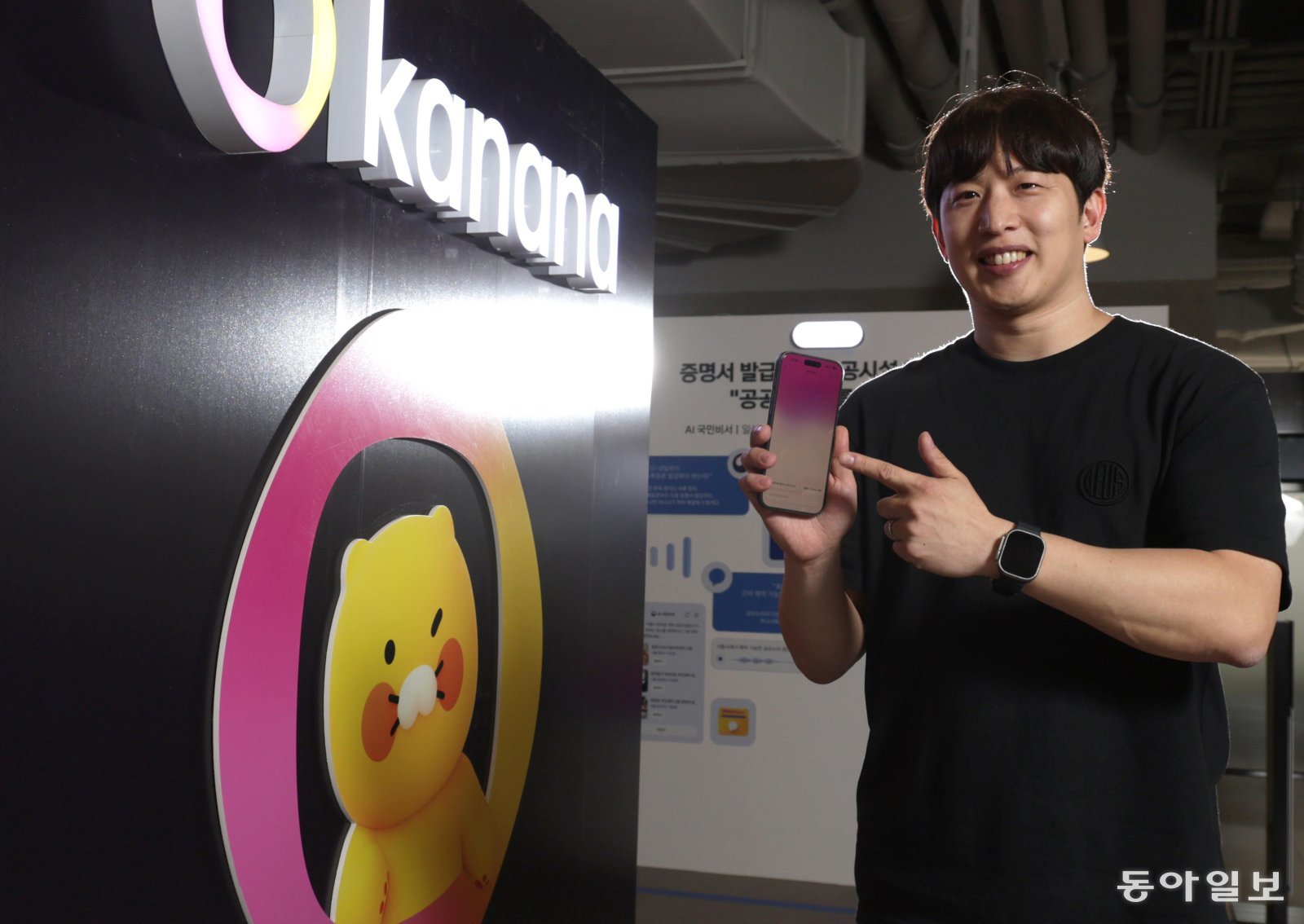
On the afternoon of the 6th, Kim Kang-hak, leader overseeing the development of Kakao’s next-generation AI service “Kanana in KakaoTalk,” strikes a pose at Kakao Pangyo Agit in Seongnam, Gyeonggi Province. Kanana in KakaoTalk presents itself as a “proactive AI” that analyzes the context of users’ conversations and offers necessary services such as scheduling and venue reservations in advance. Seongnam = Byun Young-wook, Reporter cut@donga.com
“The idea was that KakaoTalk could bring forward the future where artificial intelligence (AI) speaks to people first, like a secretary in a movie.”
This was how Kim Kang-hak, leader of Kakao’s “Kanana in Talk Studio,” explained the background to developing the proactive AI “Kanana in KakaoTalk” (Kanana) in an interview with Dong-A Ilbo reporters on the 6th. After working as a machine learning engineer at Daum and founding the conversational AI startup “Fluenty,” Kim joined Kakao in 2024 and has since been overseeing Kanana’s development.
Kanana in KakaoTalk positions itself as a “personal secretary inside KakaoTalk” that reads the flow of users’ conversations and proactively initiates dialogue to provide schedules, information, and locations. Unlike generative AIs such as ChatGPT and Claude, which require users to first ask questions and give detailed instructions, Kanana actively identifies tasks and carries them out autonomously. It is an attempt to realize in practice the role of an AI assistant like “JARVIS” in the film “Iron Man.”
● AI that knows when to step in
The core of proactive AI is the ability to decide “when to step in.” If it intervenes when there is no need, users will find it intrusive; if it fails to intervene when needed, users will feel inconvenienced. Kim said, “Even if a certain topic comes up in a conversation, it may not actually be what the user is interested in,” adding, “It is important to accurately distinguish whether the user needs help and then intervene.”
To achieve this, the development team built a virtual environment where numerous AIs converse with one another. Accurately understanding user characteristics is crucial for precise intervention in conversations. The team had AI agents with different concepts—such as a young adult who speaks briefly, a teenager who frequently uses new slang, and an older person who writes in long sentences—engage in one-on-one or group-chat conversations and then evaluated the results. In this way, they compensated for the limitations of the “on-device” model, which, due to privacy protection, cannot access actual user conversations, by using virtual data instead.
Thanks to these improvements, an internal survey compiled by Kakao based on user feedback showed that the satisfaction rate among Kanana users was about 80 percent. In particular, satisfaction with specific responses reached about 90 percent. This was the result of collecting user feedback through a closed beta test, shortening the model deployment cycle, and making continuous improvements. Kakao also plans to enhance functions so that users can directly adjust the degree of AI intervention in the future.
● 30 million “KakaoTalk secretaries”… intensifying competition in proactive AI
Competition in proactive AI has already begun worldwide. Apple has unveiled functions that enable “Siri AI” to grasp personal context from messages, emails, and more, and to handle tasks across apps. Google is also moving in a direction where “Gemini Intelligence” proactively performs multi-step tasks such as reservations and shopping by understanding users’ context and needs.
Kanana’s strongest competitive edge, according to Kakao, is the influence of KakaoTalk as a messenger. The plan is to leverage the vast everyday “context” KakaoTalk has already accumulated. On KakaoTalk, used by the vast majority of the population, information such as appointments, interests, and venue choices naturally accumulates in conversations with friends and family. Unlike separate AI services that must newly infer users’ preferences and situations, Kanana can use this conversational context as its starting point.
Based on smartphones capable of running on-device AI, Kakao projects that the number of devices supporting Kanana in KakaoTalk will increase to around 30 million by the end of the year. “Kakao’s platform power is very strong,” Kim said, adding, “The goal is not only to invigorate Kakao’s internal businesses such as Kakao Shopping, but also to boost the businesses of partners participating in Kanana, including Coupang Eats.”
ⓒ dongA.com. All rights reserved. Reproduction, redistribution, or use for AI training prohibited.
Popular News









 About Dong-A Ilbo