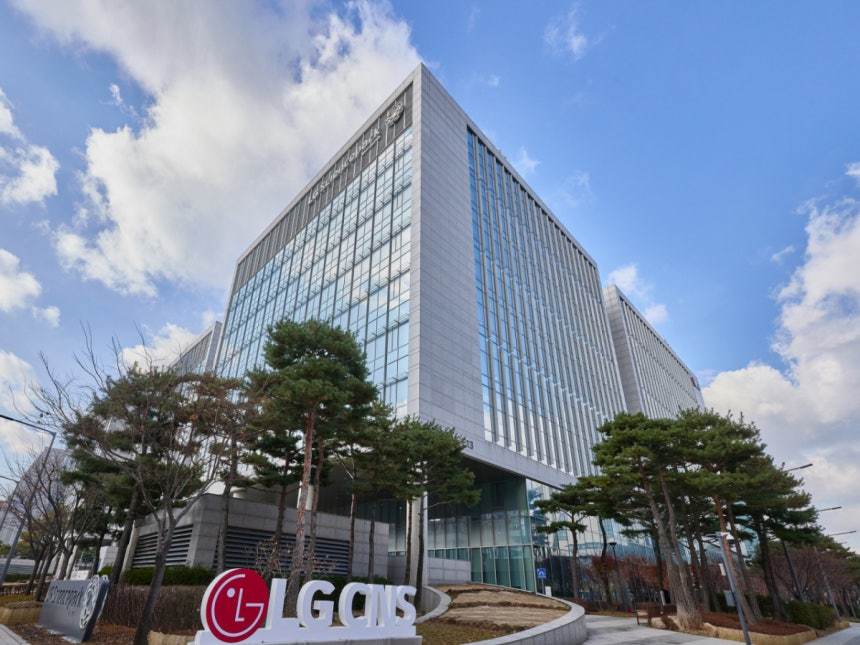
Front view of LG CNS headquarters.
LG CNS announced on the 12th that, together with DAI (DAI), the IT affiliate of Dong-A Socio Group, it has completed the construction of Dong-A Socio Group’s artificial intelligence (AI) new drug development platform.
The two companies spent about six months building the platform. The platform integrates new drug research data and is equipped with functions that support the research process with AI, from the discovery of candidate substances to verification. It is designed so that AI prediction results and actual experimental data are continuously linked and learned, gradually improving prediction performance.
New drug development typically requires the repeated verification of numerous candidate substances and usually takes 10 to 15 years, incurring substantial costs. The platform is expected to help reduce development time, costs, and the risk of failure by selecting candidate substances with a high probability of success and predicting efficacy and safety in advance.
The platform integrates and standardizes new drug research data that had been scattered across compounds and genomic information, experimental results, papers, and patents. As a result, researchers can utilize the necessary data on a single platform and use AI analysis and prediction functions.
The platform supports each stage of the new drug development process. In the stage of identifying disease causes, it analyzes and visualizes gene information by cell and spatial information within tissues using AI to aid in the discovery of therapeutic targets. In the candidate substance design stage, generative AI designs molecular structures that meet specified conditions. In the verification stage, it simulates and predicts binding potential and functional stability between candidate substances and targets, selects promising candidates, and performs virtual verification in a computer environment prior to actual experiments.
LG CNS built the platform to enable continuous performance improvement. By comparing AI prediction results with actual experimental data and feeding them back into model retraining, prediction performance improves as more research data accumulate. It has linked the entire process from data collection to AI analysis, experiments, and verification, and established a management system so that the accumulated research data can be utilized as separate assets. A data management framework that meets regulatory and security requirements in the pharmaceutical industry has also been implemented.
Meanwhile, LG CNS is expanding its related business by utilizing “AgenticWorks for BIO,” an agentic AI platform specialized in the pharmaceutical and bio sectors.
First, it participated in the Ministry of Health and Welfare’s “K-AI New Drug Development Preclinical and Clinical Model Development Project (R&D).” This is a large national research project into which approximately KRW 37.1 billion in government funding will be injected over four years and three months. It also developed an agentic AI-based annual product quality review report preparation service (hereafter APQR, Annual Product Quality Review) for Chong Kun Dang, reducing document generation time by more than 90%.
ⓒ dongA.com. All rights reserved. Reproduction, redistribution, or use for AI training prohibited.
Popular News









 About Dong-A Ilbo