Maritime drone technology revolutionizing last-mile delivery at sea
Former Navy helicopter pilot turned civilian UAV researcher, then founder
Expertise spanning sea–ship–aircraft… differentiated by unique autonomous takeoff and landing technology
Practical venture avoiding airframe manufacturing risks… “Also contributing to search for castaways and marine pollutants”
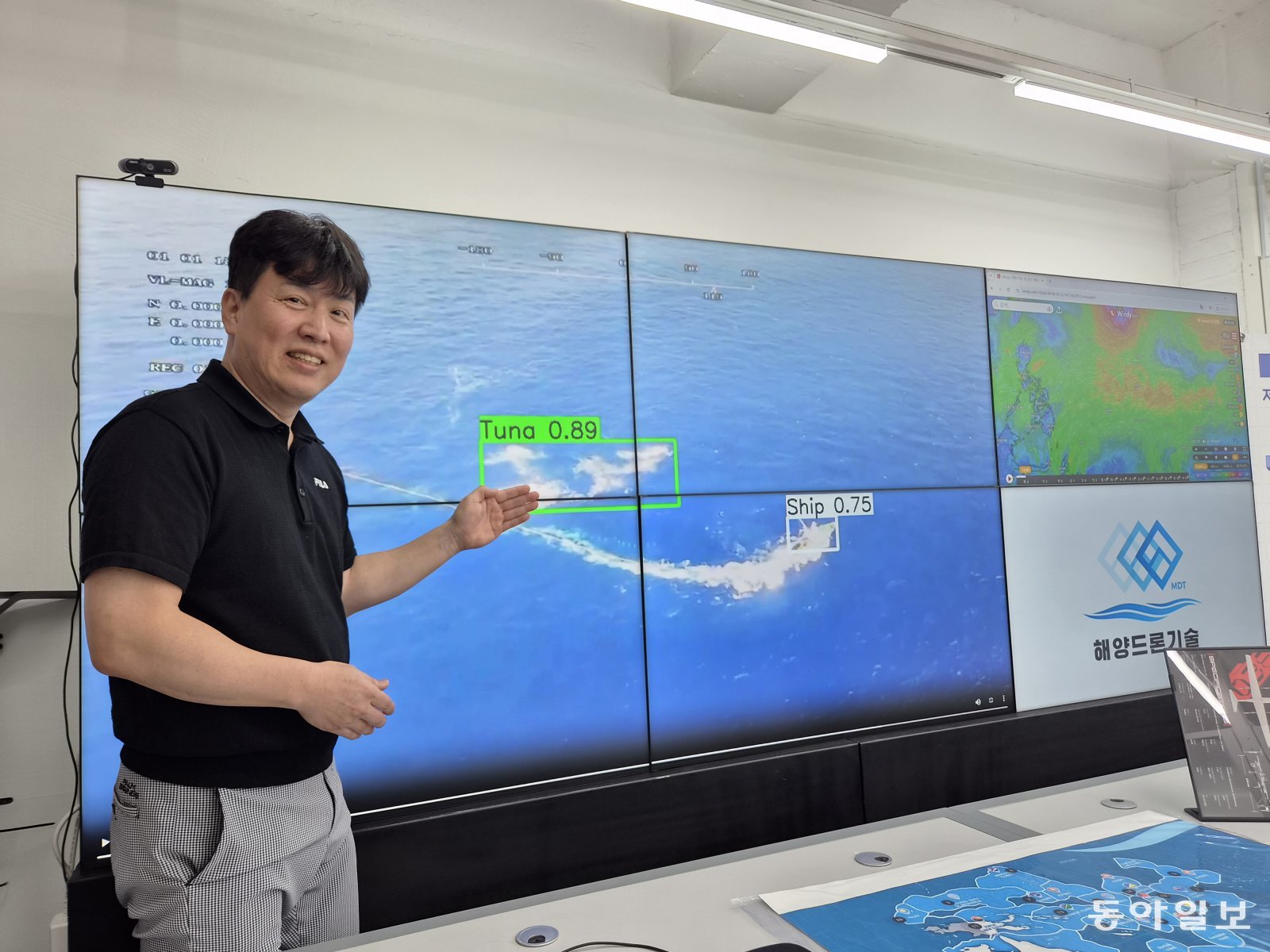
On 4 August at the company’s headquarters in Jung-gu, Busan, Hwang Eui-cheol, CEO of Marine Drone Technology, explains the current status of drone operations while showing a video captured by a drone over the South Pacific in which tuna are identified. Busan = Reporter Heo Jin-seok jameshur@donga.com
The boundless South Pacific is not merely a romantic sea. It is also a bloody battleground for survival. Captains and crews pursuing schools of tuna are under constant pressure to fill their holds once a month. They must compete with tuna fleets converging from all over the world, engaging in an intense race to reach larger tuna schools more quickly. There is someone who understands the harsh logic of this sea more than anyone else: Hwang Eui-cheol (55), CEO of Marine Drone Technology, who flew over the sea for as long as 20 years as a naval maritime operations helicopter pilot. He is replacing old, dangerous helicopters with artificial intelligence (AI) drones in the sky to locate tuna schools, transforming fishing operations across the global fisheries industry. Meeting at the company’s headquarters in Jung-gu, Busan on 4 August, Hwang said, “For now, drones are operated on board by personnel trained in drone piloting, but soon we will usher in an era of ‘fully autonomous flight (zero-pilot) drones’, in which a single person on land will simply supervise multiple drones.”
● Innovating outdated helicopters with drones Deep-sea tuna fishing is literally a “speed race” and an “information war.” The vessel that first locates a fish school and casts its net takes everything. As it takes a full two hours just to cast and haul in a net, dropping it in the wrong place wastes tens of millions of KRW in daily fuel costs and forfeits the chance to land tuna as valuable as gold. This is why deep-sea fishing companies spend enormous sums every year to search for tuna by helicopter.
However, as Hwang describes it, operating helicopters over the sea is like handling a time bomb. Due to stringent aviation regulations, even a single faulty part requires a Ministry of Land, Infrastructure and Transport inspector to travel overseas to the site, during which time fishing operations are often suspended. Most tragic of all are helicopter crashes caused by bad weather or mechanical defects. “When an accident occurs, not only the pilot but also the captain and key fishing master on board the helicopter are killed in the line of duty,” Hwang said with regret.
● World’s first AI drone for tuna school detection
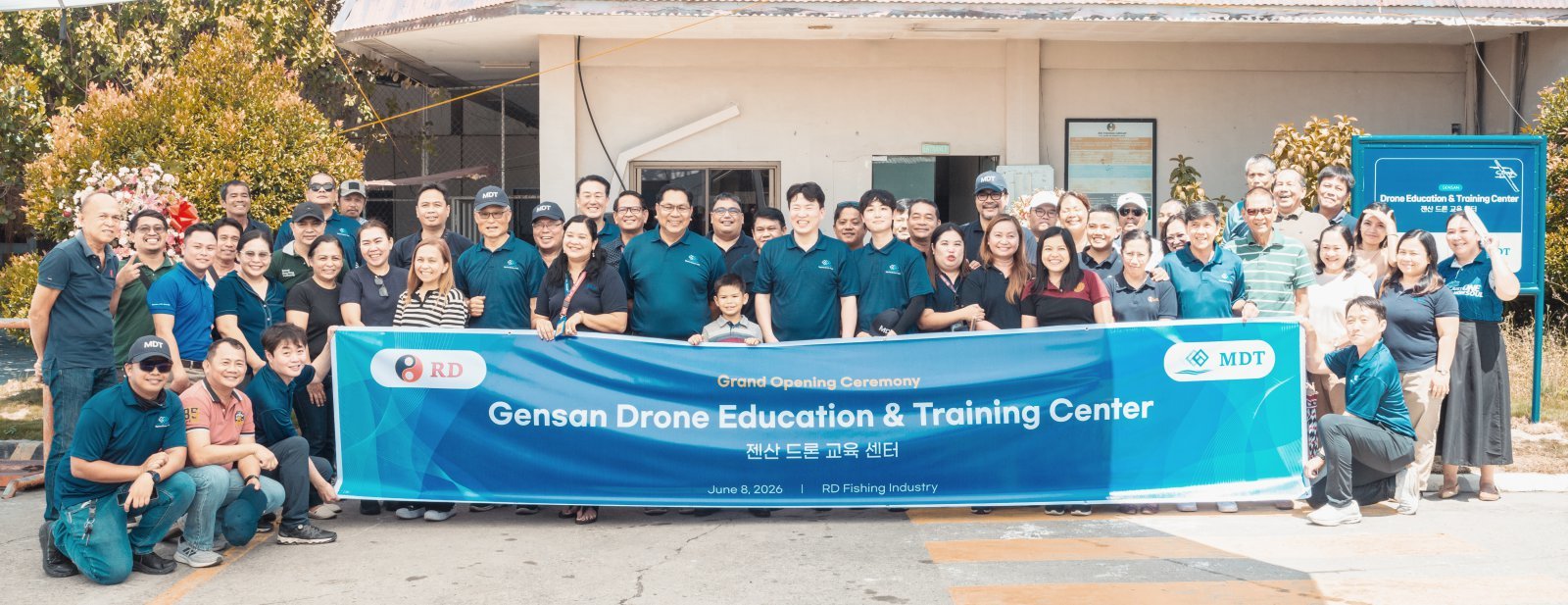
In June this year, Marine Drone Technology established a local drone pilot training center in the Philippines to provide AI drone services to Philippine deep-sea tuna fishing companies. Courtesy of Marine Drone Technology
The true value of Marine Drone Technology lies not just in the airframe that flies, but in its operating software optimized for harsh maritime environments and its AI solution, “BlueScope.” Launching and landing a drone on a rolling vessel is a problem on a completely different level from operating on land. Numerous foreign drone companies have tried and failed at sea—often literally crashing—because they did not understand the dynamics of vessels and the ocean. “We possess the convergence technology that is only possible when one understands both ships and the sea, and aircraft at the same time,” Hwang emphasized. The company has built an unrivaled technological moat that enables precise automatic landing on a moving landing pad aboard a ship that is pitching up and down in waves, rolling side to side, and suddenly moving irregularly forward and backward in winds of 14 m/s (the threshold for a strong wind advisory). It is an advanced technology that must predict the next movement of the heaving deck in 0.1-second increments and perfectly synchronize the drone’s attitude accordingly.
The AI analyzes in real time the subtle white waves that form when tuna drive prey such as anchovies or shrimp toward the surface, along with the movements of flocks of seagulls, and reports its findings. Having been trained on a massive 20 terabytes (TB) of video data on tuna schools, the on-device AI automatically detects and labels “Tuna” on the screen without the drone pilot having to search with the naked eye. “Conventional manned helicopter operations cost about KRW 1 billion per year, whereas drone operations are about KRW 330 million,” Hwang said. “Since the start of commercial operations in 2024, fishing companies have dramatically reduced their detection costs by 60%, and shortened the number of days needed to achieve a full load from 40 to 25.”
As of the first half of this year, the company has signed commercial contracts and is in operation with a total of 24 deep-sea fishing vessels. It aims to expand to 32 vessels by the end of this year and 64 vessels by the end of 2027. It has already entered not only Korea but also Japan and the Philippines. In June this year, it established a global AI drone operation and training center in General Santos, known as the “tuna capital” of the Philippines. In Papua New Guinea, home to a prime South Pacific tuna fishing ground, it plans to complete the establishment of a field-based drone operations center in August.
● Carving out a start-up path through pragmatism
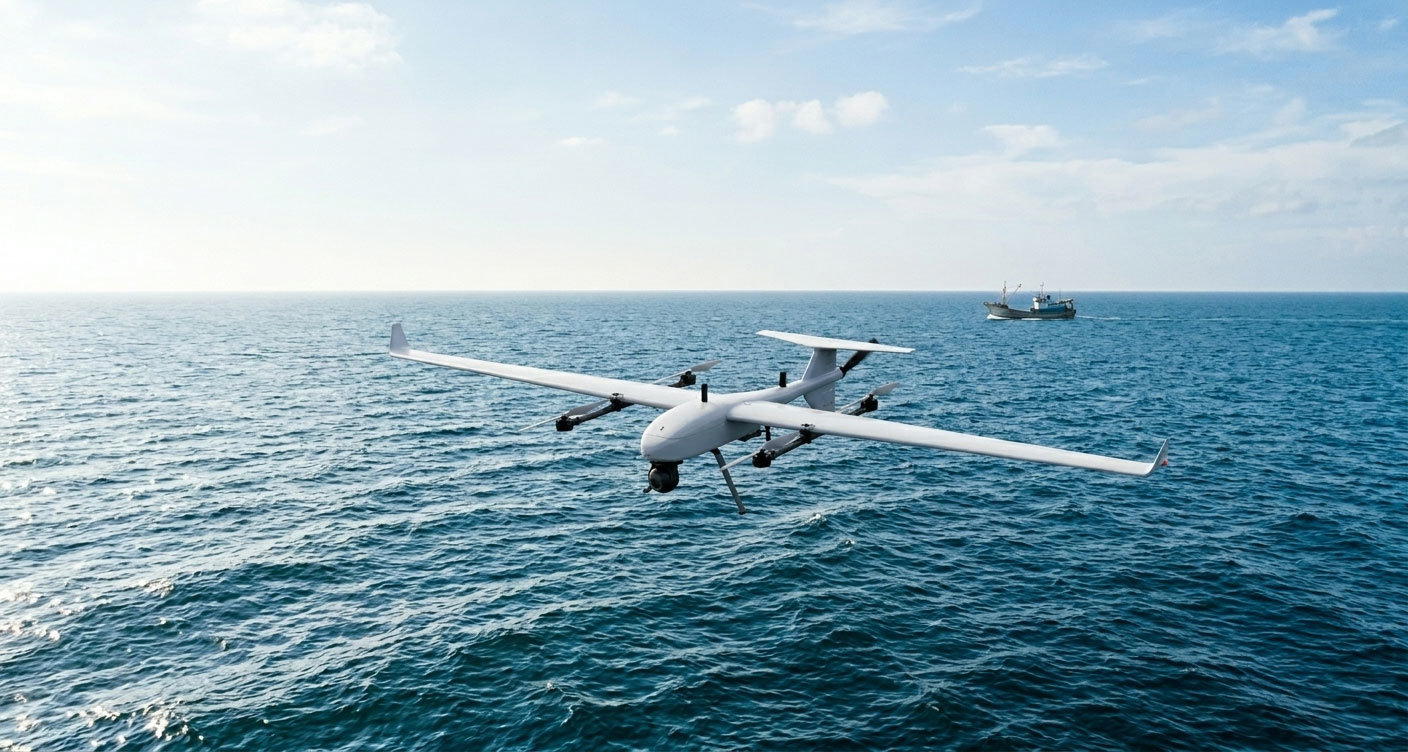
An AI drone in operation detecting tuna. Courtesy of Marine Drone Technology
His entrepreneurial trajectory differs markedly from that of many other companies that initially focused solely on airframe development. While working as an unmanned aircraft researcher at an airline’s research and development center, he closely observed the airline’s commercialization process. Just as Korean Air did not start by manufacturing aircraft but first introduced overseas commercial aircraft and built up its operations and maintenance platform before moving into defense weapons manufacturing, Hwang also chose a safe and practical start-up route.
From the outset, he did not manufacture airframes himself, but instead focused on the revenue-generating operations market. He imported about 50 commercial drones from China and elsewhere, and modified free open-source programs to create the software running on them. He then concentrated resources on building the operations platform, including training pilots to embark on tuna fishing vessels and establishing maintenance platforms. This was to avoid repeating the mistakes of companies that devoted themselves to manufacturing development only to collapse when confronted with the barrier of after-sales service (AS).
The process, however, was fraught with heartbreak and adversity. In the early stages of the business, his efforts to attract investment repeatedly failed in venture capital (VC) screenings. “I had to borrow start-up funds from my elderly mother and father, bringing tears to their eyes,” he said. Yet he did not give up and instead turned the COVID-19 pandemic into an opportunity. For crew members unable to go ashore and stuck at anchorage points, he pushed ahead with pilot projects for maritime drone deliveries of food and medical supplies. In front of civil servants who struggled with the absence of precedents, he conducted vivid demonstrations delivering fried chicken and pizza, and ultimately secured South Korea’s first-ever license as a paid drone delivery operator in 2021.
● A leap powered by 10,000 hours of drone flight data
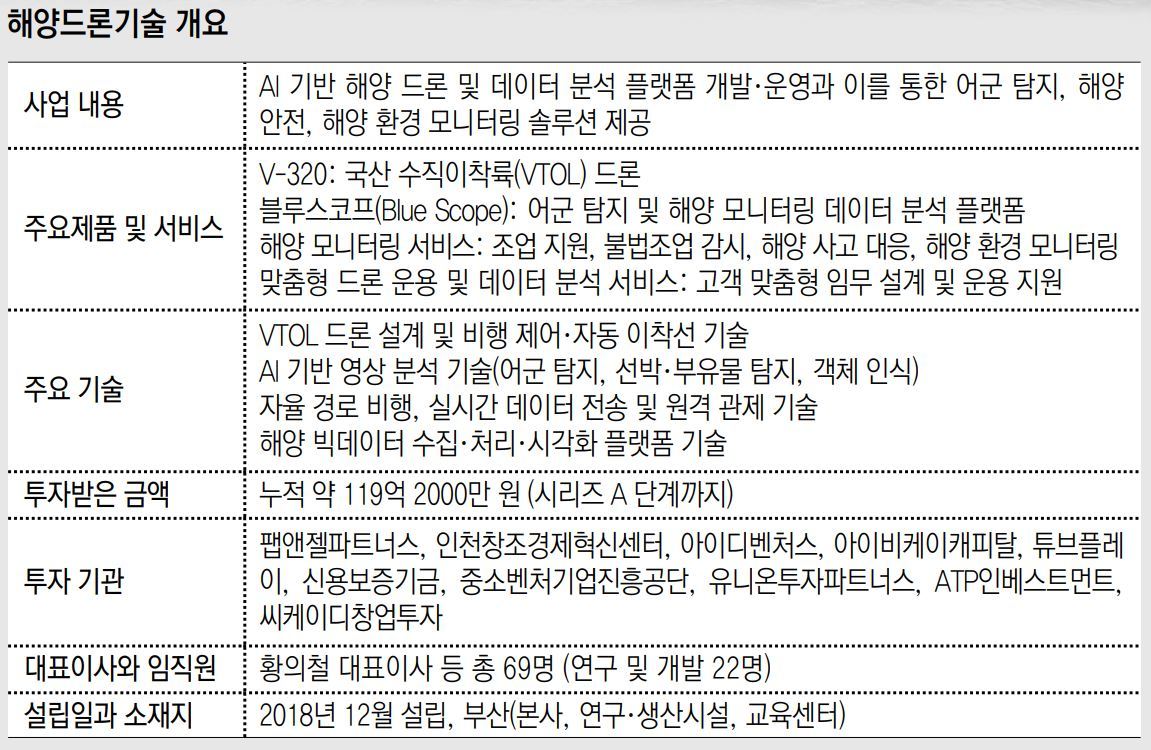
Once Marine Drone Technology had accumulated an enormous trove of real-sea operational flight data—around 10,000 hours, equivalent to circling the Earth 18 times—it finally raised a new anchor: in-house airframe manufacturing. After creating a market with services, it opened the door to manufacturing. The company has secured a 160-pyeong production facility at a knowledge industry center on Sinseon-ro in Uam-dong, Nam-gu, Busan, and has begun full-scale operation of a production line for its own maritime vertical takeoff and landing drone (MDT-V320) to replace imported airframes. It has established a mass production system capable of manufacturing at least four drones per month. Looking ahead, it is preparing to build the “Maritime Flight Center” in the Dongsam Innovation District in Yeongdo, Busan, consisting of two buildings with a combined area of 300 pyeong and an adjacent mooring facility.
The foremost goal to which the company is now staking its survival is the realization of “fully autonomous flight,” in which pilots no longer board vessels at all. To fundamentally resolve reluctance to embark on ships, it plans by 2027 to demonstrate an innovative system that uses Starlink low Earth orbit satellite communications to remotely control Pacific-based drones from a land-based control center in Busan. As a service provider, it still faces the formidable dual challenge of dealing with the extreme stress of captains whose annual pay packages in the hundreds of millions of KRW swing with fishing performance, and the harsh natural environment that can swallow airframes whole.
“With the growth of the global Islamic population, the value of tuna as a halal-certified protein source is expected to rise further, so the outlook for deep-sea fisheries is bright,” Hwang said. “We plan to solidify our overseas branches through an additional investment attraction of KRW 15 billion.” Leveraging its accumulated drone technology, Marine Drone Technology has also developed drones for high-rise building fire suppression, delivery drones capable of carrying up to 100 kg of cargo, and military drones for coastal surveillance. “Beyond tuna fishing operations, we plan to move into search and rescue for persons in distress, detection of floating pollutants, and even the defense sector, based on our vast flight and video data,” Hwang said.
ⓒ dongA.com. All rights reserved. Reproduction, redistribution, or use for AI training prohibited.
Popular News










 About Dong-A Ilbo