Government Finalizes ‘AI Basic Healthcare Strategy’ AI to assist with imaging reads and automatic documentation of consultations Supporting understaffed specialists and preventive health management ‘Remote joint care’ for patients in remote islands and mountain regions… New platform to help select emergency hospitals
As early as next year, artificial intelligence (AI) systems that support image reading assistance and chronic disease management will be rolled out to public health centers and clinics in medically underserved areas nationwide. In island and mountainous regions, AI-based non-face-to-face collaborative care will also become possible. An AI platform that helps ensure appropriate hospital transfers for emergency patients will be expanded nationwide starting in Daegu this year.
On the 6th, the government finalized and announced the “AI Basic Healthcare Strategy” at the 12th National Policy Coordination Meeting presided over by the Prime Minister. The core is to actively introduce AI to efficiently utilize limited medical resources in underserved areas.
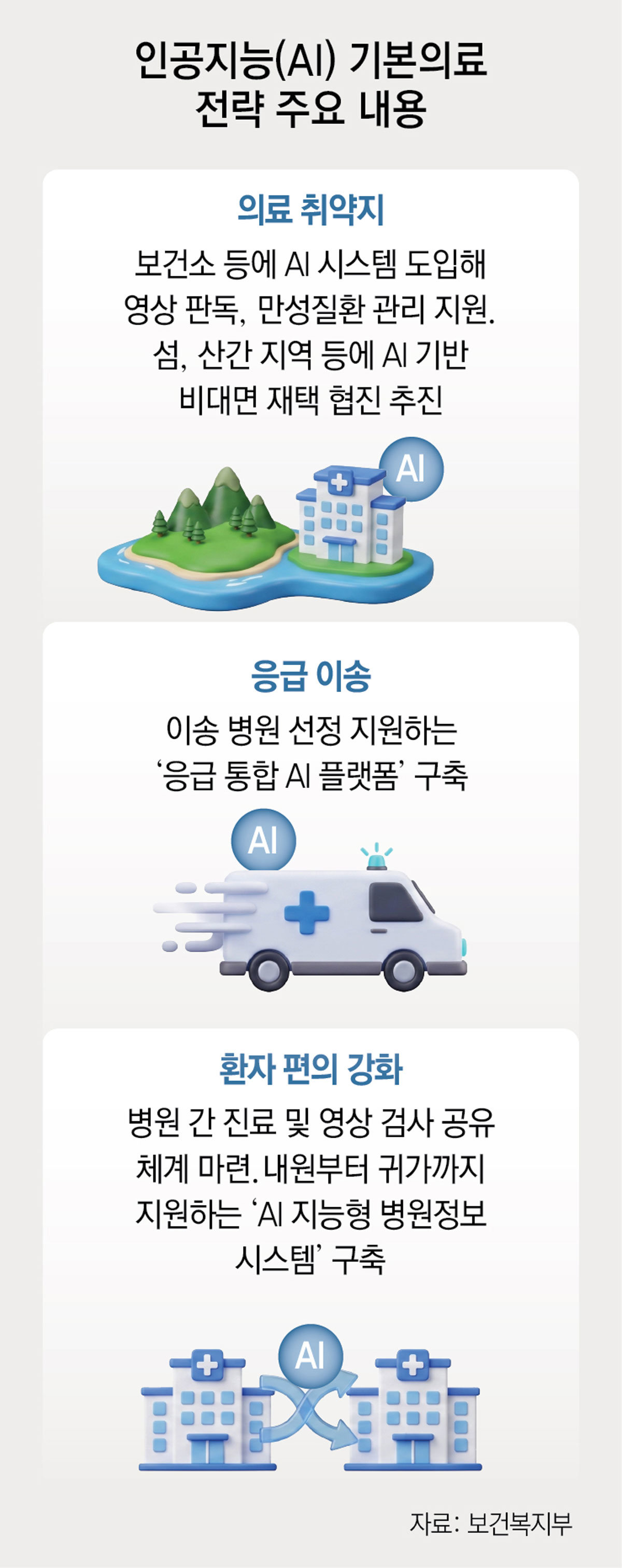
An “AI Solution Package” will be supplied to public health centers and local health clinics nationwide. The package is intended to supplement the shortage of specialists by assisting with image interpretation and automatically recording clinical notes. It will also support community health management, including chronic disease management and prediction of acute exacerbations. A similar “Primary Care AI Package” will be provided to clinic-level medical institutions in medically underserved areas, such as pediatrics, internal medicine, surgery, and obstetrics and gynecology.
A pilot project for AI-based non-face-to-face collaborative care will be implemented in regions such as islands and mountainous areas where there is a shortage of physicians. Under this program, visiting nurses will manage chronic diseases and other conditions based on AI analyses of patient data. If abnormal signs are detected, patients will be able to receive remote consultations from physicians located far away.
An “Emergency Integrated AI Platform” will also be introduced to prevent so-called “ER shopping,” by having AI assist in selecting an appropriate receiving hospital. Based on conversations between the patient and paramedics, AI will assess the severity of the condition, collect vital signs such as electrocardiograms, and analyze bed availability and medical staff status at each hospital to determine a suitable destination. After a pilot run in Daegu in the second half of this year (July–December), the system is scheduled to be expanded nationwide.
A system enabling the sharing of medical images such as computed tomography (CT) and magnetic resonance imaging (MRI), as well as medical records, between hospitals will also be established. Until now, patients often had to copy their images onto CDs or repeat the same tests when changing hospitals, drawing criticism for wasting medical resources. An “AI Intelligent Hospital Information System” that supports all services a patient experiences at a hospital—from appointment booking to admission and discharge—will also be developed. The government will integrate and open health and medical data dispersed across institutions and, based on this, pursue the development of a “Korean-style Medical AI.”
Cho Yu-ra
AI-translated with ChatGPT. Provided as is; original Korean text prevails.
ⓒ dongA.com. All rights reserved. Reproduction, redistribution, or use for AI training prohibited.








 About Dong-A Ilbo