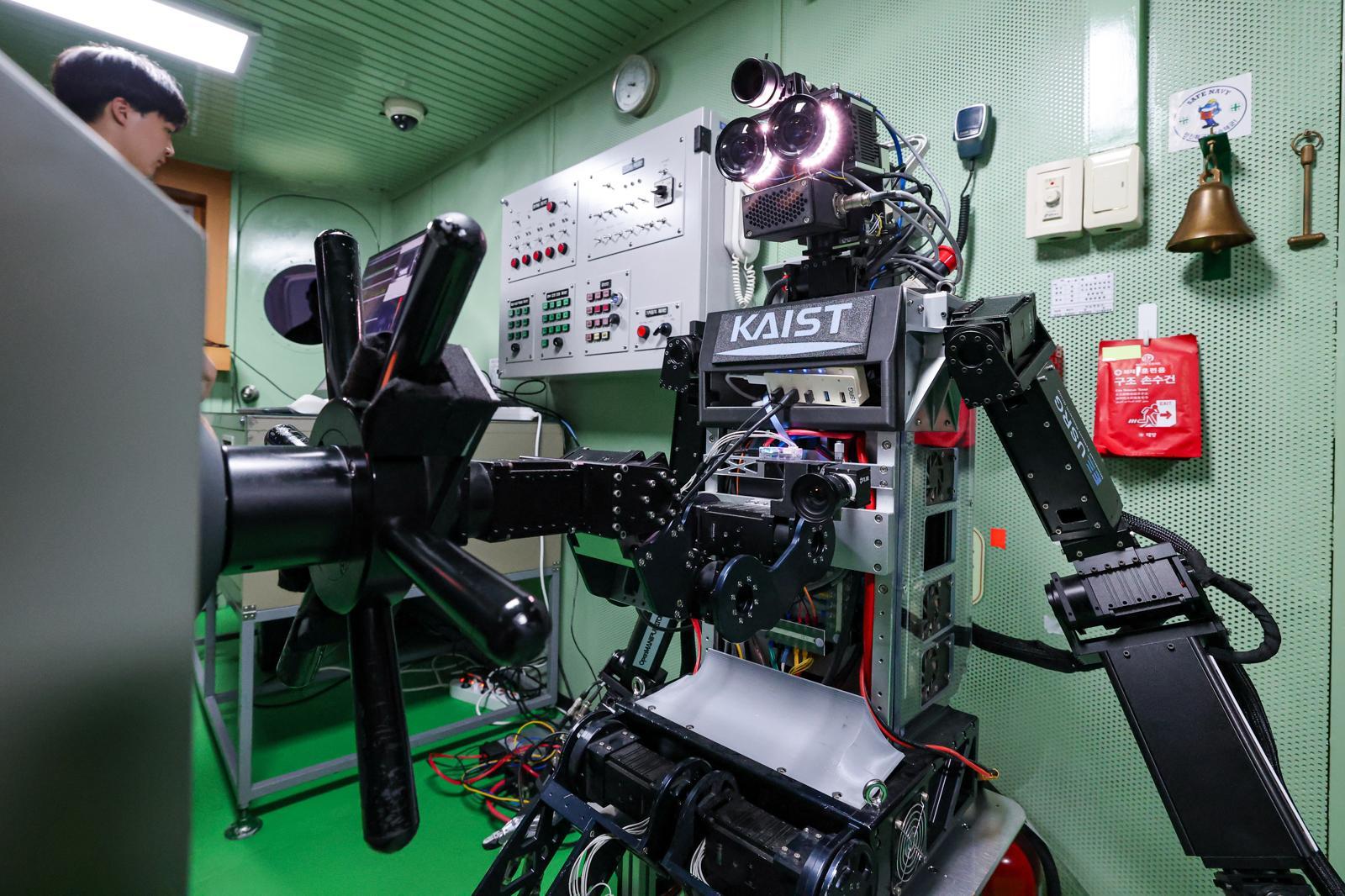
On the 23rd, at the ship-handling training center simulator of the Naval Education & Training Command in Jinhae-gu, Changwon, South Gyeongsang Province, the humanoid robot ‘PIBOT’, developed by the Korea Advanced Institute of Science and Technology (KAIST), performs a helmsman mission during a “robotic watch duty at sea combat experiment.” 2026.07.24 [Changwon=NEWSIS]
“Port 10 degrees, steer 110 degrees!”
On the 23rd at the ship-handling training center of the Naval Education & Training Command in Changwon, South Gyeongsang Province. When the officer of the watch on the bridge of the Aegis destroyer “Seoae Ryu Seong-ryong” (7,600-ton class) ordered a course change, the humanoid robot “PIBOT” seated at the helm repeated the order aloud a few seconds later. PIBOT turned the helm to port using its mechanical arms attached to its torso. As the ship in the simulator swung its bow around, cleared the narrow channel, and its course reached 110 degrees, a completion report followed: “Steady on 110 degrees!”
The Navy conducted the country’s first “robot crew combat experiment” that day together with KAIST. A helmsman is a crew member who steers the vessel by operating the helm under orders from the commanding officer or officer of the watch, a role usually carried out by enlisted sailors. This time, the humanoid robot PIBOT, under development by Professor Shim Hyun-chul’s team at KAIST, took the helmsman’s seat in place of a human. The 165 cm-tall, 65 kg robot PIBOT has reportedly learned ship-handling terminology and procedures through a large language model (LLM).
This experiment was conducted to explore concepts for operating robots on naval vessels in connection with the Navy’s ongoing “manned–unmanned teaming maritime combat system” initiative. The testing is divided into: △ land-based ship-handling simulation test (Phase 1) △ moored-ship test (Phase 2) △ at-sea daytime navigation test (Phase 3) △ at-sea extended day-and-night navigation test (Phase 4). The Navy and the KAIST research team plan to analyze and assess PIBOT’s reaction time, the appropriateness of its helm operation, and its operational convenience observed in this Phase 1 experiment, and then proceed with Phases 2–4.
The Navy expects that robots can expand their role beyond ship-handling into various other areas. Through this, it plans to reduce the workload of shipboard crews while actively responding to declining manpower levels. The development of PIBOT has been led by KAIST since 2022, with the Defense Acquisition Program Administration (DAPA) providing KRW 5.7 billion in funding.
Brigadier General Kim Hyeong-jun, head of the Navy Force Analysis Test & Evaluation Group, said, “This experiment is the first step in confirming whether a robot can perform ship-handling, traditionally an inherent duty of shipboard crew, without error,” adding, “Based on the results of this experiment, we will actively respond to the changing defense environment, including the sharp decline in conscription resources and advances in cutting-edge technologies.”
ⓒ dongA.com. All rights reserved. Reproduction, redistribution, or use for AI training prohibited.
Popular News










 About Dong-A Ilbo