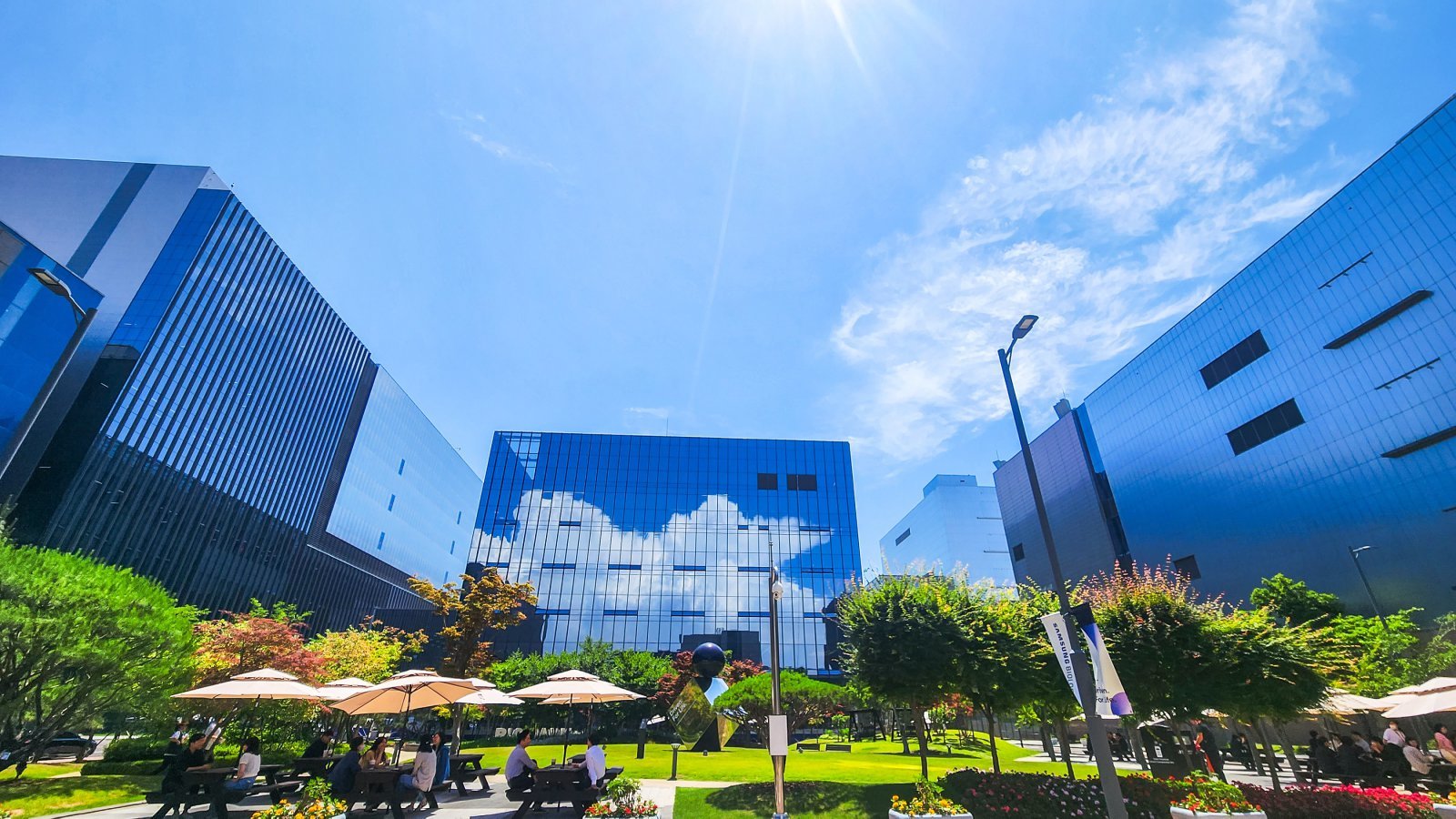
Panoramic view of Samsung Biologics headquarters. Courtesy of Samsung Biologics
Samsung Biologics continued its solid growth momentum, supported by stable business operations and favorable foreign exchange effects.
Samsung Biologics announced on the 23rd that it posted sales of KRW 1,320.9 billion and operating profit of KRW 586.4 billion in the second quarter of this year. Compared with the same period last year, sales rose 30% and operating profit increased 23%. The operating margin was 44.4%. The company maintained high profitability despite recognizing in advance the costs for the new Plant 5 and the Rockville, U.S. production facility. Cumulative results for the first half of the year (Q1–Q2) were sales of KRW 2,578.0 billion and operating profit of KRW 1,167.2 billion, each up by about 28% from a year earlier.
The company experienced disruptions in some production batches in the second quarter but maintained its existing annual performance outlook. Samsung Biologics expects production volumes at the new Plant 5 to gradually increase and the Rockville facility in the United States to contribute to revenue, while the KRW–USD exchange rate is also assessed to be acting favorably on performance. Samsung Biologics expects this year’s sales to increase by 15–20% from last year, and based on the current performance trend, it believes it is possible to achieve the upper end of this guidance.
A Samsung Biologics representative said, “We achieved strong results thanks to the full operation of Plants 1–4 and favorable foreign exchange effects,” adding, “We expect to be able to achieve the upper end of our annual sales growth guidance.”
Contract development and manufacturing orders are also steadily continuing. Since its founding, Samsung Biologics has secured a cumulative total of 115 contract manufacturing (CMO) deals and 176 contract development (CDO) deals, with cumulative order value reaching USD 21.7 billion. CMO refers to manufacturing pharmaceuticals developed by clients, while CDO refers to participating from the development stage of pharmaceuticals, including cell line development and process design.
The company is also expanding its overseas sales footholds. Samsung Biologics plans to open a European sales office in Amsterdam, the Netherlands, in the third quarter of this year. This will establish a separate sales base in Europe following New Jersey in the United States in 2023 and Tokyo, Japan in 2025. The strategy is to directly source clients and accelerate local responsiveness in the United States, Europe, and Japan, where major global pharmaceutical companies are concentrated.
The company is also pursuing large-scale mergers and acquisitions to broaden its business scope. On July 20, Samsung Biologics decided to acquire PolyPeptide Group, a Swiss peptide contract development and manufacturing organization, for approximately KRW 2,706.2 billion. The tender offer price is CHF 44.31 per share. The company will first acquire the stake held by the major shareholder and then conduct a tender offer for the remaining shareholders to secure a 100% equity interest. The acquisition process is scheduled to be completed by year-end after obtaining merger control approvals from competition authorities in relevant countries.
PolyPeptide Group is a global contract development and manufacturing company specializing in process development and commercial production of peptide active pharmaceutical ingredients. It was spun off in 1996 from the peptide production division of global pharmaceutical company Ferring and is currently headquartered in Baar, Switzerland. Since its establishment, it has carried out more than 1,000 peptide drug development and production projects and operates six production and R&D sites in five countries: Sweden, Belgium, France, the United States, and India. It employs approximately 1,500 people.
The key feature of this acquisition is that Samsung Biologics can immediately enter the peptide business without having to build a new plant from scratch. Once the acquisition is completed, Samsung Biologics will secure not only PolyPeptide Group’s production facilities, technologies, and experts, but also its existing customers and order contracts. This structure shortens the time required for plant construction, test production, quality certification, and customer acquisition, enabling revenue generation based on existing production volumes immediately after the acquisition.
Peptides are substances in which multiple amino acids are linked in short chains and are involved in hormonal functions and signaling between cells in the human body. GLP-1 class drugs, which have recently seen a surge in demand as obesity and diabetes treatments, are representative peptide therapeutics. Global pharmaceutical companies are expanding peptide new drug development beyond obesity and diabetes to include oncology, immune disorders, rare diseases, and central nervous system diseases.
Samsung Biologics has so far focused on contract development and manufacturing of antibody drugs based on its large-scale bioreactor facilities. It has since expanded its business portfolio to include messenger RNA and antibody-drug conjugates, and through this acquisition will add the peptide field to its portfolio. The move is seen as a strategy to diversify a business structure centered on antibody therapeutics and to capture production demand related to high-growth obesity treatments in advance.
The company has also secured additional land for new modality production facilities. Leveraging its Site 3 Bio Campus, Samsung Biologics plans to gradually build production facilities for high value-added pharmaceuticals such as peptides, messenger RNA, and antibody-drug conjugates. By simultaneously expanding domestic production capacity and overseas production and sales bases, the company intends to broaden the scope of contracts from the development stage to commercial production for global pharmaceutical companies.
Samsung Biologics has been included in the Dow Jones Best-in-Class World Index for five consecutive years and recently published its “2026 ESG Report.” The company plans to strengthen its competitiveness in non-financial areas such as environmental and safety management and supply chain management in parallel with the expansion of production facilities and business diversification.
ⓒ dongA.com. All rights reserved. Reproduction, redistribution, or use for AI training prohibited.
Popular News









 About Dong-A Ilbo