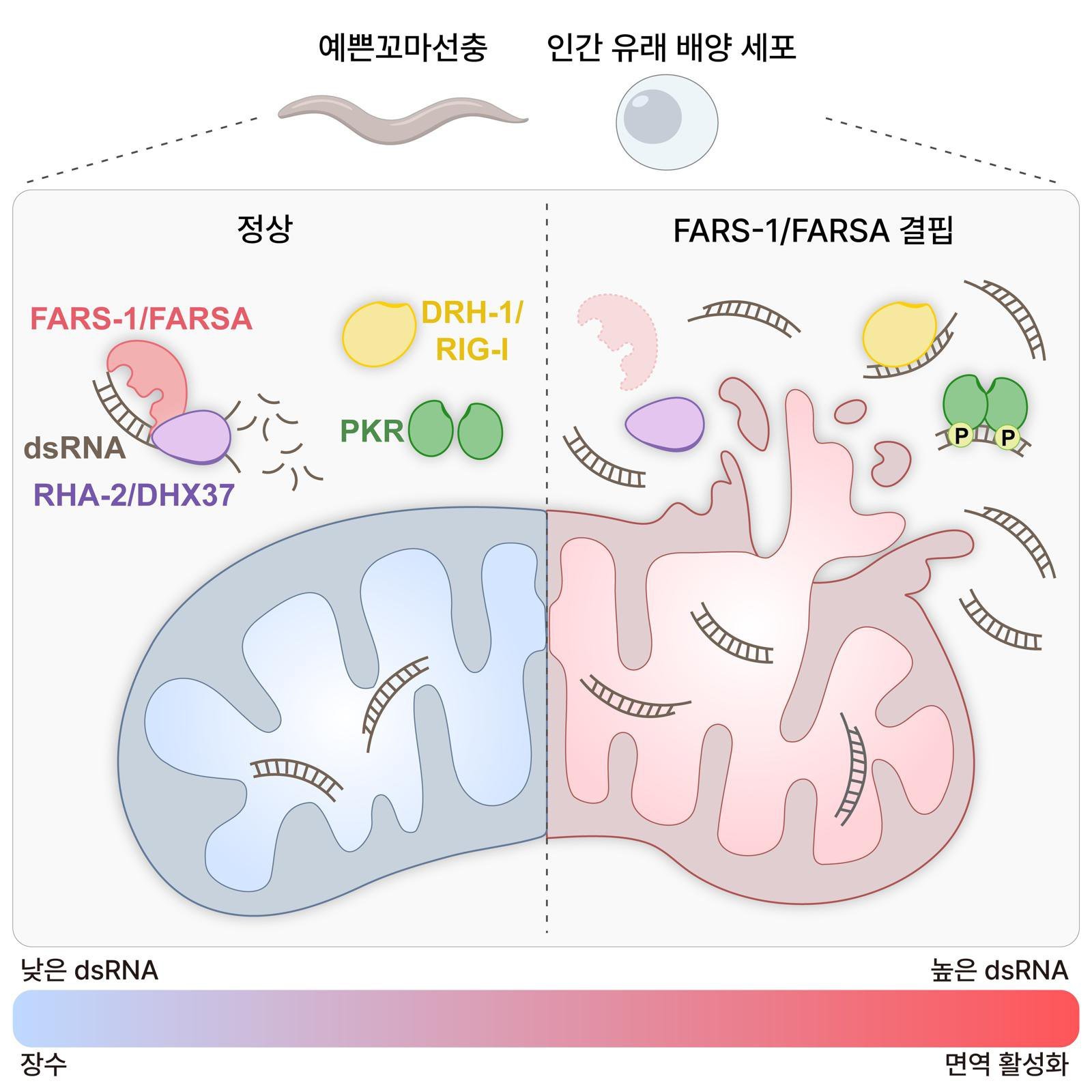
Illustration explaining the role of FARSA in maintaining the immunity-longevity balance through dsRNA regulation (provided by KAIST research fellow Son Juyoun) / News1
Domestic researchers have confirmed that when the internal cellular “immune alarm” that is triggered to respond to invading external viruses malfunctions, it can instead accelerate aging. Controlling this mechanism is expected to provide clues to delaying aging as well as contribute to the development of anti-aging therapeutics.
The National Research Foundation of Korea announced on the 27th that a joint research team led by Professor Seung-Jae Lee of the Department of Biological Sciences and Professor Yoosik Kim of the Department of Chemical and Biomolecular Engineering at KAIST has identified the mechanism by which abnormal increases in intracellular “double-stranded ribonucleic acid (RNA)” promote aging.
Double-stranded RNA is a substance that induces immune responses during viral infection. It is also naturally produced within normal cells even in the absence of external infection. The research team confirmed that as organisms age, double-stranded RNA gradually accumulates within cells, and that this excessively stimulates the immune system, leading to shortened lifespan.
The team also found that the protein “FARSA” in the body, previously known only as a protein synthesis enzyme, plays a kind of sheriff role in controlling double-stranded RNA. This protein directly binds to double-stranded RNA to prevent its excessive accumulation and preemptively block unnecessary immune responses. However, as aging reduces the expression of this protein, this line of defense collapses and aging accelerates.
This study, which newly elucidated the correlation between the immune system and aging, was published online on the 26th in Molecular Cell, an international journal in the field of life sciences. Professor Seung-Jae Lee said, “This study is significant in that it reveals the specific pathway through which intracellular double-stranded RNA accumulation promotes aging,” adding, “It will contribute to the development of therapeutic strategies for age-related diseases in the future.”
Kim Jae-hyung
AI-translated with ChatGPT. Provided as is; original Korean text prevails.
ⓒ dongA.com. All rights reserved. Reproduction, redistribution, or use for AI training prohibited.










 About Dong-A Ilbo