As more metals are mixed, the resulting nanoparticles become more uniform, a principle that has now been elucidated. Nanoparticles are ultra-fine particles about one hundred-thousandth the thickness of a human hair and are key materials in advanced industries such as semiconductors, energy, and biotechnology. The conventional understanding was that the more metals were mixed, the more non-uniform the particles became, but the new findings overturn this notion and are expected to open up new avenues for the development of next-generation energy and catalytic technologies.
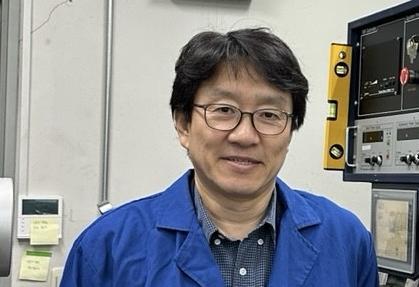
KAIST announced that a team led by Distinguished Professor Hee Tae Jung (photo) of the Department of Chemical and Biomolecular Engineering, in collaboration with Professor Matteo Cargnello’s group at Stanford University in the United States, has for the first time identified the mechanism behind the paradoxical phenomenon in which more uniform nanoparticles are formed as the number of metal types increases. The research was published in the international journal Science on the 7th.
In recent years, in the field of nanoparticles, “multicomponent” structures that mix several metals have attracted attention as a way to enhance performance. However, as the number of metal types increases, the reaction rates of each metal differ, resulting in particles of varying sizes and compositions, making it difficult to precisely fabricate nanoparticles in the desired form.
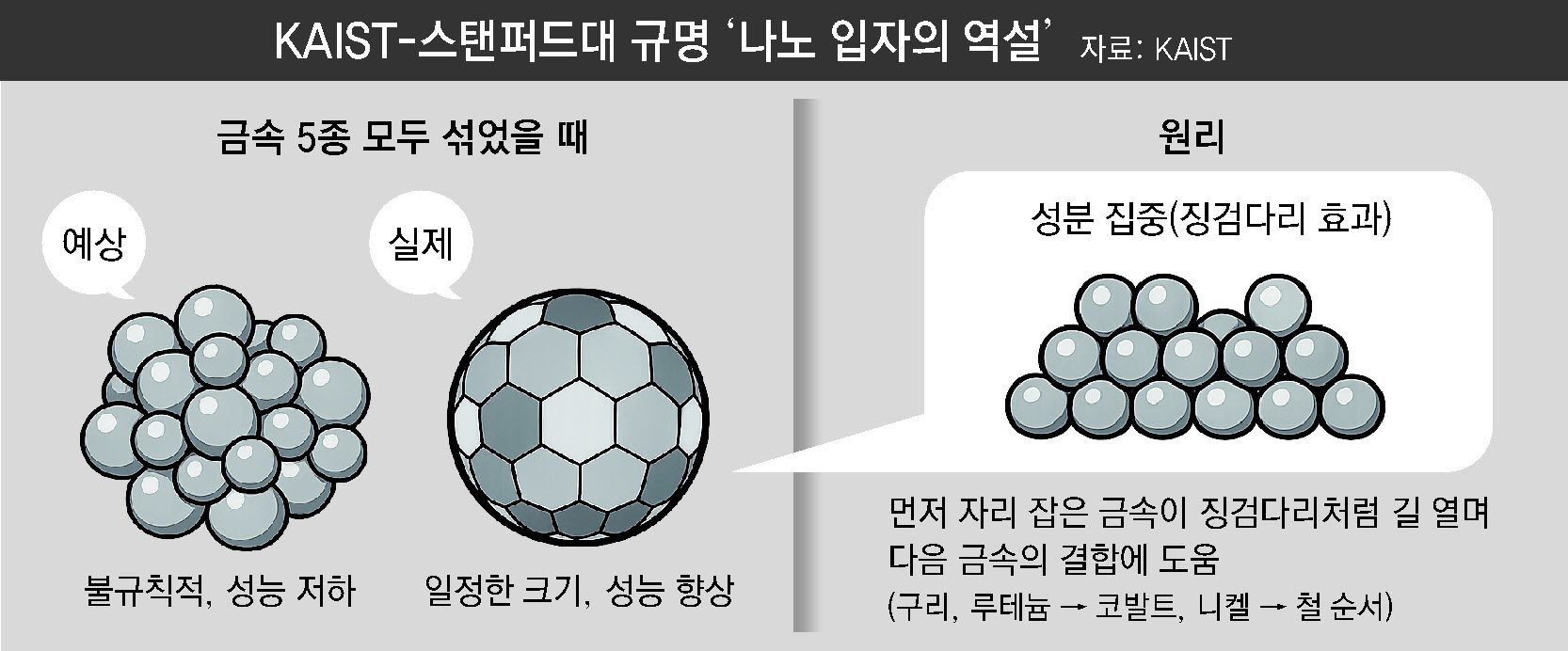
The research team focused on “competitive reactivity” that appears when multiple metals react simultaneously. As the number of metal types increased, the competition among them actually suppressed the formation of new, separate particles, and metals accumulated only on the surfaces of existing particles. A “composition focusing” phenomenon occurred, in which metals that first took their positions facilitated the bonding of subsequent metals, causing atoms to stack layer by layer in sequence.
The team began with ruthenium (Ru) nanoparticles, which are widely used as catalysts for ammonia decomposition, and tracked how four additional metals—iron (Fe), cobalt (Co), nickel (Ni), and copper (Cu)—were deposited as the solvent for nanoparticle synthesis was heated and the temperature changed.
When 2–3 metals were mixed, particles of various sizes and compositions were produced in a mixed state. In contrast, when 4 or more metals were introduced together, undesirable reactions were suppressed and only uniform nanoparticles were formed. Even though, in theory, 31 different combinations were possible when all 5 metals were used, only a single type of nanoparticle, in which all 5 metals were evenly mixed, was produced.
The process proceeded in three stages. First, copper adhered to the ruthenium surface and took its position. Next, cobalt and nickel simultaneously accumulated on top of it, and finally iron wrapped around the outermost layer, completing a structure in which the 5 metals were stacked in layers. In effect, the metals that first took their positions facilitated the bonding of the metals that followed.
The team also derived three conditions for producing uniform multicomponent nanoparticles: using 4 or more metals; ensuring that each metal can actually form metallic particles during the heating process; and maintaining a sufficiently high metal ratio relative to the starting ruthenium nanoparticles. The researchers stated that, if these conditions are met, the same principle can be applied to other metal combinations, such as chromium (Cr) and indium (In).
The team fabricated a nanoparticle catalyst composed of 5 metals and applied it to ammonia decomposition to produce hydrogen. It demonstrated about four times higher efficiency than the ruthenium single-metal catalyst most widely used in industrial settings. The catalyst also retained a stable structure even after 12 hours of treatment at a high temperature of 900 degrees, confirming its excellent heat resistance. Distinguished Professor Jung commented, “It is meaningful that the study elucidated the operating mechanism behind an unexpected paradoxical phenomenon observed in nanoparticle synthesis,” adding, “These findings are expected to be widely used in the development of high-performance catalysts and eco-friendly energy materials that enhance the efficiency of energy processes such as hydrogen production and carbon dioxide conversion.”
ⓒ dongA.com. All rights reserved. Reproduction, redistribution, or use for AI training prohibited.
Popular News










 About Dong-A Ilbo