Exports reach USD 133.2 billion, ahead of Japan and Italy
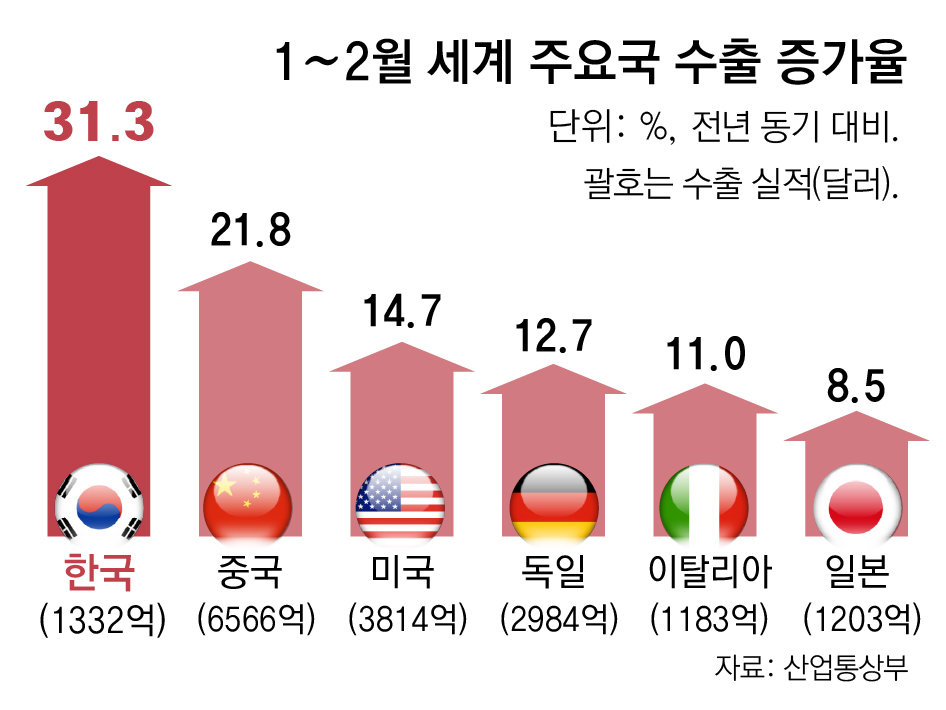
31% growth rate, highest among top seven countries
K-consumer goods such as food and cosmetics also play a key role
Upward trend likely to continue… Middle East war remains a risk factor
In January–February this year, Korea’s export value rose to fifth place globally. A boom in semiconductors and the worldwide popularity of so‑called K‑consumer goods such as food products and cosmetics were cited as key drivers.
According to the Ministry of Trade, Industry and Energy (MOTIE) on the 6th, Korea’s exports for January–February this year totaled USD 133.2 billion, ranking fifth in the world under World Trade Organization (WTO) criteria, following China, the United States, Germany and the Netherlands. The year‑on‑year growth rate was 31.3%, the highest among the top seven exporting countries. Korea ranked eighth in export value last year.
Min Moon-gi, director of the Export and Import Division at MOTIE, said, “Japan, whose mainstay is traditional manufacturing, and Italy, where agri‑fisheries and food products and bio‑health are central, showed growth of around 10%,” adding, “In Korea, exports of semiconductors surged in line with expanded global investment in artificial intelligence (AI) servers, driving overall exports to increase by more than 30%.” In January–February this year, Japan’s exports amounted to USD 120.3 billion, placing it sixth in the world, and Italy (USD 118.3 billion) ranked seventh.
The strong export momentum has continued. In the first quarter of this year (January–March), Korea’s exports reached a record high of USD 219.9 billion. The gap with Japan (about USD 189.6 billion) widened to more than USD 30 billion.
Semiconductor exports in particular were tallied at USD 78.5 billion, up 139% from the same period last year. Driven by higher memory prices, DRAM exports jumped 249.1% to USD 35.79 billion, while NAND exports surged 377.5% to USD 5.39 billion. System semiconductor exports also increased 13.5% to USD 12.11 billion.
Growth in consumer goods categories was also notable. On the back of a global K‑beauty boom, first‑quarter cosmetics exports rose 21.5% year‑on‑year to USD 3.13 billion. Exports of agri‑fisheries and food products (USD 3.11 billion), buoyed by the worldwide popularity of products such as instant noodles (ramyeon) and dried seaweed (gim), expanded by 7.4%.
Reflecting the trend toward diversification of export items, MOTIE expanded the existing list of 15 key export items to 20. This is the first time in six years, since 2020, that the government has increased the number of key export items. Five categories that have recently seen rising exports—electrical machinery, non‑ferrous metals, agri‑fisheries and food products, cosmetics, and household goods—were newly added.
Imports for January–February this year amounted to USD 109 billion, up 9.7%. The trade balance posted a surplus of USD 24.2 billion, an improvement of USD 22.2 billion from a year earlier.
While expressing concern that spillover effects from the war in the Middle East could become a negative factor for exports, the government projected that the current optimistic trend would continue for the time being. Na Seong-hwa, director-general for Trade Policy at MOTIE, said, “Semiconductor prices are expected to remain high, so exports in May are also highly likely to benefit from strong semiconductor performance. However, as the variable of the Middle East war continues to intensify, this could become an obstacle in various respects.”
ⓒ dongA.com. All rights reserved. Reproduction, redistribution, or use for AI training prohibited.
Popular News









 About Dong-A Ilbo