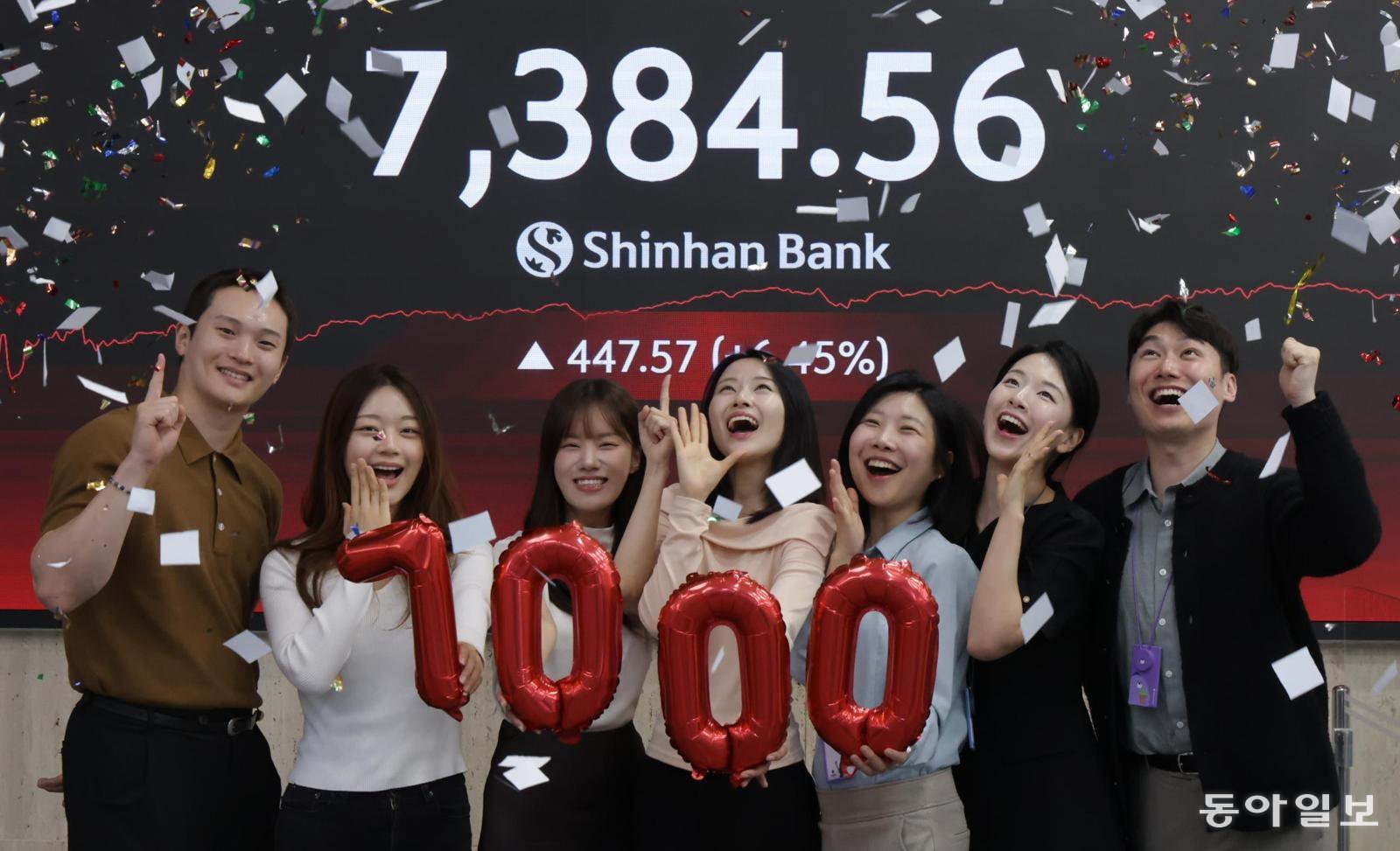
On the 6th, employees at the Shinhan Bank dealing room in Jung-gu, Seoul celebrate the KOSPI’s breakthrough of the 7,000 mark. On this day, the KOSPI closed at 7,384.56, up 6.45% from the previous trading day. Having fallen to 2,293.7 in April last year, the KOSPI has tripled in about a year, propelled by a semiconductor rally. Photo by Park Hyeong-gi oneshot@donga.com
The KOSPI on the 6th surpassed 7,000 for the first time in its history. Based on the closing price, it has tripled in 1 year and 1 month, ushering in the era of “Chilcheonpi” (KOSPI 7,000). Funds poured into artificial intelligence (AI) investments by US big tech companies have translated into earnings improvement for domestic AI infrastructure companies in semiconductors, materials/components/equipment, and power, driving a steep upward trajectory.
On the day, the KOSPI finished trading at 7,384.56, up 447.57 points (6.45%) from the previous session. During intraday trading, it climbed to 7,426.60, breaking through the 7,400 level as well. Hit by turmoil from the declaration of martial law and the announcement of US tariff policies, the KOSPI had fallen to 2,293.7 on 9 April last year, but has since tripled. The total market capitalization of the KOSPI also exceeded KRW 6,000 trillion for the first time on record.
Foreign investors were net buyers of KRW 3,108.5 billion, driving the index higher. The scale of net foreign buying on the day was the second largest ever on a daily basis and the largest so far this year. Expectations are emerging that direct foreign investment will increase thanks to the activation of integrated foreign investor accounts.
After breaking through 5,000 for the first time on a closing basis on 27 January this year, the KOSPI surpassed 6,000 in just 18 trading days. It then faced a crisis when war broke out between the United States and Iran on 28 February. On 4 March, the KOSPI plunged 12.06%, posting its largest-ever daily decline.
As expectations for ceasefire negotiations grew, the KOSPI regained the 6,000 level on 15 April, 32 trading days later. The rally continued as earnings improvement in AI infrastructure companies was confirmed, with Samsung Electronics and SK Hynix posting a combined operating profit of KRW 95 trillion in the first quarter (January–March).
According to the Korea Exchange, as of the day’s close, the KOSPI’s year-to-date gain stood at 75.23%, the highest among stock indices of the Group of Twenty (G20) major economies. It far outpaces second-place Türkiye, with a rise of 28.72%. Samsung Electronics surged 14.41% on the day, reaching the “KRW 260,000 Samsung” level, while SK Hynix jumped 10.64%, settling at the “KRW 1.6 million Hynix” level.
Growing concern is emerging over high-risk investments, such as leveraged investing with borrowed money and bets on a decline in the index, as individual investors’ FOMO (fear of missing out) spreads. Kang So-hyun, head of the Capital Market Department at the Korea Capital Market Institute, said, “No one predicted that KOSPI 7,000 would be reached this quickly,” and cautioned, “Individual investors should refrain from excessive investments based on attempts to predict the direction of stock indices.”
ⓒ dongA.com. All rights reserved. Reproduction, redistribution, or use for AI training prohibited.
Popular News








 About Dong-A Ilbo