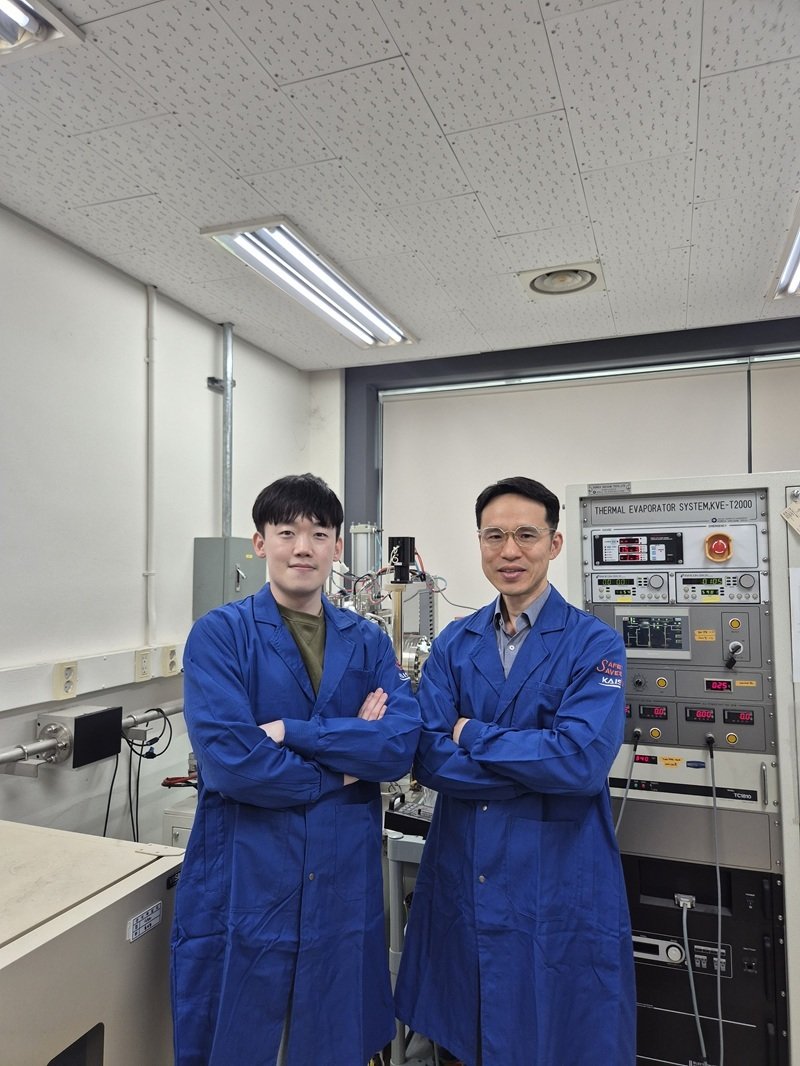
Dr. Jung Joon-gyo (left) and Professor Shin Jonghwa of the Department of Materials Science and Engineering at KAIST. Provided by KAIST
A new concept hologram technology has been developed that uses the state of light itself as an “encryption key,” allowing information to be revealed only under specific conditions.
KAIST announced on the 4th that a research team led by Professor Shin Jonghwa of the Department of Materials Science and Engineering has developed a next-generation vector hologram metasurface that utilizes the “total angular momentum of light (the sum of all rotational properties)” as the key element for information selection. The team focused on “polarization (spin angular momentum, SAM),” which is the vibration direction of light, and “orbital angular momentum (OAM),” which describes the helical propagation of light, combining them into “Total Angular Momentum (TAM).” Independently controlling these two elements within a single device has long been considered a major challenge.
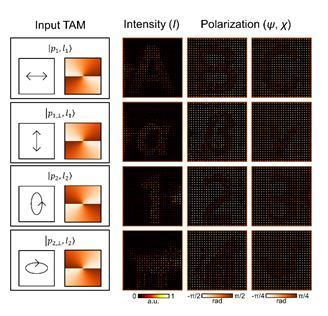
Vector hologram that generates independent intensity and polarization images depending on the conditions of the incident light. Provided by KAIST
To address this, the research team implemented a “bi-layer metasurface” constructed by precisely designing nanostructures that are far smaller than a human hair. This metasurface is an optical device based on ultra-fine artificial structures that can freely control the propagation direction and physical properties of light. The team used TAM, which combines polarization and twist of light, as a kind of “composite encryption key,” designing it so that hidden information appears only when light with specific conditions is incident. In other words, even if beams of light appear identical outwardly, the information cannot be accessed unless both the prescribed vibration direction and twist are satisfied simultaneously, enabling the realization of a high-security technology that is extremely difficult to replicate.
Professor Shin Jonghwa stated, “This research demonstrates that the core properties of light—polarization and twist—can be combined into a single independent information key and freely exploited,” adding, “It is expected to evolve into a core platform for highly secure systems resistant to counterfeiting and for ultra-high-speed optical communication technologies.”
Jeon Hye-jin
AI-translated with ChatGPT. Provided as is; original Korean text prevails.
ⓒ dongA.com. All rights reserved. Reproduction, redistribution, or use for AI training prohibited.









 About Dong-A Ilbo