If a patient’s medical history and current medications can be checked immediately in an emergency, the speed of treatment can change significantly.
The Korea Health Information Service (KHIS) is launching “Artificial Intelligence Transformation (AX)” to link medical data, which has so far remained in mere accumulation, to artificial intelligence (AI)-based services. The plan is to move beyond data standardization and into a stage where the data are used in actual clinical practice and services.
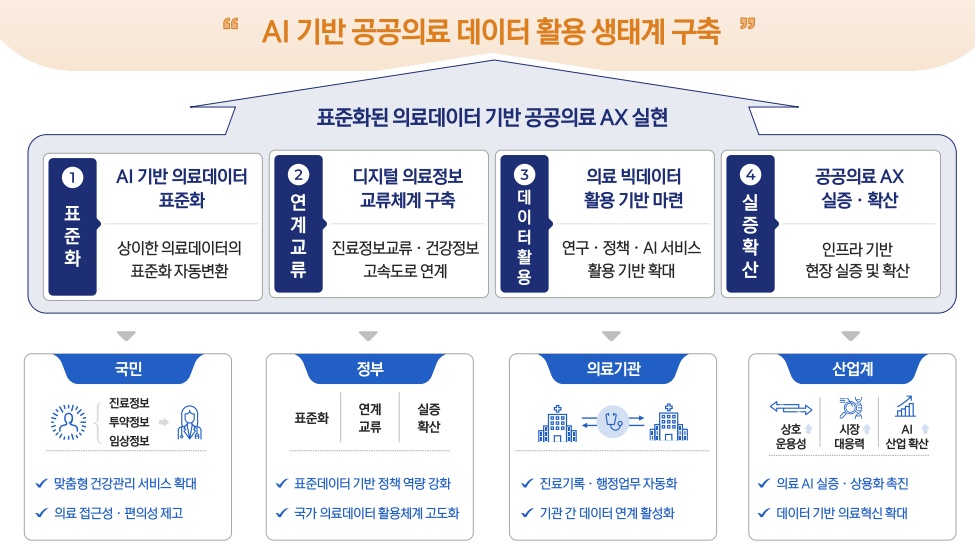
On the 30th, KHIS announced that from 2026 it will promote an AX strategy that applies AI across the entire process of medical data, from standardization to management and utilization. The core is to shift data that had remained at the level of standardization into a phase of practical use in clinical settings and services.
Although Korea currently has one of the highest adoption rates of Electronic Medical Records (EMR) in the world and holds national health insurance data covering the entire population, a key limitation has been that different medical institutions use different data standards, making mutual use difficult. Data have been accumulated, but the structure has prevented their use in the field.
● Why has medical data only been ‘piling up’?To address this issue, KHIS is moving to secure data standardization and interoperability using AI. The plan is to automatically standardize data generated at each medical institution and build an ecosystem that enables exchange and utilization of data between institutions. The “AI-based interoperability technology development (R&D)” project, which has been under way since 2025, will also be significantly expanded from 2026.
KHIS is also promoting the establishment of a “Digital Medical Information Exchange System” that integrates the “Medical Information Exchange System,” which shares medical records when patients are transferred, and the “Health Information Highway,” which allows individuals to check their own health information. The aim is to integrate fragmented data flows into one and enhance their utility.
● How will AI change the medical field?
The changes are expected to appear first in areas directly experienced by patients. AI will summarize complex medical records and automatically extract information on drug allergies, providing it through the “My Health Record” app. The key is to convert medical data into a form that laypersons can understand and then provide it.
Some effects are already being observed in the field. According to officials, applying AI to ultrasound examinations and similar tests has increased processing volume by about 30% and reduced patient waiting times, indicating improved efficiency.
However, it is also emphasized that AI’s judgments remain at a reference level. Medical staff use AI results as a supplementary tool, while final decisions and responsibility still rest with physicians. Accordingly, there are calls for ethical standards and social consensus going forward.
● Will data utilization expand into an industry?KHIS is also pursuing the expansion of an industrial ecosystem based on medical data. Through AI data utilization vouchers and testbed projects linked to data-centered hospitals, it plans to support startups in developing and verifying services that use public medical data.
In addition, the “National Integrated Bio Big Data Construction Project,” which is building genomic and clinical data for 1 million people, is set to partially open its data in October. The plan is to broaden its use to areas such as disease prevention and new drug development.
President Yeom Min-seop stated, “For many older people, it is often difficult to confirm even basic information,” adding, “We are also reviewing ways to quickly check necessary information in emergency situations.” He continued, “A data-based approach is important in managing elderly patients, including those with dementia.”
He also said, “Public medical data are structured to connect with various companies based on individual consent,” and added, “A future task is to establish an appropriate compensation system for data providers by introducing a fee structure for data utilization.”
KHIS plans to shift medical data from simple accumulation to utilization, expanding use so that it can support the development of biohealth through cooperation with the private sector. President Yeom said, “This will be a turning point for public healthcare to leap into a data-based intelligent system,” and added, “We will concentrate our capabilities on building an AI-based medical data utilization ecosystem.”
ⓒ dongA.com. All rights reserved. Reproduction, redistribution, or use for AI training prohibited.
Popular News









 About Dong-A Ilbo