Jain Energy Co., Ltd.
The battery industry has encountered a structural limitation in safety. A series of incidents, such as fires during electric vehicle charging and ignition of portable batteries on aircraft, is heightening demand for batteries that are safe from fire. As downstream industries including electric vehicles, ESS, robots, and drones grow rapidly, securing safety has emerged as a mandatory task rather than a choice.
The industry is focusing on all-solid-state batteries, which replace conventional flammable liquid electrolytes with solid ones, as a fundamental solution. According to global market research, the all-solid-state battery market is projected to grow from around 2 GWh (gigawatt-hours) in 2025 to 500 GWh by 2035, reaching approximately KRW 70 trillion in value. Among the players, Korean technology-based venture company Zain Energy Co., Ltd. is drawing attention with its independently developed “self-extinguishing solid electrolyte” technology.
Polymer solid electrolyte technology backed by 20 years of researchZain Energy is a lithium-based next-generation battery material and cell technology company established in 2022 in Ochang, Cheongju, Chungcheongbuk-do. Although the company itself is relatively new, its technology roots go back to the early 2000s. Chairman Lee Joo-young, the founder, has conducted long-term research on polymer solid electrolytes and electrolyte additives for lithium batteries, and promoted commercialization of materials by establishing Zain Chemical in 2014. Building on this experience, he launched Zain Energy together with CEO Lee Ju-hyun to commercialize solid-state battery cells and solid electrolyte materials. Based on research achievements accumulated over more than 20 years, Zain Energy has secured proprietary electrolyte source technology.
The core lies in its anion receptor-based, self-extinguishing polymer solid electrolyte technology, “Z-ARPE.” This material secures ionic conductivity of 2–4 mS/cm at room temperature in the solid state, while simultaneously achieving electrochemical stability above 4.7 V and high-temperature stability above 300 degrees. It also has flame-retardant and self-extinguishing characteristics, preventing a fire from easily spreading and allowing it to extinguish itself in the event of ignition.
In particular, thanks to its process characteristics—being injected in liquid form and then solidifying at 50–60 degrees—it offers high compatibility and commercial viability with existing lithium-ion battery manufacturing processes. The company currently holds six registered domestic patents and has filed 15 overseas patent applications.
Use of existing production lines minimizes cost and process burdenIn the current all-solid-state battery market, sulfide-based electrolytes are regarded as mainstream. While they offer strong performance advantages based on high ionic conductivity, exposure to moisture can generate toxic gases, and high-pressure processes are required to secure close contact with electrodes, resulting in high manufacturing costs and process complexity.
Zain Energy’s polymer electrolyte technology is being evaluated as an alternative that can ease these burdens. It enables stable formation of the electrode–electrolyte interface without high-pressure processing, and existing lithium-ion battery production lines can be used as they are, significantly reducing capital expenditure on equipment. It can be applied to various battery formats including pouch, cylindrical, and prismatic cells, giving it a wide range of potential applications.
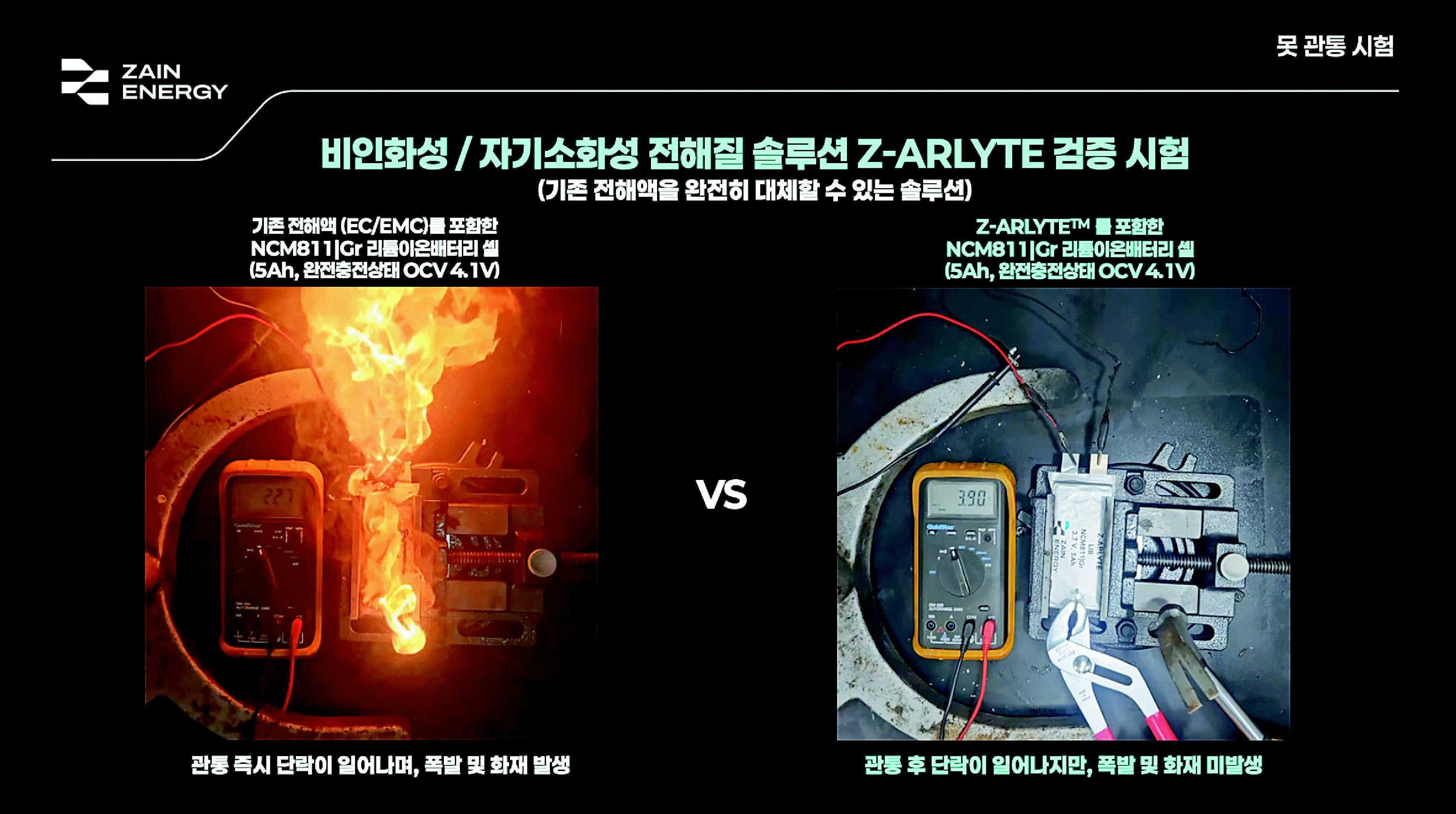
Zain Energy is pursuing a strategy of not only supplying materials but also directly manufacturing cells to validate its technology. It has completed in-house prototype development from ultra-thin solid-state battery cells with a capacity of 20 mAh (milliampere-hours) up to large-capacity cells of 50 Ah (ampere-hours). The 20 mAh ultra-thin cells were confirmed to operate stably even in a high-temperature environment of 150 degrees, and the 5 Ah solid-state battery cells maintained operation without ignition in nail penetration and cutting tests.
At the pilot infrastructure level, the realization of solid-state battery cells with verified safety is being seen as evidence of the mass-production applicability of polymer solid electrolyte technology.
Global testing underway… Full-scale entry into the supply chainMarket response to the company’s technological capabilities is also gaining momentum. Major OEMs in the United States and Europe are conducting evaluations of Zain Energy’s electrolytes and cells at their own expense, directly verifying compatibility with their existing production processes. Demand is also increasing for customized solid-state battery cells, and the potential for expanding production scale is under review.
Zain Energy plans to begin supplying 20 mAh ultra-thin solid-state battery cells, 5 Ah high-safety solid-state battery cells for body-contact energy storage devices, and 8 Ah battery cells for small drones this year. Based on order volumes, the company intends to gradually secure supply capacity on the MWh (megawatt-hour) scale and subsequently expand its business into the medium- and large-sized battery markets and the global solid electrolyte material supply chain.
In the longer term, it is targeting an IPO (initial public offering) around 2029–2030. The company is regarded as presenting a new growth model for technology-focused SMEs in the domestic battery industry by simultaneously pursuing localization and commercialization of materials.
“Leading the all-solid-state battery era through polymer electrolyte innovation”
Interview with Lee Ju-hyun, CEO of Zain Energy Co., Ltd.
“Global innovation companies were not large corporations from the outset. Most began in small spaces with limited resources and grew through technology and products.”
CEO Lee Ju-hyun described Zain Energy’s challenge in these terms. Just as major Korean conglomerates started with the determination and will of their founders, he is convinced that genuine innovation often begins more quickly and boldly within small organizations.
The battery materials sector has a strongly conglomerate-centric supply chain structure, making it difficult for startups to enter. Lee has confronted this barrier head-on. Nevertheless, his reason for not giving up is clear. While it is hard for SMEs to catch up with large corporations through economies of scale, he believes it is possible to create new markets with differentiated technology. The fact that Zain Energy originated from the technology and resolve of founder Dr. Lee Joo-young is an extension of this belief.
Lee cites as his key strength the ability to significantly enhance safety while utilizing existing lithium-ion battery manufacturing lines as they are. From the manufacturer’s standpoint, this enables simultaneous improvement in performance and safety without additional capital expenditure on equipment.
He stresses that what is important for Zain Energy now is to present its technology to the market. The company plans to start with niche markets, gradually expand its solid-state battery business, and step by step build production scale, quality, and price competitiveness to complete full commercialization. “Becoming a strong small and mid-sized company that challenges the global market with source material technology developed in Korea—that is the direction Zain Energy is determined to realize.”
ⓒ dongA.com. All rights reserved. Reproduction, redistribution, or use for AI training prohibited.
Popular News









 About Dong-A Ilbo