Qatar: “May be unable to honor up to 5-year contract”
If it materializes, rate hikes… heavier burden on industry
Government says low share of Qatari supplies means “no problem”
Audit of KNOC over failure to exercise priority purchase rights
during overseas sales of domestic strategic oil reserves
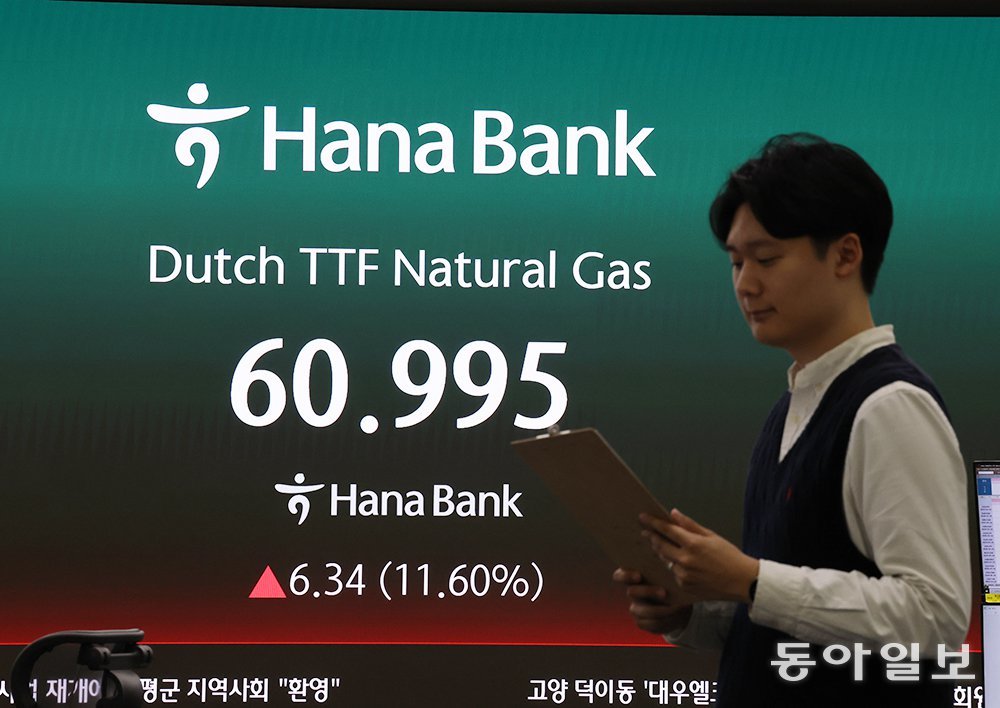
On the 20th, at the dealing room of Hana Bank’s headquarters in Jung District, Seoul, the price of the Netherlands TTF futures, the key benchmark for European natural gas prices, is displayed. International gas prices are rising and concerns are mounting over disruptions to global gas supply following an attack on Qatar’s liquefied natural gas (LNG) facilities. Photo by Han-Gyeol Lee always@donga.com
Qatar, whose liquefied natural gas (LNG) production complex came under attack, stated on the 19th (local time) that it could declare ‘force majeure’ on LNG supply contracts signed with countries including South Korea for several years, raising concerns that this could have a negative impact across the broader economy.
Given the nature of LNG imports, which are typically conducted through long-term contracts of 10–20 years, failure to execute these contracts would require purchasing gas on the spot market at relatively higher prices. Prices would also become highly volatile. The government assesses that, as Qatar accounts for about 14% of South Korea’s LNG imports, there is no problem with short-term supply and demand. However, if the situation is prolonged, it will inevitably increase upward pressure on electricity and gas tariffs and weigh on the industrial sector as a whole.
● Natural gas market surges more than 10% in a single day
According to the energy industry on the 20th, LNG is generally imported through long-term contracts spanning 10–20 years. This ensures stable supply at relatively low prices. South Korea is reported to have concluded 20-year LNG import contracts with QatarEnergy, Qatar’s state-owned energy company.
The issue is that QatarEnergy has suggested the possibility of declaring force majeure for up to five years in connection with the current situation. Force majeure clauses stipulate that in the event of circumstances akin to natural disasters, such as war or facility damage, the supplier is not held liable for failing to deliver contracted volumes on time. If actually declared, supplies of Qatari LNG could be disrupted for up to five years.
The government maintains that there is no problem with domestic gas supply and demand. The presidential office stated, “The share of Qatari LNG in imports is not high at around 14%, and alternative sources have been secured, so there is no issue with supply and demand.” As South Korea has diversified its LNG import sources to countries such as Australia, the United States and Malaysia, the domestic share of Qatari LNG has fallen from 35.5% in 2016 to 14.9% last year.
An official from the Ministry of Trade, Industry and Energy said, “Immediately after the outbreak of the Iran war, the government drew up a contingency plan assuming a situation in which no Qatari LNG volumes come in at all, effectively making the share ‘zero’.”
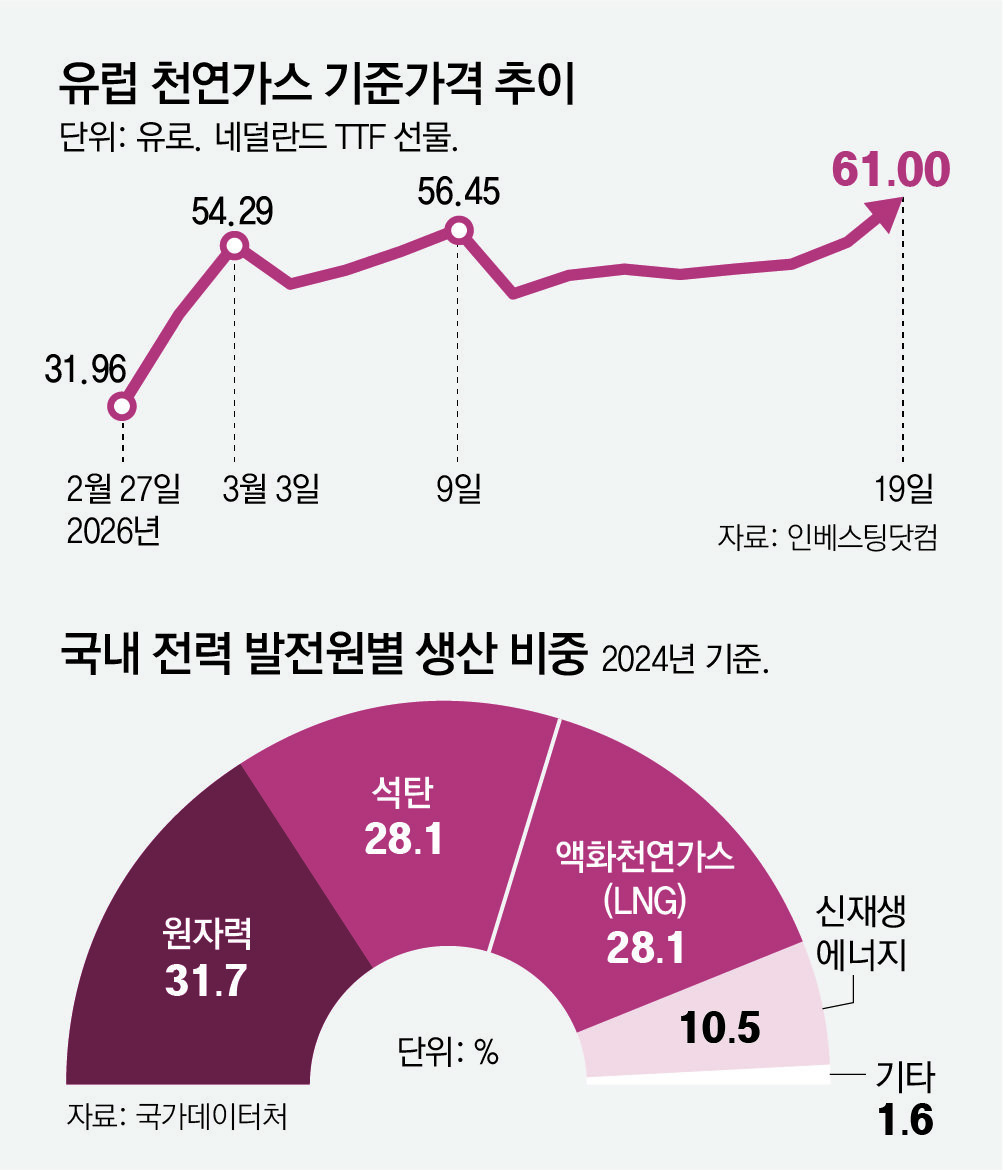
However, if the Middle East crisis drags on, Qatari volumes will have to be replaced from other sources. In that case, it is highly likely that imports will be more expensive than Qatari LNG. The Netherlands TTF futures price, the key benchmark for European natural gas, closed at 61.0 euros, up 11.5% from the previous day. Intraday, it rose as high as 74 euros.
South Korea relies on LNG for 28.1% of its total power generation. City gas, which is mainly used for heating and cooking, is also mostly LNG. This means upward pressure on electricity and heating costs could intensify due to higher prices. The government, including the Ministry of Trade, Industry and Energy, is reviewing options to import LNG through spot purchases or short- to medium-term contracts if force majeure is actually declared.
Some observers offer an optimistic view that a force majeure declaration will not in fact be made, as such a move would result in losses for QatarEnergy approaching KRW 100 trillion.
● Petrochemical industry faces ‘naphtha supply crunch’ and raw material procurement crisis
The domestic petrochemical industry is also expected to suffer inevitable damage. With profitability already deteriorating and raw material procurement unstable, additional LNG supply uncertainty could further increase cost burdens. If the supply of liquefied petroleum gas (LPG) and condensate is also disrupted, it will be difficult to avoid negative effects on the entire industrial sector.
LNG, LPG and condensate, whose supply chains have been disrupted by Iran’s attack on Qatar, are all essential raw materials for the operation of domestic petrochemical companies. LNG is the main fuel used to run naphtha cracking centers (NCCs), core facilities in petrochemical production. Condensate, a by-product of natural gas, is a key feedstock for naphtha. Because condensate yields more naphtha than conventional crude oil, some facilities refine condensate specifically to secure naphtha.
The presidential office stated, “We also plan to implement export control measures to minimize overseas outflows of naphtha.”
Meanwhile, it has been confirmed that 900,000 barrels of crude oil owned by foreign companies and stored at domestic strategic oil stockpiling bases were not supplied domestically but sold overseas, prompting the Ministry of Trade, Industry and Energy to launch an inspection of Korea National Oil Corporation. The explanation given is that Korea National Oil Corporation did not exercise its preemptive right to purchase. Recently, Saudi Aramco, the Saudi Arabian state-owned oil company, shipped 12 million barrels of crude oil to South Korea aboard six very large crude carriers (VLCCs). This is the first case in which crude oil secured through private channels after heightened tensions in the Strait of Hormuz has entered South Korea via an alternative route.
ⓒ dongA.com. All rights reserved. Reproduction, redistribution, or use for AI training prohibited.
Popular News








 About Dong-A Ilbo