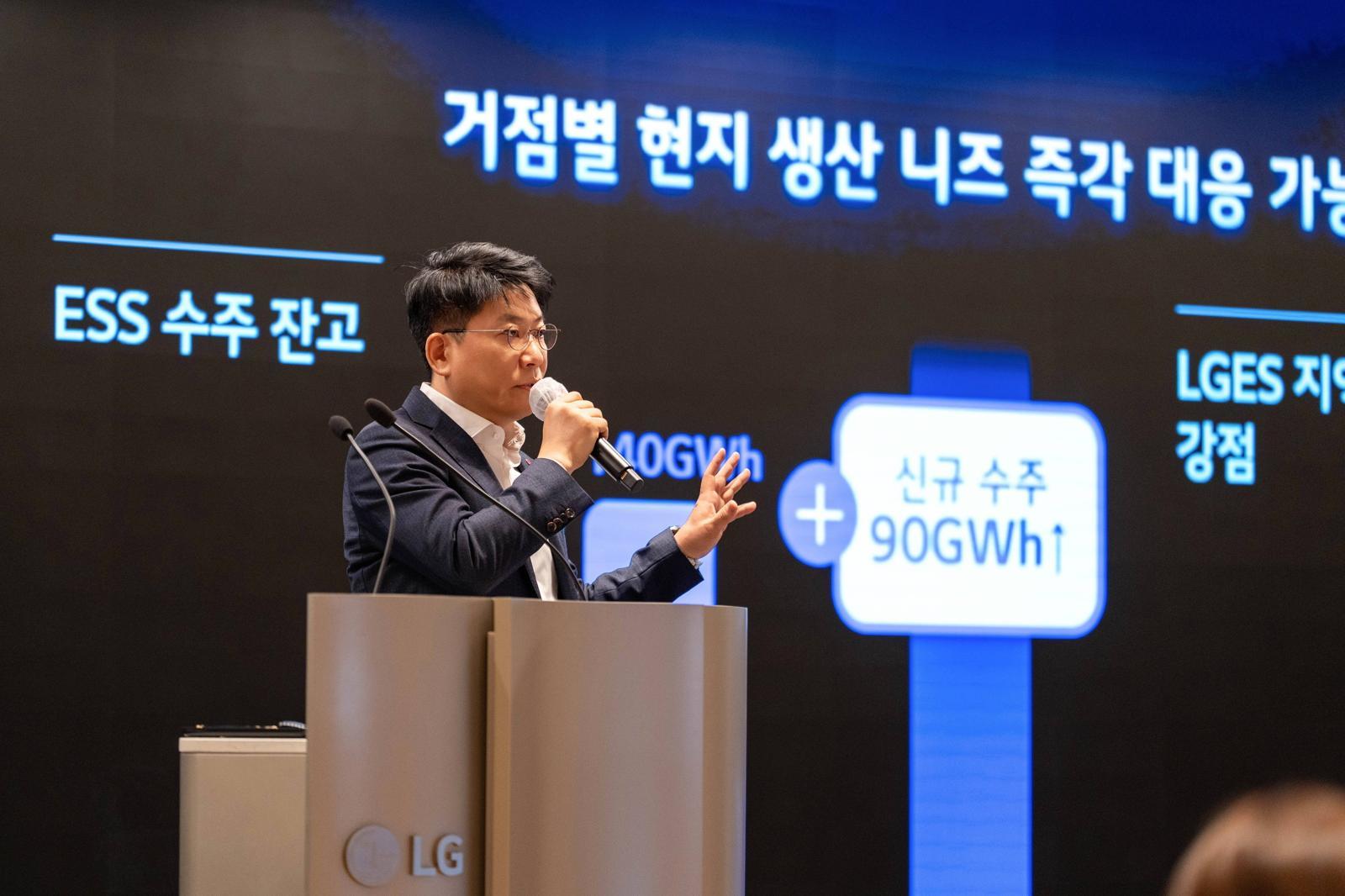
Kim Dong-myeong, President of LG Energy Solution, delivers a speech at the “6th Annual General Meeting of Shareholders” held at LG Twin Towers in Yeouido, Seoul.
LG Energy Solution held its annual general meeting of shareholders on the 18th and unveiled its core strategies for 2026, centered on the full-scale expansion of its ESS business and the reorganization of its business portfolio. CEO Kim Dong-myeong stated, “This is a period of ‘value shift’ in which the growth value of industries is being redefined,” adding, “The company will generate tangible results with its prepared capabilities and execution power.”
Kim assessed that the global ESS market has entered a full-fledged phase of structural growth this year, expressing strong confidence. This year’s new order target has been set above last year’s record-high 90 GWh, and the company plans to nearly double its global ESS battery production capacity to more than 60 GWh by the end of this year.
A significant portion of this production capacity will be concentrated in North America, where the steepest growth is expected. He emphasized, “This growth momentum will not be given to all battery companies, but will be concentrated among a limited number of players capable of meeting local production and supply chain requirements.” In North America, the company plans to swiftly convert existing EV assets to ESS to solidify its position as the only non-Chinese producer of locally manufactured LFP batteries for ESS, while in Europe it intends to respond to market demand through local production using idle assets and a cost-competitive supply chain.
Regarding the EV market, he noted that the long-term growth trajectory remains intact, but that a different approach from the past is now required. Kim said, “Going forward, groundbreaking performance and competitive pricing, rather than subsidies and regulatory policies, will be the main drivers of demand recovery,” explaining that it is necessary to create proactive growth momentum through the wider adoption of autonomous driving, achieving price parity with internal combustion engine vehicles, and advancing fast-charging technologies. He projected that EV demand recovery will gain full momentum when next-generation electric vehicle models enter mass production around 2029–2030, and stressed that the company will strengthen its global market leadership based on robust manufacturing capabilities and quality control systems.
The company is also accelerating the reorganization of its business portfolio. It plans to increase the combined share of ESS and new businesses from the current level of about 20% to the mid-40% range, thereby balancing its business structure, which is currently heavily weighted toward EVs. In the EV business, it will enhance product diversity by expanding mid- to low-priced lineups and introducing new form factors, while also broadening its response scope to electrification demand such as EREVs and HEVs. In new businesses, the company intends to expand customer touchpoints in areas such as humanoid robots, UAM (Urban Air Mobility), and ships, and extend its business into software and services. Kim stated, “In EVs and ESS, as well as in new businesses such as humanoids, we will offer differentiated competitiveness and provide end-to-end value by combining software solutions to enhance safety and operational efficiency and by taking responsibility for after-sales service.”
Strengthening product and future competitiveness is also a key priority. The company aims to simultaneously enhance performance and price competitiveness across its core product lineup, including prismatic LFP batteries for ESS, LMR batteries for EVs, cylindrical high-nickel 46 series, and pouch-type high-voltage mid-nickel batteries. Next-generation technology development is proceeding in parallel. The company is preparing for the commercialization of solid-state batteries and is progressing with the development of dry electrode processes as planned. Sodium-ion batteries are currently undergoing technology verification with customers.
The company also made clear its commitment to improving its financial structure. Kim said, “We are shifting our investment focus from scale expansion to efficiency.” Capital expenditure (Capex) peaked in 2024 and has entered a declining trend, and going forward, investments will be centered on what is strictly necessary. This means the company will improve cash flow by concentrating resources on projects that actually generate profits, rather than on large-scale investments aimed merely at expanding size. Through this, it plans to enhance actual profitability and steadily accumulate free cash flow that the company can deploy at its discretion. Kim stressed, “Through this, we will be able to achieve a genuine enhancement of shareholder value.”
At the general meeting, all key agenda items, including approval of the 6th-term financial statements, approval of amendments to the articles of incorporation, and approval of the directors’ remuneration limit, were passed as originally proposed.
ⓒ dongA.com. All rights reserved. Reproduction, redistribution, or use for AI training prohibited.
Popular News







 About Dong-A Ilbo