From parts supply to assembly and packaging, automation takes over… 2023 generative AI boom accelerates AI adoption
Advancing digital twins in partnership with NVIDIA… Managing even what human eyes can’t see
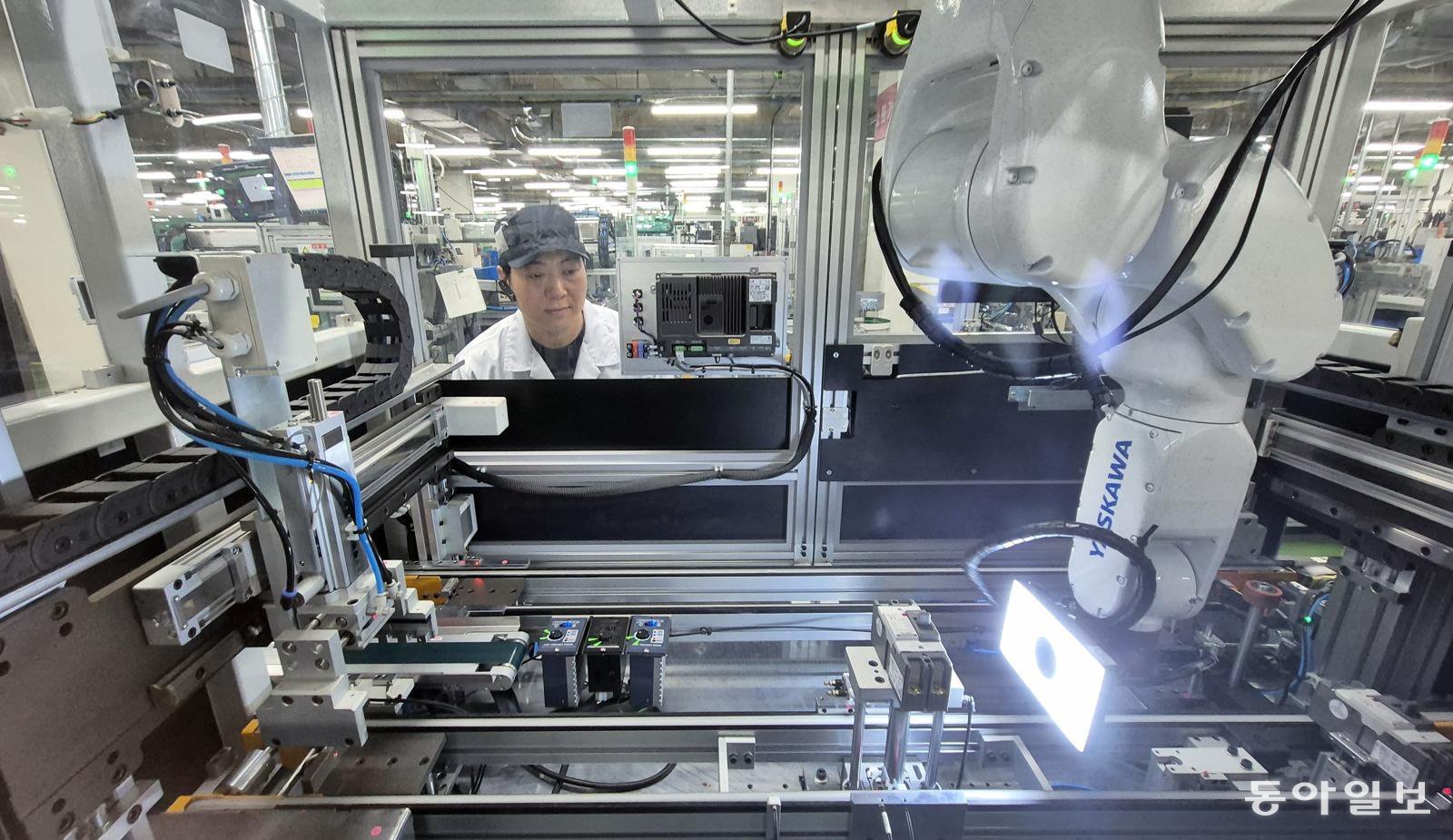
An LS ELECTRIC employee monitors a robotic arm inspecting products for defects at the company’s factory in Cheongju, North Chungcheong Province. The robot has enhanced its accuracy by learning from thousands of defective images using generative artificial intelligence (AI). Cheongju=Reporter Hong Jin-hwan jean@donga.com
At LS ELECTRIC’s factory in Cheongju, North Chungcheong Province, visited recently, a camera-equipped robotic arm was taking images of finished circuit breaker products from all angles—top, bottom, left, and right. The photos taken by the robot are analyzed in real time by artificial intelligence (AI) to check for defects. LS ELECTRIC introduced generative AI into its product inspection process in 2023, significantly improving work efficiency. A company official said, “The probability of misreading a non-defective product as defective used to be 10%, but it is now 0%.”
Targeting the global power grid market, LS ELECTRIC is using state-of-the-art AI on its manufacturing lines to boost productivity and drive quality innovation. The company is transforming beyond simple equipment automation into an intelligent smart factory where AI makes autonomous judgments and continually evolves.
● Defect rate at ‘0.0007%’ after AI adoption
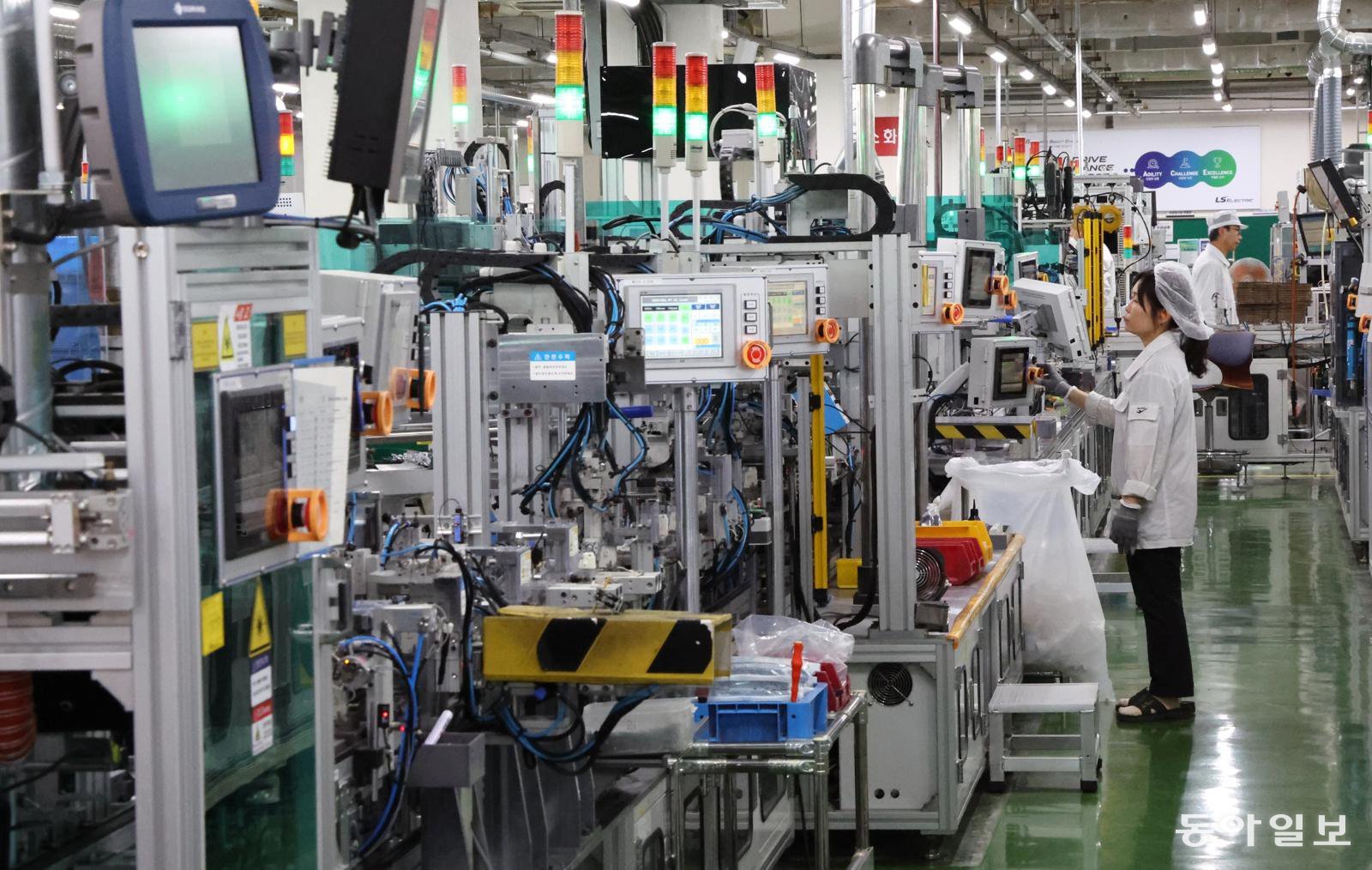
LS ELECTRIC employees overseeing and inspecting automated manufacturing processes. Cheongju=Reporter Hong Jin-hwan jean@donga.com
Building G at LS ELECTRIC’s Cheongju factory, where the AI robotic arm has been deployed, has an automated system across the entire line from parts supply and assembly to testing and packaging. This facility produces 26 million industrial circuit breakers and 12 million contactors annually. Inside the factory, more than 20 automated guided vehicles (AGVs) and autonomous mobile robots (AMRs) transport parts seamlessly according to programmed commands and AI-driven real-time traffic analysis. Only one or two employees per line are needed to monitor whether the process is running smoothly.
The Cheongju factory is designed to automatically manage inventories as well. Automation equipment on each line is linked to a Manufacturing Execution System (MES), generating more than 500,000 data points per line per day, which are used as big data. Based on this, LS ELECTRIC strictly controls inventory so that materials used in manufacturing do not exceed 1.5 days’ worth each day, fundamentally eliminating inventory waste.
On top of this data infrastructure, LS ELECTRIC introduced generative AI into the product inspection process in 2023. When robots verify products, the key is not so much “knowing what a normal product looks like” as it is accurately determining “what should be identified as defective.” In the past, to create defective samples for computer learning, workers had to intentionally scratch or twist flawless products to generate flaws, and even then, producing just over 10 samples a day was a challenge.
With the advent of generative AI, however, feeding only a few defective samples now enables the system to instantly create thousands of virtual defective product images in various forms. Training computer vision with these images has significantly improved both the accuracy and speed of product verification.
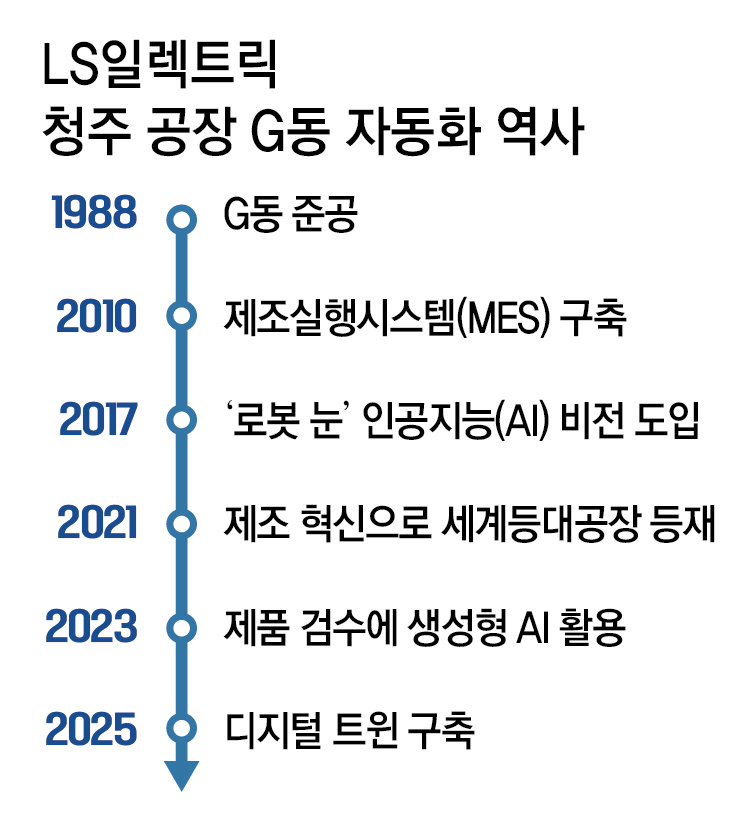
Source: LS ELECTRIC
In industrial settings, the so-called “over-inspection rate,” where machines mistakenly classify non-defective products as defective, is regarded as the biggest cause of inefficiency in mass production. Conventional robotic inspection systems showed an over-inspection rate of 10%, meaning that out of 100 items flagged as defective, 10 were actually good products. After the introduction of generative AI, this figure has become a perfect “0%.” In other words, every product that the robot classifies as defective is in fact defective. Building on this, LS ELECTRIC has enhanced process integrity to the point that the overall defect rate at the Cheongju factory has reached 7 PPM (7 per 1 million), one of the highest levels among global smart factories.
● Managing every corner of the factory with digital twins LS ELECTRIC is now maximizing factory operation efficiency by advancing its “digital twin” technology through partnerships with global big tech companies. Collaborating with Microsoft, NVIDIA, and data analytics specialist Sight Machine, the company has built a system that replicates the entire factory line operation in a virtual space and controls it via computer. The system is built by combining Microsoft’s cloud with NVIDIA’s digital twin platform “Omniverse,” and the data generated are analyzed with Sight Machine to further advance factory operations.
Recently, the company has even introduced “ray tracing” technology, used in high-definition rendering and game engines for simulating light reflection and textures, to make the virtual factory identical to the real one. Kim Hyeong-gyu, manager of LS ELECTRIC’s Smart Factory Team, explained, “This has enabled us to train AI robots within the virtual space and extract highly reliable data.”
The most notable example of digital twin application is the “vacuum furnace (vacuum hall)” process. This process involves welding under high heat in an enclosed space. Once the equipment is activated, the door must remain closed for 16 hours. As a result, it was impossible to visually confirm whether the internal temperature was evenly distributed or whether the process was proceeding properly, but digital twin technology has solved this. Without physically opening the door, it is now possible to monitor and simulate the internal heat distribution and operating status in real time in a virtual space, almost as if looking through the equipment.
The energy consumption efficiency of the Cheongju factory is also continuously improving. LS ELECTRIC links production data with energy data to track and control the power consumption and carbon emissions of each piece of equipment in real time. Through this, it has reduced energy use by more than 60% compared to before the system was introduced. Cho Uk-dong, head of LS ELECTRIC’s AP·EMEA Business Division, said, “This is becoming a powerful tool for proactively responding to tightening ESG environmental regulations, particularly in the European Union (EU).”
Recently, the company has partnered with South Korea’s largest cloud provider, Naver Cloud, to jointly develop an AI agent solution that applies AI models to power equipment diagnostics. An LS ELECTRIC official said, “Once this solution is introduced, even non-experts will be able to easily manage complex power equipment with the help of conversational AI.”
ⓒ dongA.com. All rights reserved. Reproduction, redistribution, or use for AI training prohibited.
Popular News








 About Dong-A Ilbo