Ministry of Science and ICT, Korea Atomic Energy Research Institute
Developing next-generation AI semiconductors for space and defense
Maintains computing functions even under proton beam exposure
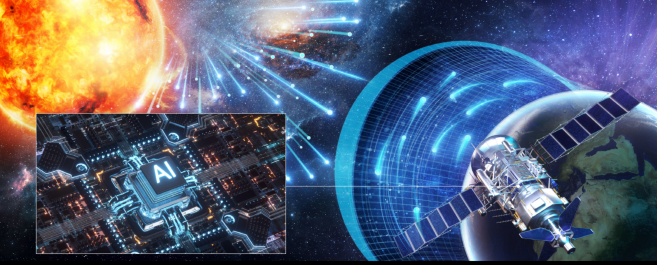
High-performance semiconductor devices that can operate reliably in the harsh radiation conditions of space are essential to implement artificial intelligence (AI) and the Internet of Things (IoT) on artificial satellites and space probes. Provided by the Korea Atomic Energy Research Institute
A Korean research team has, for the first time on the ground, verified the radiation tolerance performance of AI semiconductor devices suitable for AI operation. The achievement is regarded as laying the foundation for the development of domestically produced radiation-hardened semiconductors for use in space environments.
The Ministry of Science and ICT announced on the 19th that a research team led by Principal Researcher Kang Chang-gu and Senior Researcher Lee Yong-soo at the Korea Atomic Energy Research Institute, in joint research with a team led by Professor Cho Byung-jin of Chungbuk National University, has developed a next-generation neuromorphic AI semiconductor for space and defense applications and confirmed that its functions were maintained even after exposure to harsh radiation conditions. The research findings were published in the March issue of the international journal “Materials Science in Semiconductor Processing.”
The competitiveness of aerospace technology hinges on how stably electronic systems can maintain performance under extreme conditions. In particular, high-performance semiconductor devices are essential for implementing AI and IoT on artificial satellites and space probes to enhance data collection and analysis capabilities.
In outer space, electronic equipment is exposed to high-energy cosmic radiation. This is because the strength of the Earth’s magnetic field, which blocks radiation, weakens with increasing distance from the planet. Radiation causes damage and defects in semiconductor devices, leading to performance degradation, malfunction, and even permanent failure. In the case of memory semiconductors, there is also a risk that stored information may be corrupted when exposed to radiation.
The research team fabricated neuromorphic transistors based on indium gallium zinc oxide (IGZO), a next-generation semiconductor material, and verified their radiation tolerance. A transistor is a semiconductor device that amplifies electrical signals or controls current flow. Neuromorphic semiconductors, which mimic the human brain’s neural networks, are attracting attention as next-generation technology due to their high energy efficiency and high-speed processing capability.
When the research team irradiated the IGZO transistors with a 33 MeV (mega-electron volt, a unit of energy) high-energy proton beam using the proton accelerator at the Korea Atomic Energy Research Institute in Gyeongju, Gyeongsangbuk-do, and then evaluated the device performance, they observed performance degradation, including a 10–30% reduction in drive current and an increase in internal resistance. However, the devices’ fundamental switching operation and computational functions were maintained. The radiation dose corresponds to approximately 20 years of exposure to space radiation in low Earth orbit. Protons are one of the radioactive particles commonly found in space environments.
To evaluate the AI computing capability of devices exposed to radiation, the team conducted computing simulations. In a handwritten-digit recognition test, the devices recorded a high accuracy of 92.61%. Their ability to clearly distinguish 16 different states was also confirmed.
IGZO semiconductors are considered a key candidate material for displays and logic devices mounted on spacecraft and satellites because they are resistant to radiation damage, thin, and have excellent electrical properties. They are expected to serve as a cornerstone for the localization of AI semiconductors for space and defense applications.
Professor Cho stated, “We plan to further study technical strategies to compensate for performance degradation and develop this technology into a core capability in the field of aerospace AI semiconductors.” Principal Researcher Kang said, “It is hoped that these research results will be utilized as a core next-generation AI semiconductor technology that can be used in extreme environments, such as radiation environments with limited power supply.”
Efforts to validate device and equipment performance in actual space environments and collect research data are also continuing. The U.S. lunar exploration rocket Artemis II, scheduled for launch on April 1, will carry semiconductor chips from Samsung Electronics and SK hynix as secondary payloads. Through a support program for space validation of domestically produced device components, the Korea AeroSpace Administration is also securing space heritage for domestic semiconductors, sensors, and batteries by loading them onto verification satellites.
ⓒ dongA.com. All rights reserved. Reproduction, redistribution, or use for AI training prohibited.
Popular News










 About Dong-A Ilbo