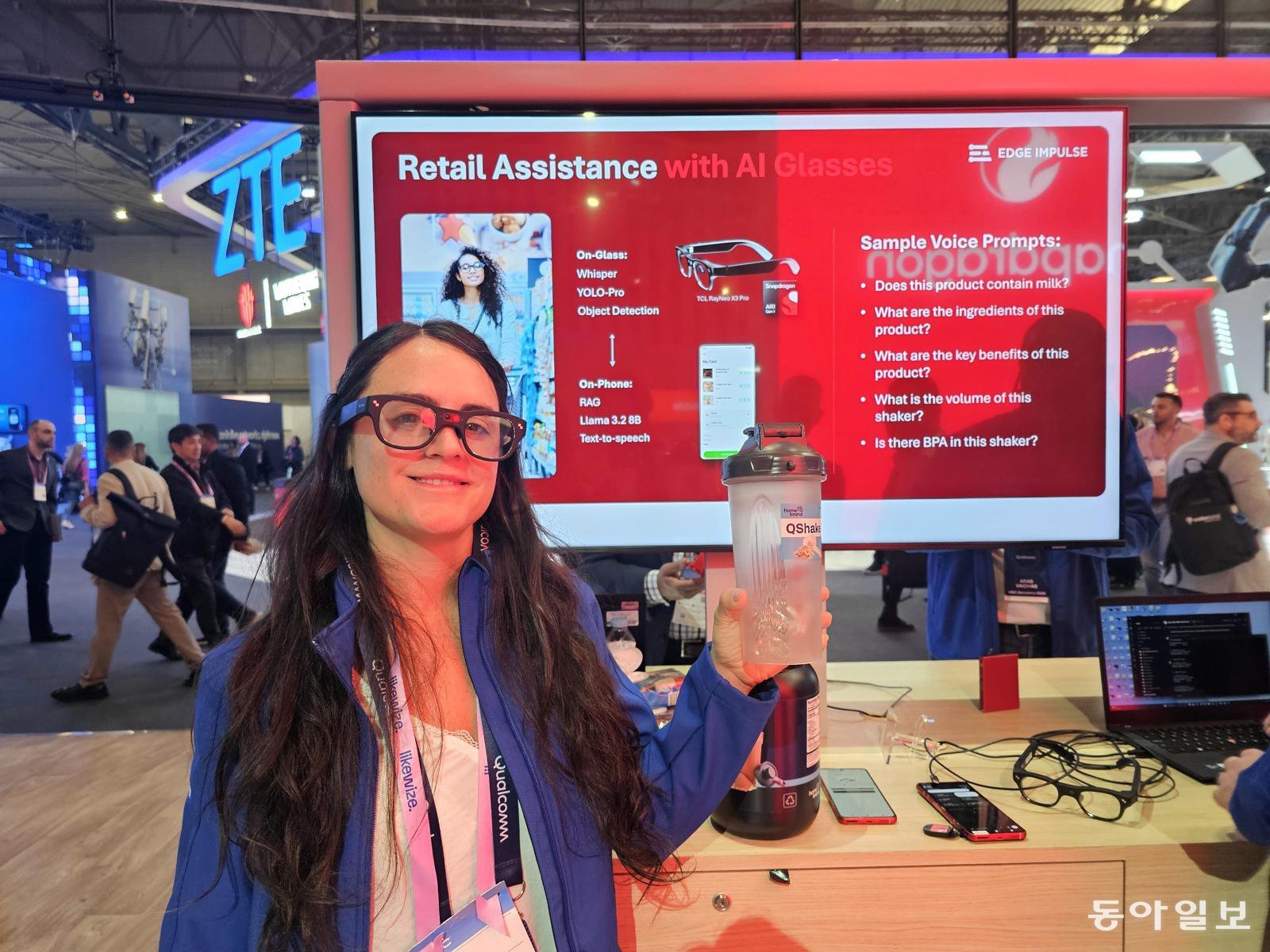
On 2nd (local time), an employee wearing smart glasses demonstrates a product at Qualcomm’s booth at ‘Mobile World Congress 2026 (MWC26)’ in Barcelona, Spain. Barcelona = Kim Jae-hyung monami@donga.com
“This is a container for a highly nutritious beverage.”
On 2nd (local time), this was the answer that came back at Qualcomm’s booth at ‘Mobile World Congress 2026 (MWC26)’ in Barcelona, Spain, when a beverage bottle in front of the user was captured while wearing smart glasses and the question was asked, “What is this?” The Qualcomm Snapdragon augmented reality (AR) and wearable-dedicated chipset (NPU) mounted on the frame of the glasses processes voice and visual information, then delivers an optimal answer via a mobile phone using a retrieval-augmented generation (RAG) method.
This scene shows a visual language model (VLM) being implemented as a gateway to “physical AI,” in which artificial intelligence (AI) emerges into the real world beyond screens. VLM is the backbone of VLA (Vision-Language-Action) technology, which converts visual information into language and connects it to physical actions. Qualcomm’s placement of a large number of Internet of Things (IoT) devices such as Xiaomi smart glasses in one section of the exhibition hall is seen as a move to preempt embedded AI software for manufacturers.
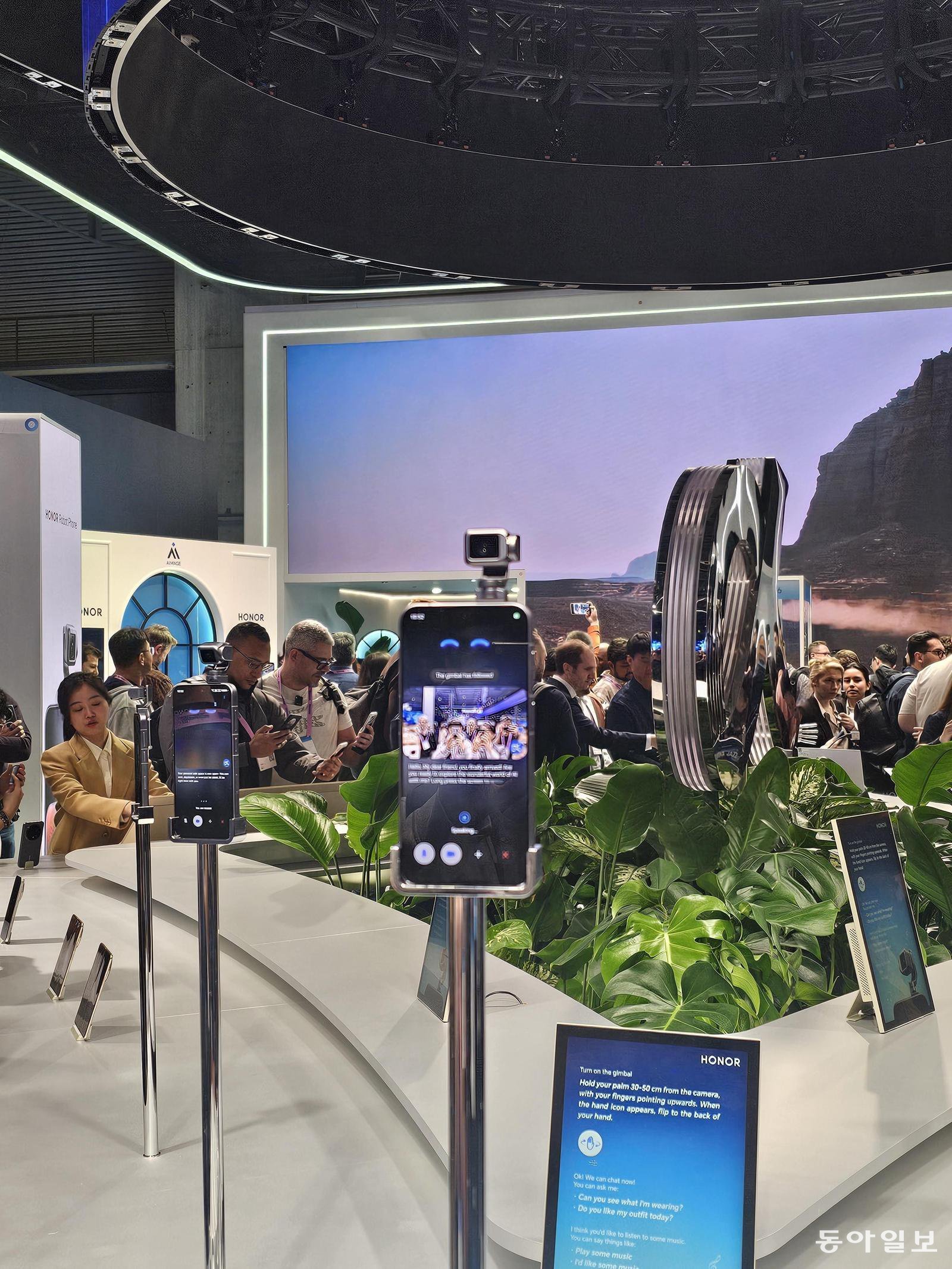
A view of the “robot phone” on display at the nearby Honor booth (below). Barcelona = Reporter Kim Jae-hyung monami@donga.com
The booths that attracted the most visitors with physical AI that day were those of Chinese companies. Honor’s “robot phone” used a miniature gimbal camera on the back to autonomously track visitors’ movements and shoot from the optimal angle, while its built-in VLM immediately processed audiovisual information to answer questions and even enabled physical interaction by nodding the camera joints. ZTE also showcased advanced humanoid robots at the forefront, demonstrating that China is leading hardware convergence based on VLM.
Korean companies responded with domestic foundation models. LG AI Research Institute announced at this MWC that it would unveil the next-generation model “EXAONE 4.5,” which understands reality through visual intelligence, in the first half of the year. The plan is to lay the groundwork for a Korean-style humanoid and executable AI. Im Woo-hyung, Co-Head of LG AI Research, said, “Beyond the AX (AI transformation) stage, we will create tangible value in the real world and prove world-class performance and infrastructure efficiency.”
Kim Jae-hyeong
AI-translated with ChatGPT. Provided as is; original Korean text prevails.
ⓒ dongA.com. All rights reserved. Reproduction, redistribution, or use for AI training prohibited.










 About Dong-A Ilbo