[MWC 2026 Networks Become the Brains of AI] Part 1: A Major Shift Beyond the Gigabit Speed Race
MWC opens with 110,000 global leaders in attendance
SKT unveils ‘full-stack’ infrastructure strategy
KT showcases spaces merging K-culture with AI
LG U+ debuts active ‘IXIO Pro’
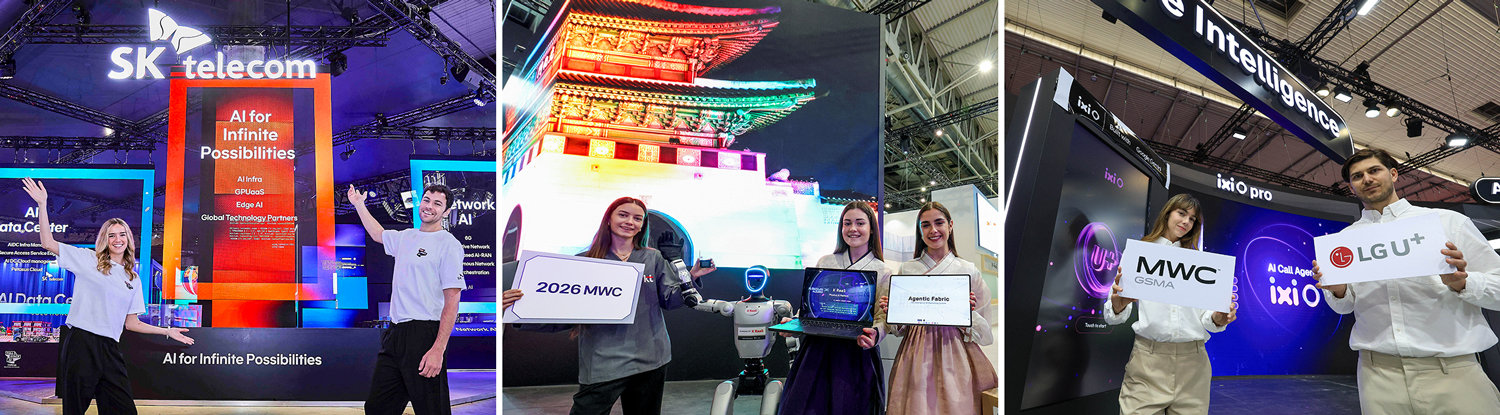
South Korea’s three mobile network operators will participate in ‘Mobile World Congress 2026 (MWC26)’, the world’s largest information and communications technology (ICT) exhibition, which opens on the 2nd (local time) in Barcelona, Spain. SK Telecom, KT and LG Uplus plan to introduce and demonstrate their self-developed artificial intelligence (AI) models and services to visitors from around the world at their exhibition booths. Provided by each company
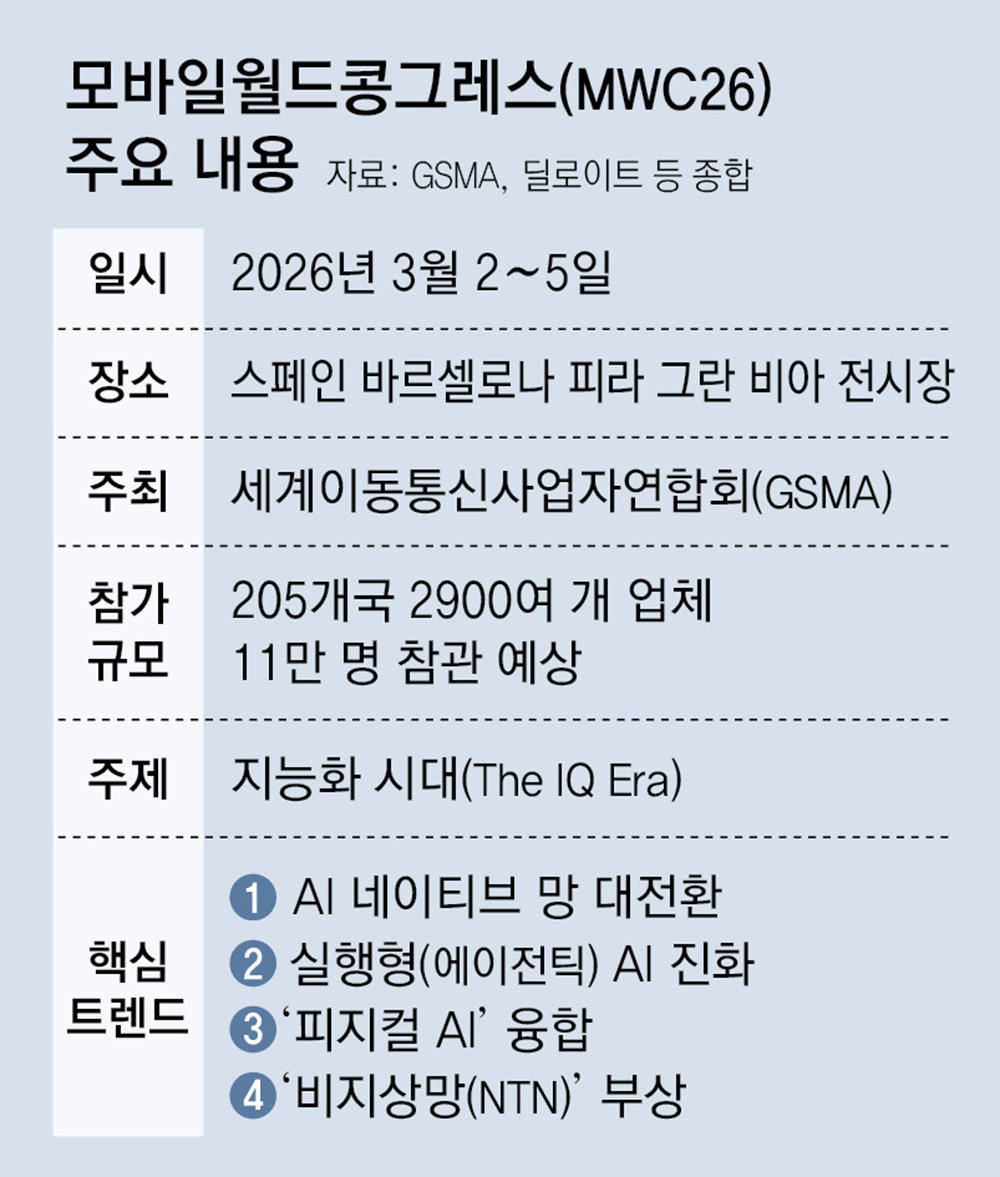
The world’s largest information and communications technology (ICT) exhibition, ‘Mobile World Congress 2026 (MWC26)’, which brings together 110,000 global leaders in the mobile and telecommunications sectors from more than 200 countries, opens on the 2nd (local time) in Barcelona, Spain. Marking the 20th anniversary of its hosting in Barcelona, this year’s main theme is ‘The IQ Era’.
The competitive landscape among global telecom operators, which have been racing for gigabit (ultra-high-speed data transmission) speeds, is set to be completely reshaped from this year. This shift is driven by a paradigm transformation to ‘AI-native networks’, where the networks themselves make decisions and optimize operations. MWC26 has become the stage where telecommunications networks evolve from simple data transmission channels into massive ‘AI brains’.
● AI-driven upheaval shakes up the telecom landscape
AI, which has emerged as a catalyst for sweeping transformation across industries, is no exception for the telecommunications sector. Investment, competitive dynamics and technology development directions are all being rapidly reorganized around AI.
Global consulting firm McKinsey projects that USD 5.2 trillion (KRW 7,524.4 trillion) will be needed by 2030 to meet demand for AI data centers. As astronomical amounts of capital are expected to pour into AI infrastructure, the center of gravity in telecom infrastructure is also rapidly shifting from physical equipment such as towers and antennas to AI software. Executable (agentic) AI networks that autonomously handle traffic distribution, fault diagnosis and network slicing without human intervention are now in full swing.
The competitive landscape is also diversifying as not only telecom operators but also big tech and the aerospace industry join the race. Google Cloud, in partnership with Deutsche Telekom, is unveiling ‘MINDR’, an autonomous diagnostic system in which AI automatically detects and fixes network failures. Non-terrestrial networks (NTN), which fill in blind spots of terrestrial networks, are also a core agenda item. Low Earth orbit (LEO) satellite communication companies such as Starlink are creating a new pillar in the network industry by leveraging coverage free from physical constraints.
● K-telecom operators move to secure leadership in AI technologiesSouth Korea’s three mobile network operators and Samsung Electronics are setting up large-scale booths at MWC26 to spotlight the future direction of next-generation technologies such as AI-based call agent services, AI contact centers (AICC) and AI data centers (AIDC).
LG Uplus is taking the most proactive steps. The company is unveiling ‘ixi-O Pro’, a next-generation AI call agent that understands conversational context through users’ everyday data and responds proactively, as well as showcasing technologies such as ‘Autonomous NW’, an autonomous network solution with embedded AI, and the security solution ‘ixiGuardian 2.0’. CEO Hong Beom-sik will take to the main keynote stage to present the company’s ‘human-centric AI’ vision. This is the first time an LG Group executive has appeared as a main keynote speaker at MWC.
SK Telecom has put forward a ‘Full-Stack AI’ strategy that encompasses the entire process from infrastructure deployment to service delivery. In Hall 3, the company visualized its AI vision with a large transparent light-emitting diode (LED) installation dubbed the ‘Infinity Gate’. It has also prepared experiential zones, including demonstrations of its large-scale AI model ‘A.X K1’.
KT has set up an exhibition in Hall 4 themed around Gwanghwamun Square, using six themed zones that combine ‘K-culture’ and AI to promote South Korea’s advanced technological capabilities and culture to visitors from around the world. While putting forward its ‘Physical AI’ strategy, which connects robots, equipment and information technology (IT) systems into a single intelligent ecosystem, KT is also unveiling its robot platform ‘K RaaS’ for the first time at the venue.
Samsung Electronics is demonstrating its strength as a leading telecommunications equipment manufacturer by unveiling new mobile devices such as the ‘Galaxy S26 series’ with enhanced AI features, alongside B2B (business-to-business) solutions that use AI to automate network operations.
The AI-centered restructuring trend becomes even clearer on the keynote stage. Mats Granryd, Director General of GSMA, AT&T CEO John Stankey and Nokia CEO Justin Hotard emphasize the sweeping transition to ‘AI-native networks’. In addition, SpaceX Chief Operating Officer (COO) Gwynne Shotwell will present a blueprint for ultra-connected satellite networks, further intensifying the competition for leadership.
ⓒ dongA.com. All rights reserved. Reproduction, redistribution, or use for AI training prohibited.
Popular News








 About Dong-A Ilbo