In March 2016, ten years ago, Google DeepMind’s Go artificial intelligence (AI) ‘AlphaGo’ defeated 9-dan Lee Sedol. AI has since penetrated everyday life and the workplace, posing a threat to people’s livelihoods. As AI replaces developers and mass layoffs continue at big tech companies, a bleak report (Citriini Research) has even emerged warning that such layoffs will ultimately trigger an economic crisis by 2028.
Although AI-driven fears are shaking Wall Street, the Go community, which was expected to be the first to collapse, has survived. The landscape has been reshaped by players who chase the AI-recommended “blue spot” (the move with the highest winning probability) and understand AI, but humans are still playing Go against humans. According to the Korea Baduk Association, the Go-playing population (those who know how to play Go), which was estimated at about 9.2 million in 2015, declined by only about 4% to 8.83 million as of 2023. People continue to enjoy Go and immerse themselves in professional players’ matches.
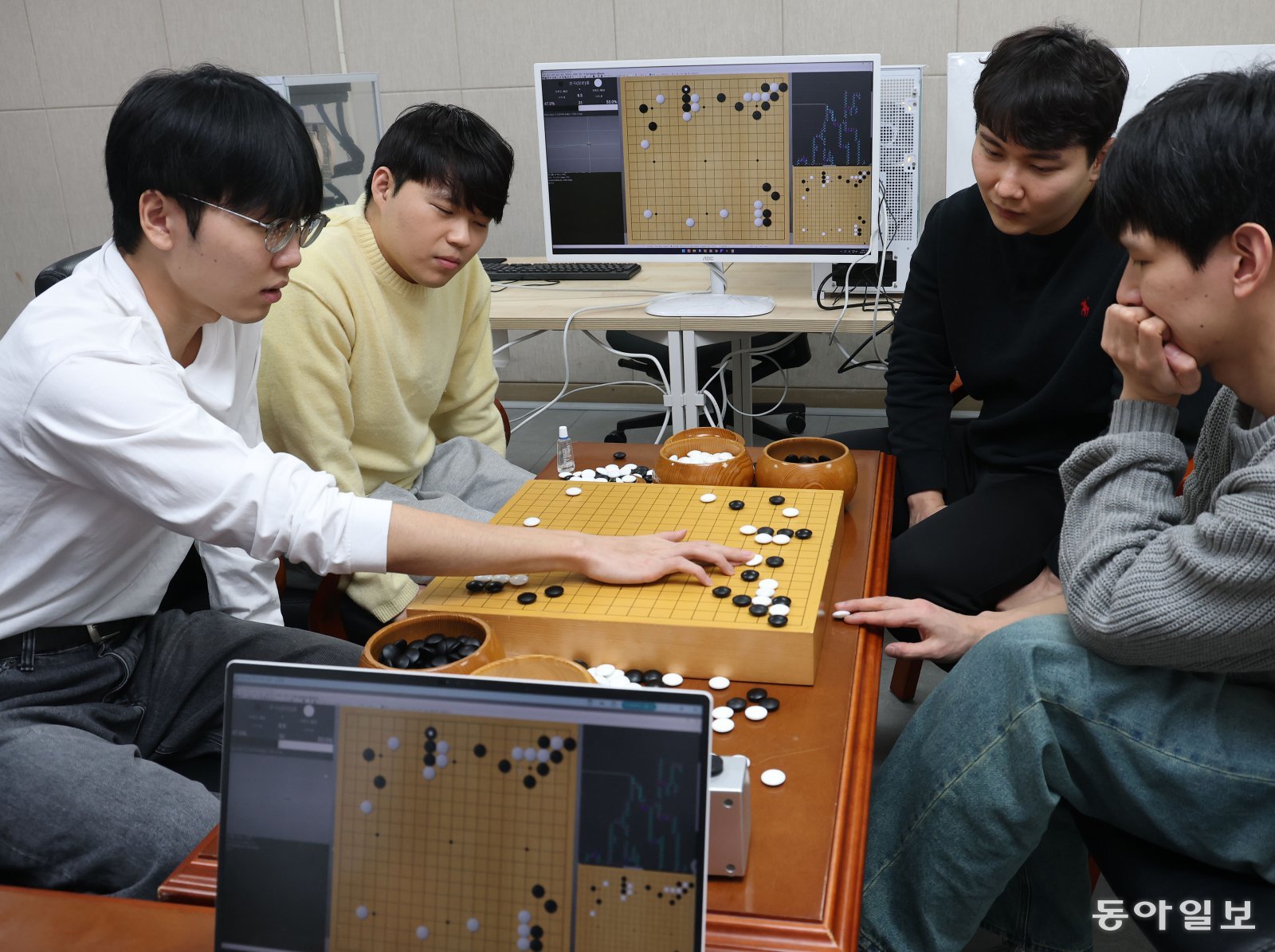
Members of the Korean national Go team study games using the Go artificial intelligence (AI) KataGo at the Korea Baduk Association in Seongdong District, Seoul, earlier this month. Photo by Kim Jae-myung base@donga.com
“We have about 16 of NVIDIA’s latest graphics processing units (GPUs). The ‘KataGo’ (Go AI) screen the trainees are looking at now is actually being run on the latest GPUs in the next room.”
Ten years after Google DeepMind’s Go AI ‘AlphaGo’ appeared, the Korea Baduk Association looks completely different from the pre-AlphaGo era. Bookshelves once crammed with game records of Go legends such as Cho Hun-hyun and Lee Chang-ho and with standard opening theory books have all disappeared, replaced by NVIDIA’s latest ‘GeForce 5090’ GPUs, which sell for KRW 5 million to KRW 7 million per unit. At the Korea Baduk Association earlier this month, Jin Si-young, 9-dan, a coach of the national Go team, said, “Nowadays we mainly study game records played by AIs,” adding, “They are of much higher quality than game records played by humans.”
The Go world survives after AlphaGo, but excessive reliance on AI remains an issue
In March 2016, the match between ‘AlphaGo’ and 9-dan Lee Sedol demonstrated that artificial intelligence could surpass the capabilities of the strongest human player, sending a shockwave through the Go community. Some predicted that human-versus-human Go would disappear altogether. Contrary to these expectations of total collapse, however, the Go world has survived—albeit in symbiosis with AI. Only players who understand the AI-recommended “blue spot” (the move with the highest winning probability) and can play in an AI-like style have remained competitive. Hong Min-pyo, 9-dan, head coach of the Korean national Go team, said, “Differences in understanding of AI translate directly into differences in professional players’ strength.”
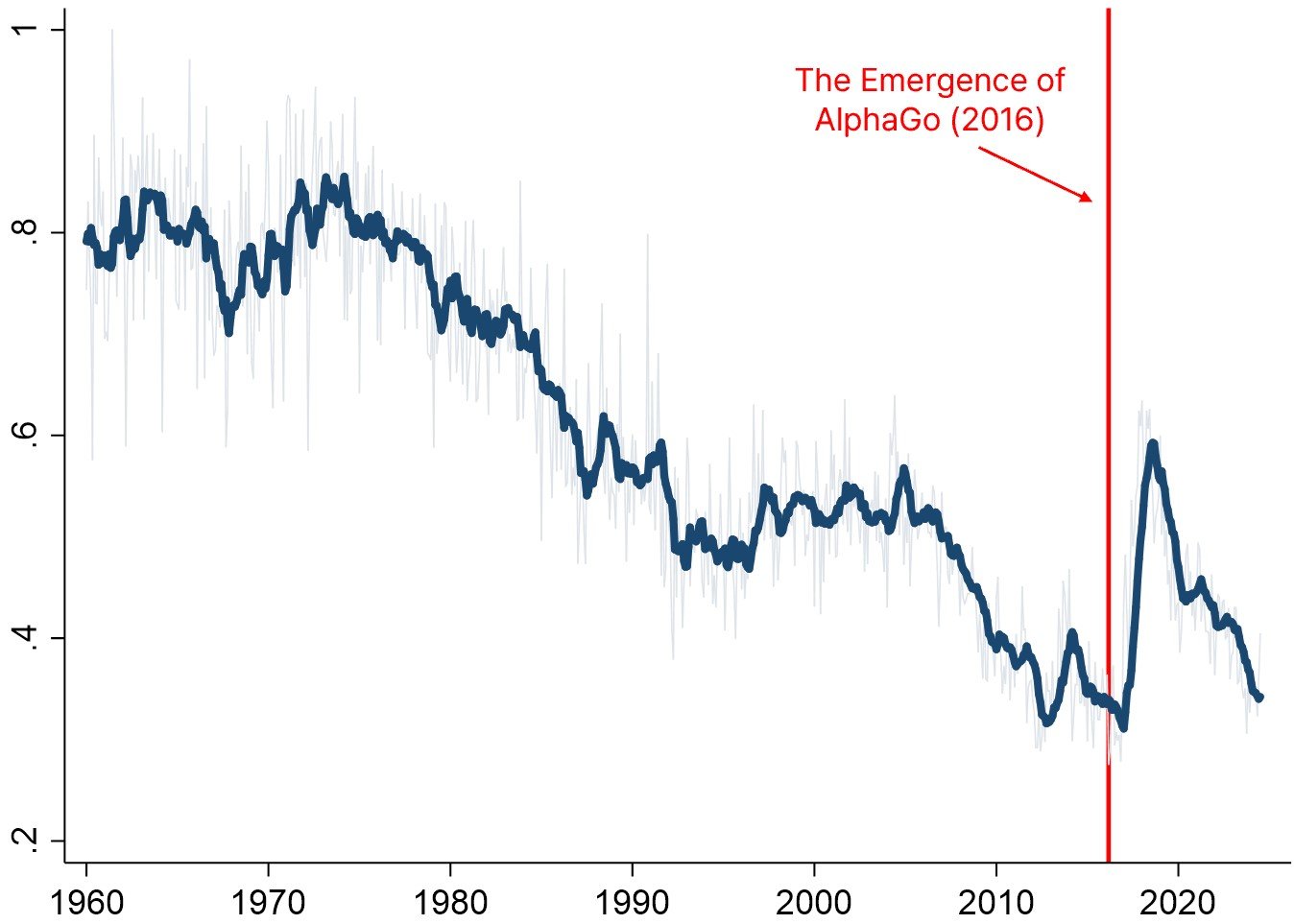
For this reason, some argue that professional players have become less “creative” than in the past, while others contend that the diversity of game records has in fact increased. Professor Hong Soon-man of the Department of Public Administration at Yonsei University, who won the “Originality Prize” at last year’s UEC Cup World Computer Go Tournament organized by the University of Electro-Communications (UEC) in Japan, developed a “historical novelty index” that quantifies how many new moves appeared, and analyzed Go game records from the 1960s to the 2020s.
The “historical novelty index” compares whether the first eight moves played in Go games from 1960 to 2024 had ever appeared before, and quantifies this as a score. The closer the score is to 1, the more new moves appear, implying that the game records are creative and diverse. The graph shows that diversity in game records rose sharply after the 2016 “AlphaGo shock.” Courtesy of Professor Hong Soon-man
The analysis found that just before AlphaGo’s emergence, in 2015, the index stood at a low level in the 0.3 range on a scale of 0 to 1. After AlphaGo appeared, however, the index climbed close to 0.6. Professor Hong said, “AlphaGo shattered human preconceptions,” adding, “Professional players began experimenting with a wider range of moves after watching AI casually play and win with moves that humans would never have chosen.”
Interestingly, diversity declined again after the open-source Go AI ‘KataGo’ appeared around 2019. This coincided with the start of full-scale AI study by professional players using KataGo. Professor Yoo Je-jung of the Korea Institute for Advanced Study (KIAS), an amateur 3-kyu who participated in developing the indigenous Korean Go AI ‘Baduki’, said, “Because players often memorize and replay about the first 20 moves of a game, it can look as if fewer new moves are appearing,” but added, “Recently, however, we are starting to see a variety of moves that defy AI’s predictions.”
Kim Ji-seok, 9-dan, who became the 18th player in Korea to reach 1,000 career wins, likewise said, “Even before AI, we used to imitate the opening strategies of top players. Only the object of imitation has changed to AI,” and added, “If anything, AI presents a far greater variety of techniques, so I think openings themselves have become more diverse than before.”
Nonetheless, excessive dependence on AI has emerged as a problem. Currently, countries such as Korea and Japan—excluding China—mostly train using the open-source Go AI ‘KataGo’, a program developed by U.S. engineer David Wu. Chinese players primarily use their domestically developed AI ‘Fine Art’ (‘Jueyi’ in Chinese).
There is concern that if the use of the open-source KataGo were suddenly to become difficult, there would be no ready “alternative.” Coach Hong said, “Because Fine Art is not disclosed by China, professional players would be much weaker today if KataGo had not been available,” and warned, “If KataGo stops being updated or runs into problems, training and developing new players could be seriously affected.”
Seeing the ‘big picture’ is a uniquely human capability
Excessive reliance on AI and the resulting fears now confront every industry, not just Go. Paradoxically, the first sector to be hit by AI has been software, the very field that developed AI. With the advent of coding-specialized AI, large numbers of engineers at big tech firms have been laid off, and as AI agents smart enough to replace software products are released, the share prices of Software-as-a-Service (SaaS) companies selling subscription-based software solutions have plunged. The term “SaaScalypse” has emerged on Wall Street.
Experts advise that “finding capabilities unique to humans is ultimately the way to survive.” Professor Hong said, “Clues can be found in Go AI,” explaining, “AI aggregates pieces of data to see the whole, whereas humans excel at looking at the big picture to check whether they are heading in the right direction.”
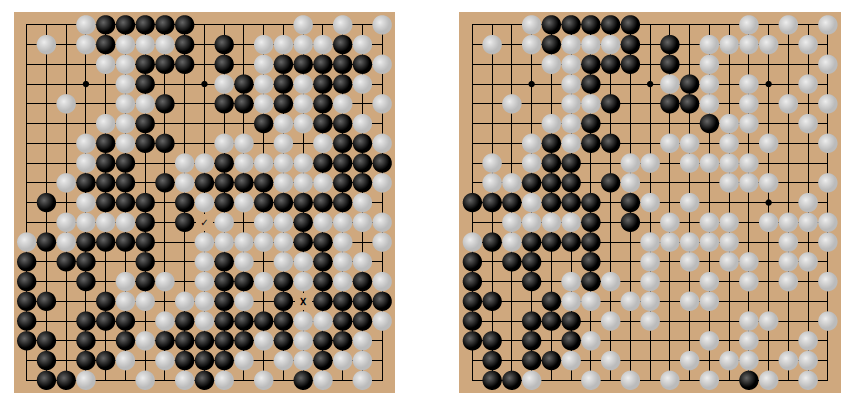
In the position on the left, Black (KataGo) should have sacrificed some stones at the bottom side and played at the point marked with ‘?’ to save the large group (dama, a huge territory), but failing to see the big picture and relying only on probabilities, KataGo played elsewhere instead of the ‘?’ point. As shown on the right, this allowed White (MIT research team) to capture the entire right side with a single move. Courtesy of MIT
In a paper presented by a Massachusetts Institute of Technology (MIT) research team at the 2023 International Conference on Machine Learning, human players achieved a winning rate of over 90% after inducing KataGo to mistakenly believe it was winning by a large margin. The researchers made meaningless moves to reinforce KataGo’s confidence in its victory. Once trapped in this misconception, KataGo chose “consecutive passes” (skipping its turns without placing stones) to try to end the game quickly, and the researchers exploited this by destroying the huge territory KataGo had built, thus securing the victory.
Any amateur Go player with a sense of the “big picture” could see that KataGo was in danger. The research team concluded, “Human insight into structural flaws across the entire board cannot be replaced.” Professor Hong commented, “This is a common pitfall for AI not only in Go, but also in other sectors such as medicine and law.”
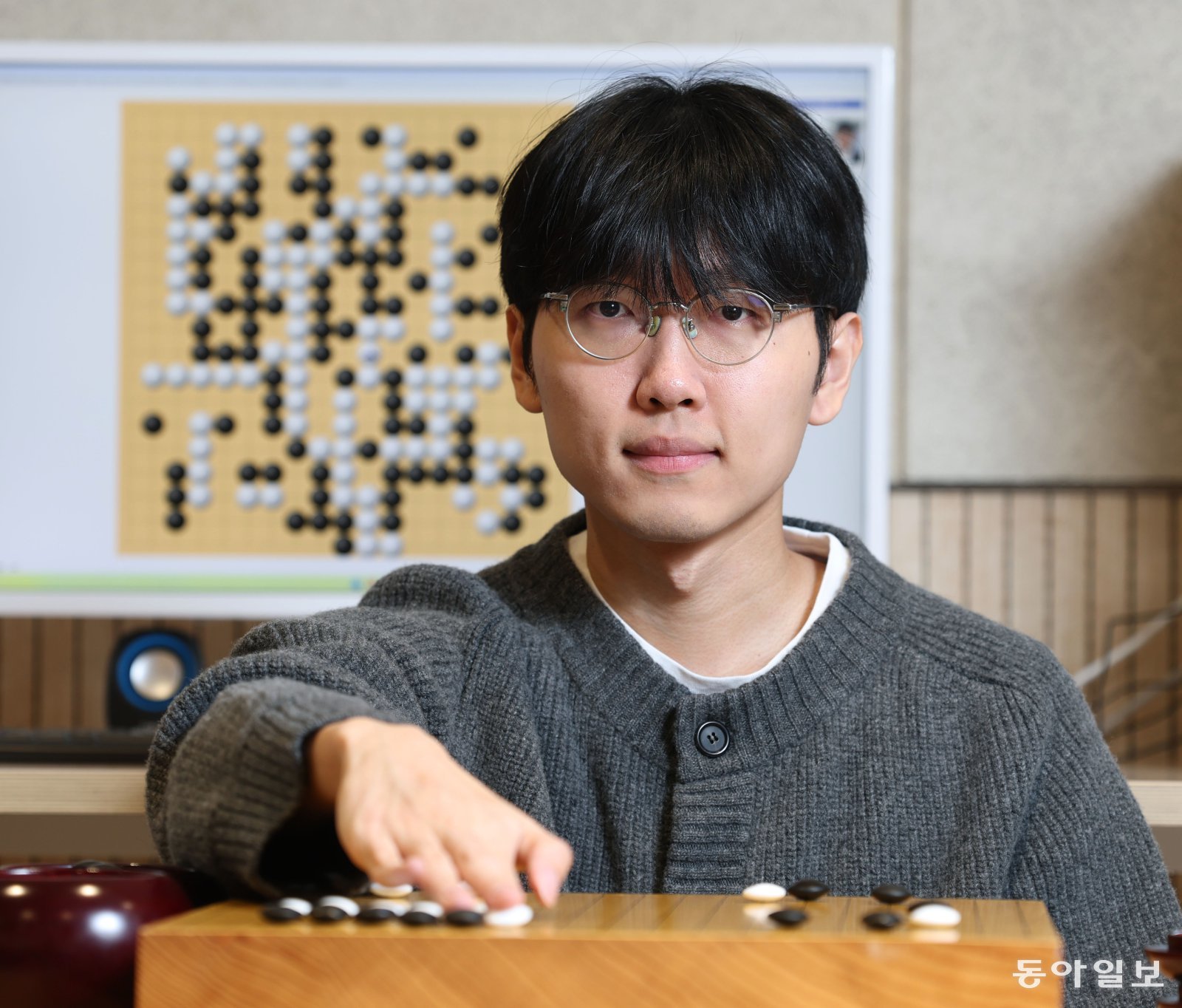
9-dan Shin Jin-seo at the Korea Baduk Association in Seongdong District, Seoul, earlier this month. Widely regarded as the player who best understands artificial intelligence (AI), Shin emphasized that “Go games played by humans who see the overall ‘story’ still have value.” Photo by Shin Won-gun laputa@donga.com
Shin Jin-seo, 9-dan, the current world number one who has swept major titles and won the gold medal at the 2022 Asian Games, said, “Artificial intelligence (AI) pursues perfect Go, but humans look at the overall ‘story’,” adding, “This is the biggest difference between AI Go and human Go.”
Kim Ji-seok, 9-dan, also said, “The reason Go’s popularity has not declined sharply is that what Go fans want to see is not the ‘correct answer’ itself, but rather the process in which two humans do their utmost to compete,” stressing that there is still room for humans in the game.
ⓒ dongA.com. All rights reserved. Reproduction, redistribution, or use for AI training prohibited.
Popular News










 About Dong-A Ilbo