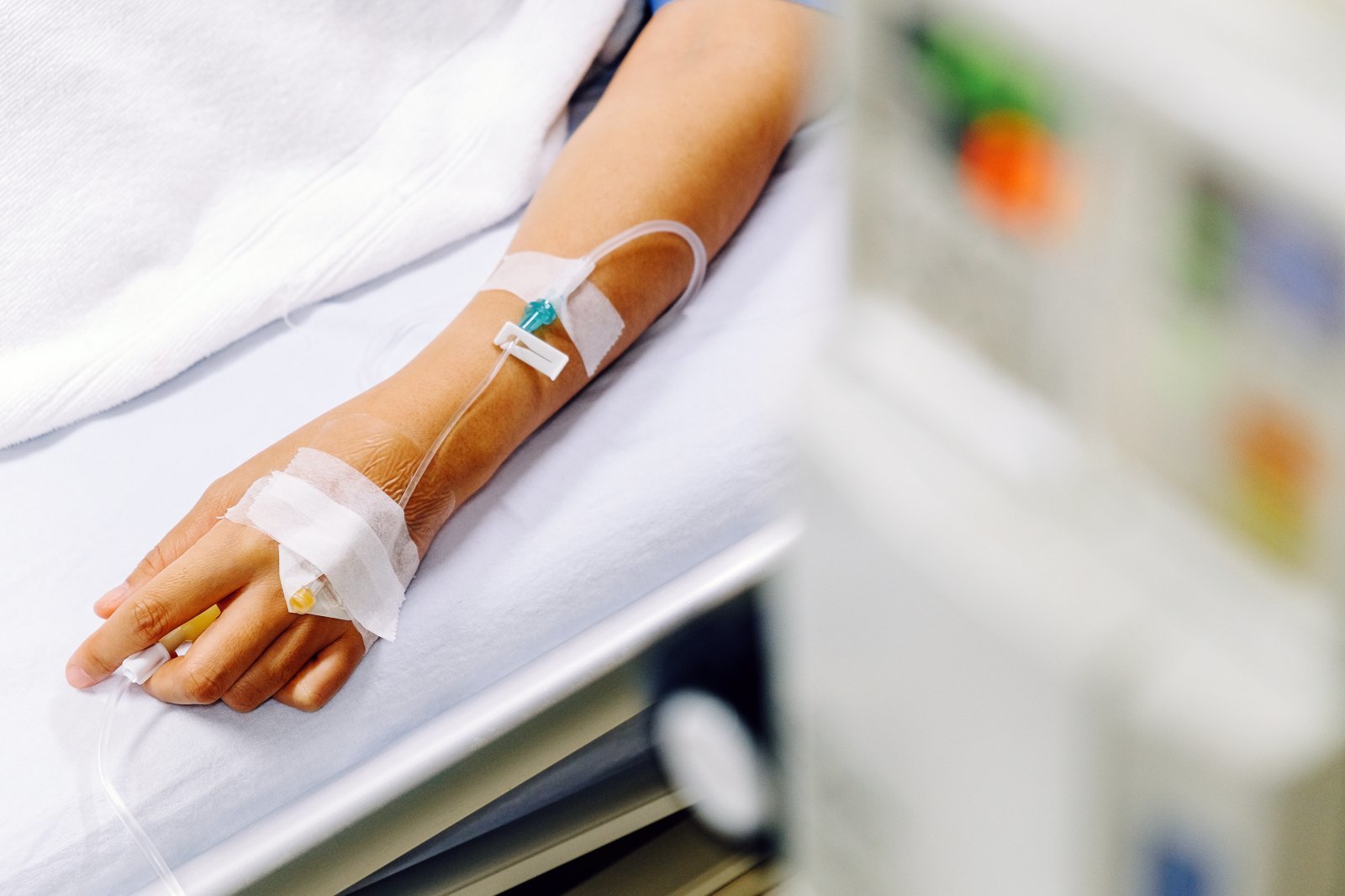
File photo of a patient receiving intravenous infusion therapy at a hospital. Artiva plans to conduct a Phase 3 trial of its pre-manufactured NK cell therapy ‘AB-101’ for refractory rheumatoid arthritis, administered in the outpatient setting without patient-specific cell collection and manufacturing. Getty Images Bank
Unlike CAR-T, which is made in a personalized manner from a patient’s own cells, an autoimmune disease treatment using a pre-manufactured NK cell therapy administered in the outpatient setting is entering Phase 3 clinical development. Artiva Biotherapeutics, the U.S. affiliate of GC Cell, plans to initiate a global Phase 3 trial in the second half of this year evaluating ‘AB-101’ in combination with rituximab in patients with refractory rheumatoid arthritis.
Artiva will present clinical data on AB-101 in patients with rheumatoid arthritis (RA), Sjögren’s disease (SjD), and systemic sclerosis (SSc) at the American College of Rheumatology (ACR 2026) annual meeting. The efficacy analysis population consists of 34 patients, and the safety analysis population consists of 60 patients. On 9 November, the company also plans to disclose updated results with increased patient numbers and extended follow-up duration.
AB-101 is an allogeneic cell therapy that uses NK cells obtained from healthy donors, manufactured in advance and cryopreserved for use when needed. Unlike autologous CAR-T, which requires harvesting the patient’s own T cells followed by genetic modification and expansion, it is an “off-the-shelf” product that does not require waiting for patient-specific manufacturing.
● ‘Efficacy comparable to CAR-T’…Not a head-to-head clinical comparisonIn its ACR abstract, Artiva stated that combination therapy of AB-101 and rituximab demonstrated a treatment response comparable to autologous CAR-T. However, this is not based on a clinical trial directly comparing the two therapies under the same conditions.
GC Cell told donga.com, “Both the autologous CD19 CAR-T and the AB-101 combination regimen share the common mechanism of inducing treatment effects by deep depletion of B cells.” The company added, “The expression ‘efficacy comparable to autologous CAR-T’ does not imply direct superiority or non-inferiority,” and explained, “It means that AB-101 also achieved the deep B-cell depletion observed with CAR-T, accompanied by clinically meaningful responses.”
Among the 34 patients in the efficacy analysis, 16 had rheumatoid arthritis, 11 had Sjögren’s disease, and 7 had systemic sclerosis.
The rheumatoid arthritis patients were a treatment-refractory population with a mean disease duration of 14.3 years. Among 7 patients evaluable at 6 months, 71% achieved ACR50. ACR50 is an index that assesses whether rheumatoid arthritis symptoms such as joint pain and swelling have improved beyond a specified threshold.
In 11 patients with Sjögren’s disease, systemic disease activity and patient-reported symptom burden such as fatigue and pain improved at 3 and 6 months. At 6 months, salivary secretion also increased compared with baseline.
In 7 patients with systemic sclerosis, scores reflecting the degree of skin thickening decreased at both 3 and 6 months. Among 6 patients evaluable at 6 months, 83% achieved rCRISS25 and 50% achieved rCRISS50.
GC Cell commented, “The current results are early clinical data based on a small number of patients and lack a control arm,” adding, “Additional follow-up is needed to determine the magnitude and durability of efficacy.”
File photo representing cell therapy research. Artiva is developing AB-101, an “off-the-shelf” cell therapy using NK cells from healthy donors manufactured in advance. Getty Images Bank
● Outpatient administration without patient-specific manufacturingAnother feature of AB-101 is that it does not require a patient-specific cell manufacturing process.
For autologous CAR-T, T cells must be collected from the patient and then undergo genetic modification, expansion, and quality control to produce a personalized therapy. It can take several weeks before actual administration, and following infusion, patients are often hospitalized or closely monitored at specialized cell therapy centers to watch for acute adverse events such as cytokine release syndrome (CRS) or immune effector cell–associated neurotoxicity syndrome (ICANS).
By contrast, AB-101 uses NK cells from healthy donors that are pre-manufactured and stored frozen, eliminating the need to wait for patient-specific cell collection and individualized manufacturing.
GC Cell stated, “Because there is no need to wait for patient-specific cell collection and individualized manufacturing, the burden related to treatment preparation time and supply can be reduced,” adding, “In the current clinical trial, AB-101 is administered intravenously in the outpatient setting every two weeks following preconditioning and rituximab combination, without hospitalization.”
The company continued, “Administration is already being performed at community rheumatology clinics,” and noted, “If safety and feasibility of outpatient administration are reproduced in real-world practice, reliance on specialized CAR-T centers could be reduced.”
As of 1 May, among the 60 patients in the safety analysis set, no CRS, ICANS, graft-versus-host disease (GvHD), or hypogammaglobulinemia had been reported, according to the company.
Treatment-emergent adverse events were reported in 56 patients. Most were hematologic adverse events such as neutropenia, which the company attributed more to the cyclophosphamide and fludarabine-based preconditioning regimen used before infusion than to AB-101 itself.
● Global Phase 3 in 150 patients
Artiva has selected treatment-refractory rheumatoid arthritis as the first indication for its Phase 3 program.
The global Phase 3 trial ‘CONCERT-RA’ will enroll approximately 150 patients and randomize them 2:1 to an AB-101 plus rituximab combination arm or a rituximab monotherapy arm. The primary endpoint is the ACR50 response rate at 6 months after treatment.
GC Cell said, “Discussions with the U.S. Food and Drug Administration (FDA) on the Phase 3 design have been completed,” adding, “In the ongoing Phase 2a study, we are further assessing the durability and reproducibility of responses, long-term safety, and the relationship between B-cell depletion and clinical response.”
The Phase 3 trial is targeted to start in the second half of this year, with topline results planned for release in the second half of 2028.
At ACR, Artiva will also present a study analyzing the treatment limitations in rheumatoid arthritis patients who have used two or more existing therapies without achieving adequate benefit. The company estimated that there are approximately 150,000–200,000 such patients in the United States.
ⓒ dongA.com. All rights reserved. Reproduction, redistribution, or use for AI training prohibited.
Popular News









 About Dong-A Ilbo