Only three BESS companies worldwide are ‘DSX-ready’—with just one Korean battery maker among them
North American ESS production capacity to exceed 50GWh by year-end, enabling local support from cells to system integration
U.S. data center power consumption projected to reach 391TWh by 2030…poised to capture AI power infrastructure demand
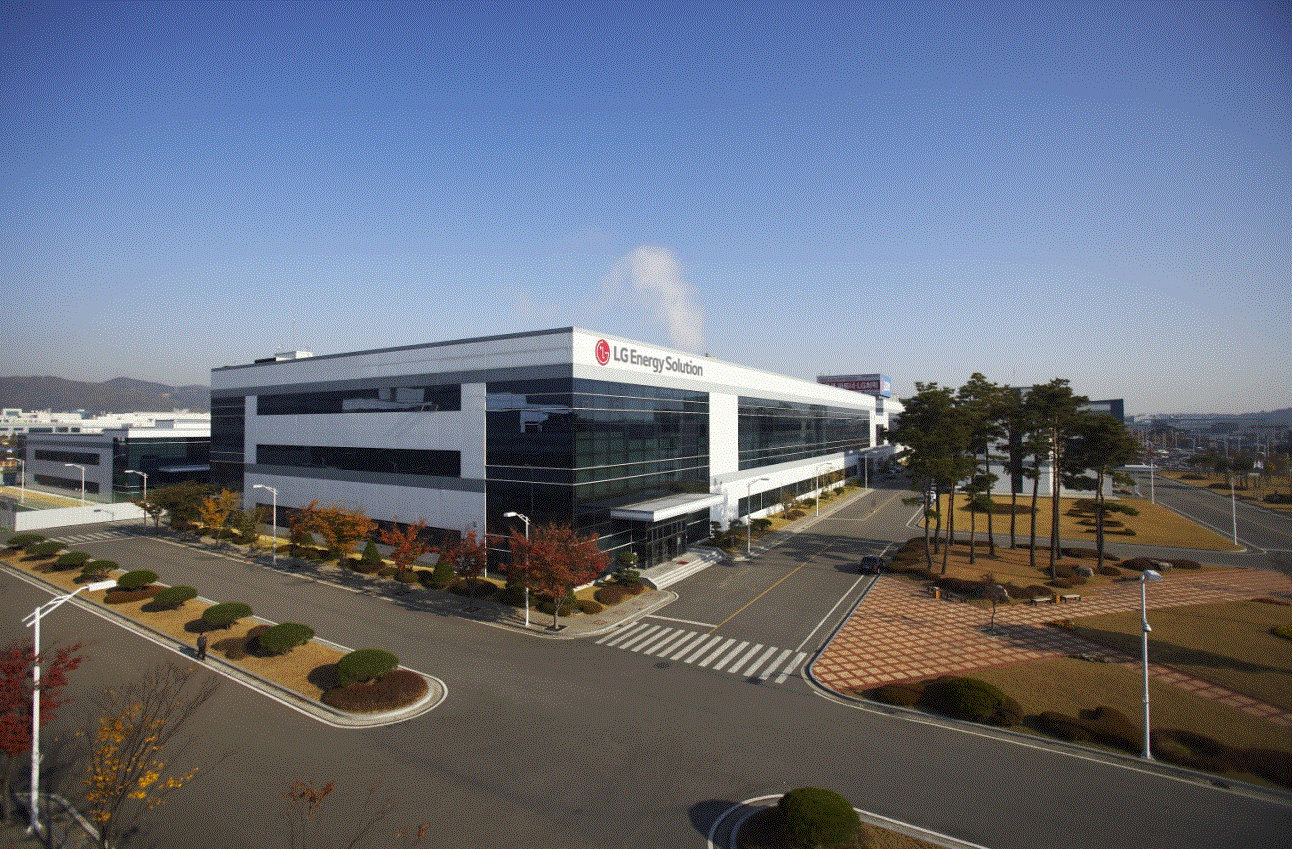
Panoramic view of LG Energy Solution’s Ochang plant. Courtesy of LG Energy Solution.
LG Energy Solution has selected artificial intelligence (AI) data centers as a new market for energy storage systems (ESS) and is moving to expand its business in North America. As the battery industry broadens its business scope to ESS amid the electric vehicle “chasm,” AI data centers, which must respond to rapid changes in power demand, are emerging as major sources of large-scale battery demand.
LG Energy Solution is also the only Korean battery company to be named in the next-generation AI factory ecosystem that Nvidia is building. The company plans to leverage its local supply chain in North America, which produces everything from cells to packs, and combine it with its own system integration (SI) capabilities to increase orders for data center ESS.
LG Energy Solution has joined Nvidia’s inaugural “DSX Ready” program as a battery energy storage system (BESS) company. Only three BESS companies worldwide have been selected by Nvidia, and LG Energy Solution is the only one among Korean battery makers.
DSX is a platform established by Nvidia to integrate and optimize the entire process of an AI factory, from design and construction to operation. “DSX Ready” is a qualification program for partner products and solutions that meet the requirements needed for this ecosystem.
Power issues are more critical for AI factories than for conventional data centers. Because large-scale graphics processing units (GPUs) operate simultaneously, power consumption can fluctuate significantly even over short periods. In addition to the increase in the data center’s own power use, there is a need to manage sudden load variations and to maintain voltage and frequency in a stable manner. In AI data centers, the role of ESS is expanding beyond simple emergency power or energy storage to encompass managing power loads and supporting stable power supply.
● Responding to AI data center power demand with LFP-based ESS
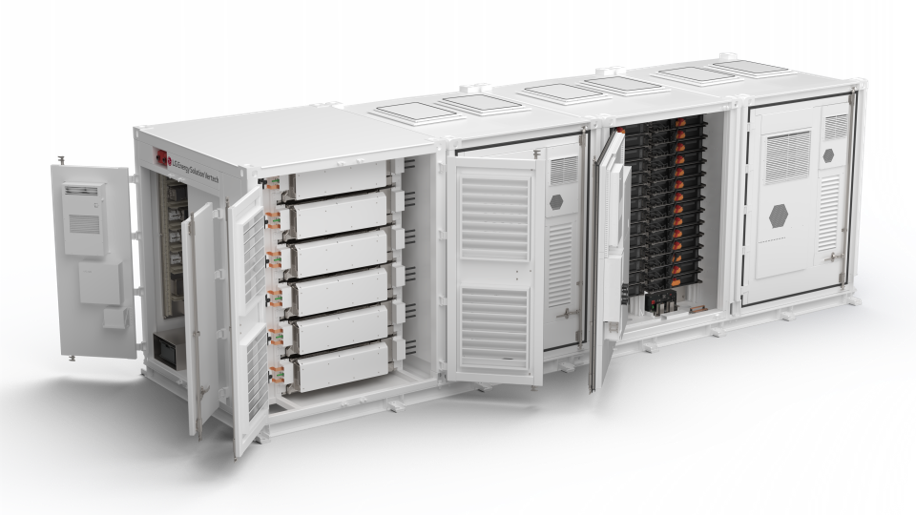
LG Energy Solution’s product that meets DSX Ready requirements is the “JF2 AC Link,” which is based on high-capacity lithium iron phosphate (LFP) batteries.
The company has enhanced power control functions to suit AI data centers. It applied an “AI Load Smoothing” function under which the battery charges and discharges to mitigate power load when AI server power consumption rises or falls sharply.
It is also equipped with a “Voltage Ride-Through” function that maintains power supply even when grid voltage suddenly drops or increases. In addition to responding to changes in voltage and frequency, it incorporates “Grid-Forming” technology that can autonomously create reference voltage and frequency for the grid when power supply is unstable.
The system is designed in modular form so that additional ESS can be added as data center size increases. ESS can initially be installed according to the starting scale of the data center, and power facilities can then be expanded as servers and GPUs are added.
On the same day, LG Electronics also met Nvidia DSX Ready requirements with its large-capacity coolant distribution unit (CDU). This effectively places LG affiliates in Nvidia’s ecosystem simultaneously in the core cooling and power infrastructure segments for AI data centers.
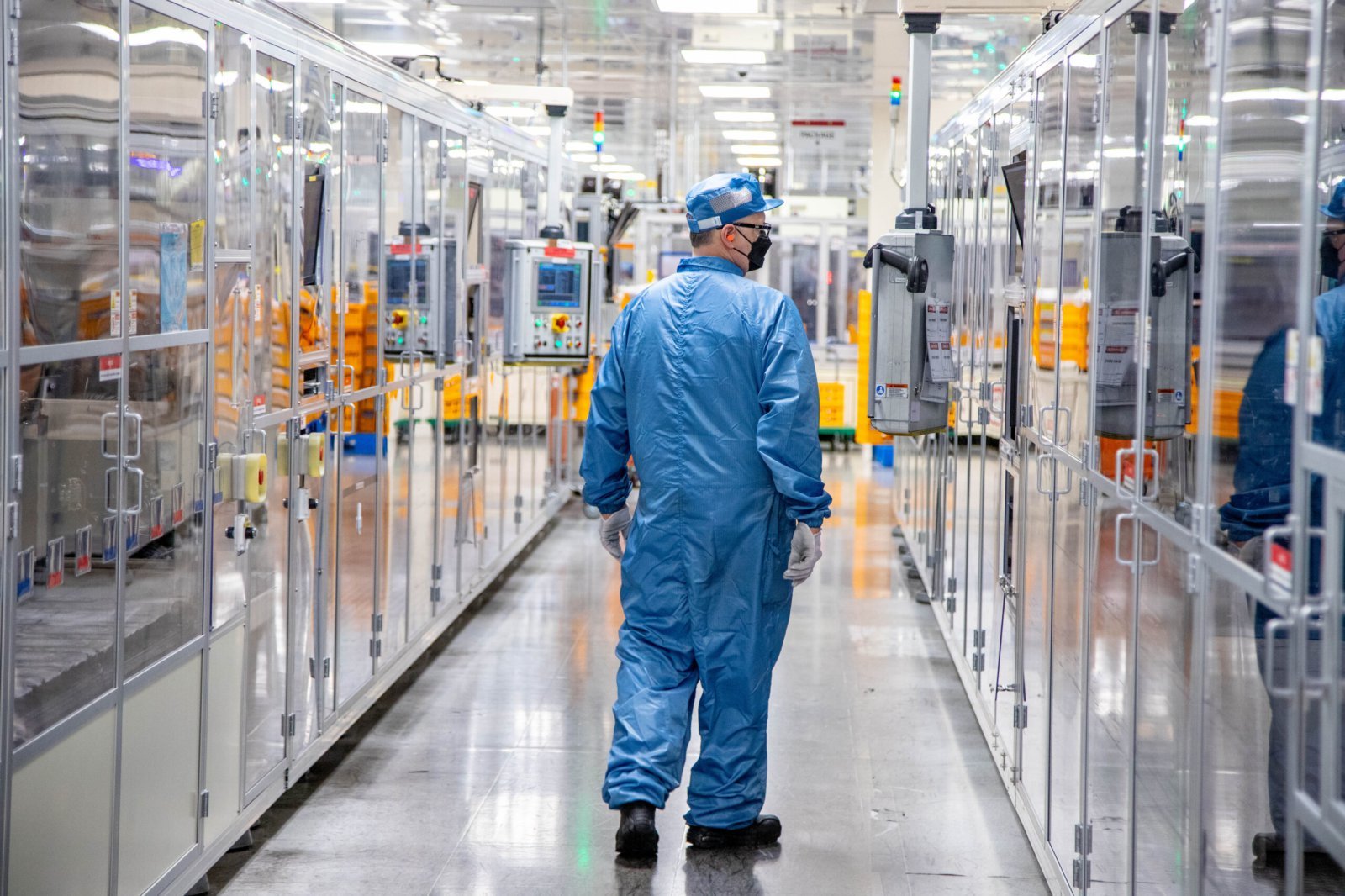
An employee inspects the battery production process at LG Energy Solution’s Holland, Michigan plant. Courtesy of LG Energy Solution.
● North American ESS capacity to reach 50 GWh by year-end… Local production from cells to packs
Another pillar of LG Energy Solution’s strategy in the AI data center market is its production capacity in North America.
The company currently operates five ESS production bases in North America. It manufactures ESS products in the United States from cells to packs and links, and plans to expand its North American ESS production capacity to more than 50 GWh by the end of this year.
With AI data center investment rapidly increasing, particularly in the United States, LG Energy Solution believes that a local production base capable of supplying large volumes will be a key factor in winning orders. It can also take advantage of policy incentives for local production, such as the investment tax credit (ITC) under the U.S. Inflation Reduction Act (IRA).
Through its U.S. ESS system integration (SI) subsidiary Vertech, LG Energy Solution provides comprehensive services that cover the entire ESS business, from battery design to system construction, operation, and maintenance.
The strategy is to combine its manufacturing capabilities for battery cells and packs with power conversion system (PCS)-based control technology and SI, and supply them to data center operators as a single ESS system.
This is also linked to LG Energy Solution’s broader ESS business expansion. As ESS becomes a new large-scale demand source in a battery industry that has grown primarily around electric vehicles, AI data centers are emerging as a major demand driver for the expansion of the North American ESS market.
● U.S. data center power consumption 180→391 TWh… AI boosts ESS market growth
The scale of power used by AI data centers is also growing rapidly.
According to Bloomberg New Energy Finance (BNEF), annual power consumption by U.S. data centers is projected to rise from 180 TWh last year to 391 TWh in 2030. This represents more than a doubling in just a few years.
As data centers grow larger, sudden power demand that cannot be addressed by simply expanding generation capacity also increases. By using ESS, power can be stored when demand is low and supplied when demand surges. This reduces the burden on the grid while ensuring stable power supply to data centers.
LG Energy Solution is already increasing large-scale ESS contracts in North America.
In May, it signed a contract with U.S. utility DTE Energy to supply ESS batteries with a total capacity of 6 GWh. DTE Energy is a company engaged in large AI data center projects, including for Oracle.
In July, it agreed to supply batteries for a solar-plus-ESS project by Google and Cypress Creek Renewables (CCE). This is an energy infrastructure project that combines generation assets and ESS to support the power demand of big tech companies.
LG Energy Solution’s JF2 AC Link product, which has joined Nvidia DSX Ready. Courtesy of LG Energy Solution.
LG Energy Solution plans to leverage its participation in Nvidia DSX Ready as an opportunity to secure additional orders in the North American AI infrastructure market. As Nvidia integrates the products required for AI factory construction into a single ecosystem, LG Energy Solution has secured an early partner position in the BESS segment.
In particular, the company intends to expand its ESS business for AI data centers by utilizing its five North American production bases, year-end capacity of more than 50 GWh, and in-house SI capabilities.
Kang Chang-beom, Executive Vice President and head of LG Energy Solution’s ESS Battery Business Division, said, “Our participation as a partner in Nvidia’s first DSX Ready program is a testament to the competitiveness of LG Energy Solution’s products optimized for AI data centers,” adding, “Based on our local production capabilities and technological strength, we will continue to expand our presence in the AI infrastructure business.”
ⓒ dongA.com. All rights reserved. Reproduction, redistribution, or use for AI training prohibited.
Popular News







 About Dong-A Ilbo